
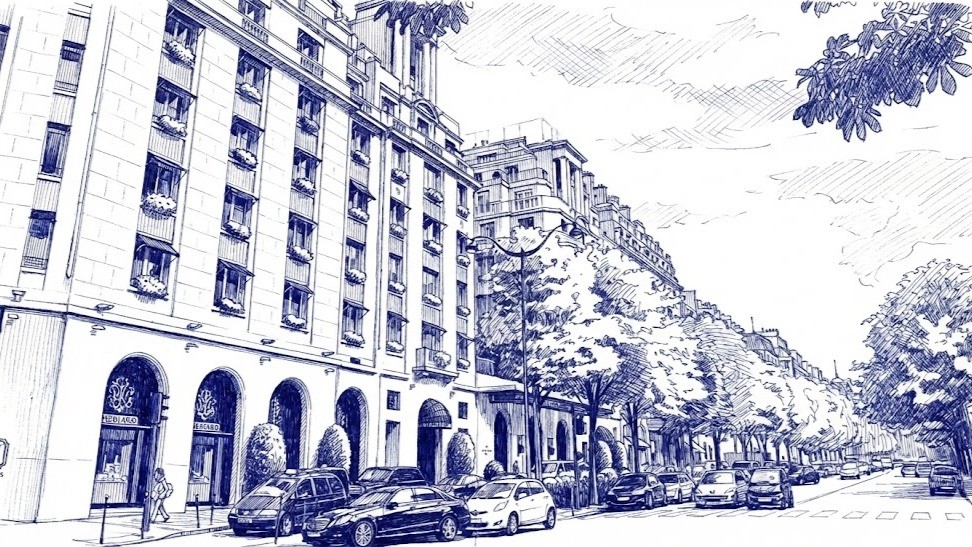
Avenue George V: Power, Prestige and Real Lives Behind One of Paris’s Most Iconic Addresses
Avenue George V is not only one of the most prestigious avenues in Paris; it is one of the most symbolic. Situated in the heart of the 8th arrondissement, between the Champs-Élysées and the Seine, it forms a cornerstone of the Golden Triangle, alongside Avenue Montaigne and Avenue des Champs-Élysées.
Beyond its monumental architecture and luxury hotels, Avenue George V has been home to diplomats, royalty, cultural icons, industrialists and international elites whose presence shaped its reputation. This is an avenue where political history, high society and global luxury intersect — not in theory, but in lived reality.
This article revisits Avenue George V through its history, its architecture and, importantly, through the real figures who lived, stayed or made it one of the most influential addresses in Europe.
1. Historical Origins and International Symbolism
The avenue was created during the late 19th-century urban expansion of western Paris. Initially named Avenue d’Alma, it was renamed Avenue George V in 1918 in honor of King George V of the United Kingdom, symbolizing the Franco-British alliance during World War I.
From that moment on, the avenue took on a strong international and diplomatic identity. Its width, alignment and proximity to major institutions made it an obvious choice for embassies, official residences and later, luxury hospitality.
It was designed as: • a ceremonial axis • a diplomatic and institutional corridor • a prestigious residential and hospitality address • a gateway between Parisian power and international influence
2. Well-Known Figures and Historic Residents
Unlike purely residential streets, Avenue George V is defined by a combination of permanent residents, long-term occupants, and historically significant stays.
Documented figures and associations include:
• King George V and British royalty While King George V did not reside permanently on the avenue, the naming itself reflects the deep diplomatic ties, reinforced by frequent royal and official visits hosted in buildings along the avenue.
• The Rothschild family (extended presence in the Golden Triangle) Members of the Rothschild banking dynasty owned and occupied multiple properties in the surrounding Golden Triangle, including near Avenue George V, reinforcing its financial and aristocratic aura.
• Heads of State and official delegations The avenue’s palaces — particularly the Four Seasons George V — have hosted presidents, monarchs and prime ministers for decades, including U.S. presidents, Middle Eastern royalty and European heads of state.
• Elizabeth Taylor and Richard Burton During their stays in Paris, the couple frequently resided at the George V hotel, making the avenue synonymous with Hollywood glamour in the 1960s and 1970s.
• Michael Jackson Michael Jackson was a well-documented guest of the George V hotel during his Paris visits, contributing to the avenue’s modern celebrity mythology.
• Fashion and luxury executives Senior executives of LVMH, Kering and major couture houses have historically owned or rented apartments on Avenue George V due to its proximity to Avenue Montaigne and corporate headquarters.
• Diplomats and ambassadors Several buildings on or near the avenue have served as diplomatic residences, chosen for security, prestige and proximity to embassies.
What defines Avenue George V is not a single famous resident, but a continuous concentration of global power figures passing through, staying, owning and investing there.
3. Architecture: Grandeur Designed for Power
Architecturally, Avenue George V was built to impress.
Its defining features include: • monumental Haussmannian façades • exceptional ceiling heights • wide balconies overlooking the avenue • large reception rooms designed for entertaining • stone staircases and ceremonial entrances • buildings capable of hosting both residences and institutions
Many apartments occupy entire floors and were designed for receptions, diplomatic gatherings or private salons rather than purely domestic life.
Upper floors in certain buildings offer partial views of the Seine or distant Eiffel Tower perspectives — features that dramatically enhance value.
4. A Lifestyle Built Around Access and Influence
Living on Avenue George V is less about neighborhood intimacy and more about strategic centrality.
Residents benefit from: • walking access to Avenue Montaigne • immediate proximity to luxury hotels and concierge services • direct access to the Champs-Élysées • high-security infrastructure • proximity to embassies and international institutions • exceptional dining and event venues
This lifestyle appeals to: • international executives • diplomats • investors • family offices • buyers seeking a symbolic Paris address
It is not a family street in the traditional sense — it is a power address.
5. The Real-Estate Market: Trophy Assets
Real estate on Avenue George V is among the rarest and most expensive in Paris.
Typical buyers include: • ultra-high-net-worth individuals • sovereign wealth structures • international family offices • diplomatic entities • long-term capital investors
Most sought-after properties: • full-floor Haussmann apartments • high-floor residences with balconies • architect-renovated prestige apartments • apartments in buildings with concierge and security • discreet properties shielded from the street
Many transactions are conducted off-market due to confidentiality requirements.
6. Price Positioning and Market Logic
Prices on Avenue George V consistently rank at the very top of the Parisian market.
Values are driven by: • address symbolism • international recognition • architectural quality • rarity • security • proximity to the Golden Triangle
Unlike family-oriented streets, this market is driven by global capital rather than local demand, making it remarkably resilient to short-term market cycles.
Avenue George V is not just prestigious — it is geopolitical, cultural and symbolic. It is an avenue shaped by kings, presidents, global celebrities, financiers and decision-makers. Its real estate is not merely residential; it is representational.
To own or live on Avenue George V is to claim a place within Paris’s global narrative.
This is not simply an address. It is a statement of power, access and permanence.
Thomas Herremans