
Avenue de Breteuil
Introduction
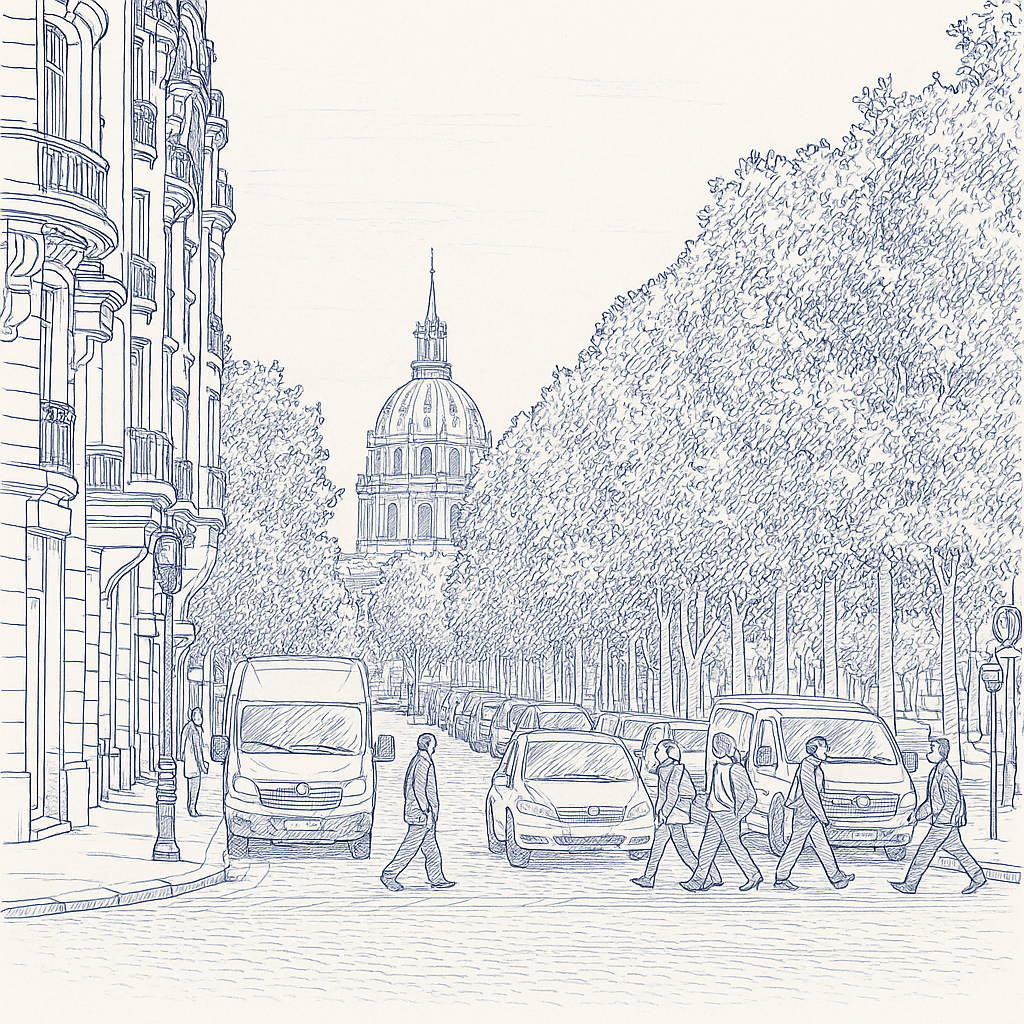
Avenue de Breteuil unfolds its broad, tree-lined perspective in the heart of the 7th arrondissement, connecting the Esplanade des Invalides to Place de Breteuil at the edge of the 15th. A rare example of 19th-century urban planning conceived as genuine monumental staging, this avenue offers an exceptional vista: on one side the golden dome of the Invalides, on the other, in the distance, the silhouette of the Montparnasse Tower. Nearly forty meters wide, lined with service lanes planted with chestnut and lime trees, Avenue de Breteuil stands out for its generous scale, inherited from the great Haussmannian works, and for the residential calm that reigns despite its strategic position. It is a prestigious address, discreet yet highly recognizable, which has attracted for over a century a wealthy clientele seeking space, greenery, and unobstructed views in the heart of Paris.
History
Avenue de Breteuil owes its name to Louis Auguste Le Tonnelier de Breteuil, Baron de Breteuil (1730-1807), French diplomat and statesman, minister under Louis XVI, known for his role in the final days of the Ancien Régime. Its construction was part of the grand development plan for the 7th arrondissement under the Second Empire, continuing the Haussmannian transformations that redrew Paris between 1853 and 1870. The avenue was designed according to a logic of monumental perspective, symbolically linking the Esplanade des Invalides—a military and symbolic landmark since Louis XIV—to the new Place de Breteuil, itself adorned in 1904 with the statue of Louis Pasteur, a tribute to the great scientist whose work revolutionized medicine. This dual polarity, between military tradition and scientific modernity, gives the avenue a distinctive identity, blending historical prestige with progressive aspiration. Throughout the 20th century, Avenue de Breteuil established itself as one of the most coveted addresses in the 7th arrondissement, home to diplomats, senior civil servants, and great bourgeois families drawn by the width of the street, its calm, and its proximity to the ministries and institutions structuring the Invalides district. Many buildings along Avenue de Breteuil have also housed embassies and official residences, reinforcing its institutional and international character. The central service lanes, planted from the outset, created genuine linear gardens, rare at this scale within inner Paris, which fully contribute to the address's prestige.
Architecture
Avenue de Breteuil presents a homogeneous ensemble of Haussmannian buildings constructed between 1870 and 1900, characterized by their honey-colored cut-stone façades, continuous balconies at each noble floor, and slate roofs punctuated by elegant dormer windows. The avenue's exceptional width, designed to accommodate vast planted service lanes, gives the buildings a luminosity rare for old Parisian construction, with façades benefiting from significant setback from traffic. The apartments, often of large size, are distinguished by their enfilade double living rooms, ceiling heights frequently exceeding 3.20 meters, and unobstructed views of the Invalides dome for upper floors on the north side. Some later buildings reflect Art Nouveau and then Art Deco influence in the treatment of balcony ironwork and carriage doors. The avenue's architectural ensemble today constitutes remarkably preserved heritage, largely protected under the heritage protection perimeters of the 7th arrondissement.
Neighborhood Life
Avenue de Breteuil lives at the tranquil pace of an upscale residential neighborhood, far from the commercial bustle of major Parisian thoroughfares. The central service lanes, true green lungs, are frequented from early morning by joggers and families accompanying their children to the area's renowned schools. The Avenue de Saxe food market, set up on the nearby central median on Thursday and Saturday mornings, is an essential rendezvous for residents, renowned for the quality of its producers. Local shops, elegant and discreet, are concentrated more on the adjacent streets, the avenue itself retaining an essentially residential vocation. Transport access is excellent, with Saint-François-Xavier station (line 13) and Duroc (lines 10 and 13) nearby, allowing quick connections to central Paris. Proximity to the Invalides, the Rodin Museum, and the Champ-de-Mars completes an exceptional living environment, blending heritage, culture, and nature in the heart of the capital.
Real Estate Market
The real estate market on Avenue de Breteuil caters to an international, wealthy clientele, often consisting of diplomats, business leaders, and families seeking large family apartments in a calm, secure environment. Properties on offer are predominantly large, from 120 to over 300 m², with a high proportion of double or triple exposures and unobstructed views over the planted service lanes. Apartments requiring complete renovation trade between €13,000 and €14,500/m², while renovated properties with high-end finishes, including home automation, reversible air conditioning, and noble materials, reach €16,000 to €18,500/m². Exceptional properties, particularly upper floors with direct views of the Invalides dome or corner apartments with terraces, can exceed €20,000 to €22,000/m², with certain exceptional transactions recorded well beyond that for rare surfaces such as a private mansion or full floor. The average time on market is generally four to eight weeks, with the most qualitative properties finding buyers very quickly despite high acquisition amounts. The trend in recent years confirms the resilience of this ultra-high-end market, driven by constant international demand and structurally limited supply.
Conclusion
Avenue de Breteuil embodies a rare Parisian art of living, combining Haussmannian grandeur with the tranquility of an exceptional green setting. A prestigious address par excellence, it appeals to an international clientele seeking space, discretion, and heritage, in one of the most sought-after sectors of the capital.
Thomas Herremans