
Avenue des Champs-Élysées — The world's most celebrated mile
Introduction
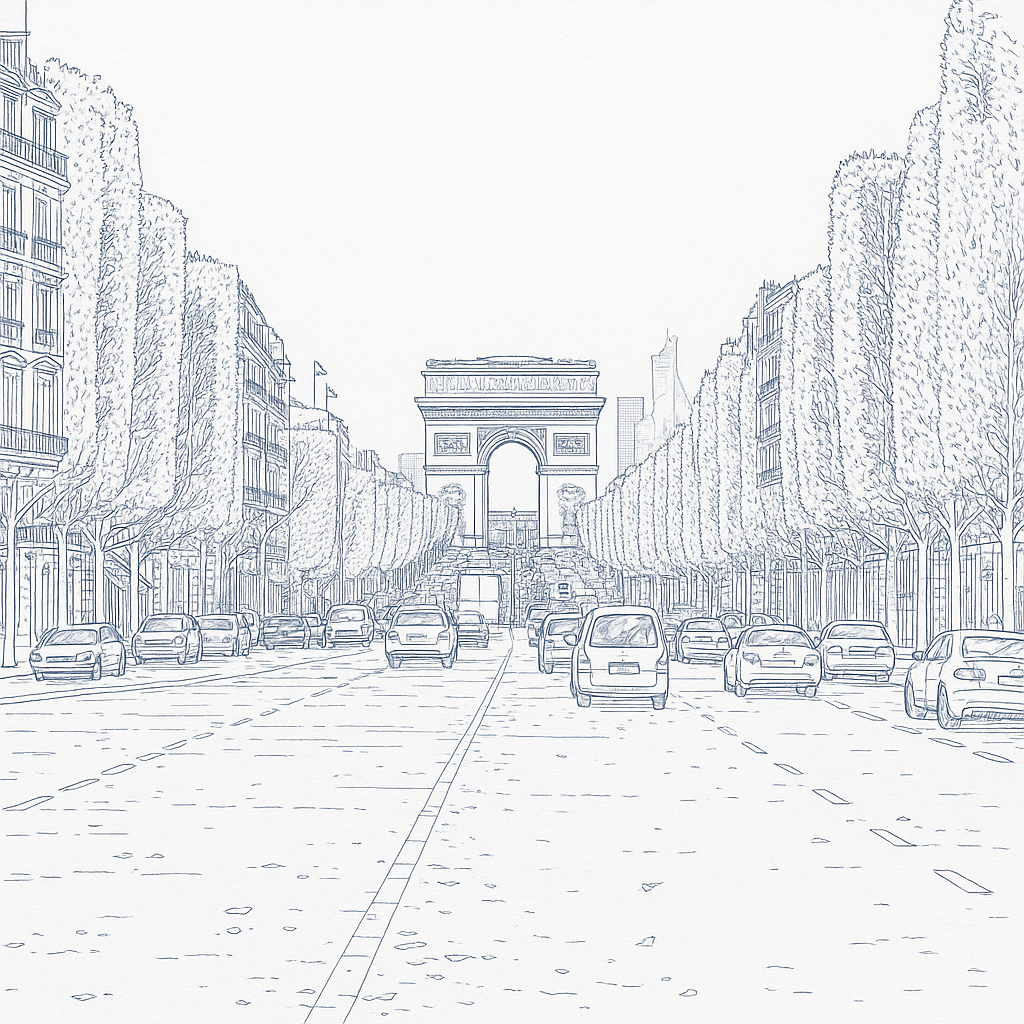
Few thoroughfares in the world carry a name that alone conjures an entire country. The Avenue des Champs-Élysées is one of them. Connecting Place de la Concorde to Place Charles-de-Gaulle and its Arc de Triomphe, it unfurls nearly 1,900 meters of one of the most famous perspectives on the planet, running through the full length of the 8th arrondissement. Unlike the hushed residential streets that surround it, such as Avenue Montaigne or Rue de la Boétie, the Champs-Élysées lives at the pace of perpetual bustle, a blend of international tourism, prestige commerce, and grand national events. Two distinct sequences can be identified: the lower, tree-lined and calmer section known as the "Jardins des Champs-Élysées," and the upper, commercial stretch between the roundabout and the Étoile, lined with shops, cinemas, and terraces buzzing late into the night.
History
The very name of the avenue draws from Greek mythology: the Champs Élysées designated the paradisiacal resting place reserved for virtuous souls after death. This name was given in 1709 to what was then a simple promenade laid out across marshy land and market gardens, an extension of the Tuileries alley designed as early as 1667 by André Le Nôtre for Louis XIV. The idea was already that of a monumental perspective opening onto the horizon, a green corridor escaping the Louvre toward the west. Yet it was not until the 18th century, and especially the Second Empire and Haussmann's great works, that the avenue truly took on its current form, with widened sidewalks, cut-stone apartment buildings, and its status as a national showcase. Napoleon I had the Arc de Triomphe erected at its far end in tribute to the Grande Armée, completed only in 1836 under Louis-Philippe. Since then, the avenue has become the privileged stage for France's great historical moments: the military parade of July 14th, the final finish of the Tour de France since 1975, but also darker scenes such as the German army's parade in June 1940, and unforgettable scenes of jubilation such as General de Gaulle's triumphant march on August 26, 1944, cheered by an immense crowd. Throughout the 20th century, the avenue gradually transformed into a hub of commerce and entertainment, with the establishment of prestigious cinemas, cabarets such as the Lido, and more recently the flagship stores of the world's greatest luxury houses, from Louis Vuitton to Cartier.
Architecture
The avenue presents a composite architecture reflecting its various historical layers. In its lower section, a few 19th-century mansions remain, particularly around the roundabout, with classical cut-stone façades, wrought-iron running balconies, and Mansart-style zinc roofs. The upper, more commercial section mixes renovated Haussmannian buildings with fully glazed modern façades designed for luxury brands and historic automobile showrooms. The Théâtre Marigny, the Grand Palais visible below, and the Arc de Triomphe that magnificently closes the perspective to the west form a monumental ensemble unique in the world, combining classicism, eclecticism, and the assumed modernity of contemporary storefronts.
Neighborhood life
By day, the Champs-Élysées buzzes with an uninterrupted stream of tourists from around the world, photographing the Arc de Triomphe or window-shopping in front of Chanel, Dior, or Zara. The Renault and Peugeot showrooms offer true technological display windows, while the great cinemas (Gaumont, UGC) continue to draw Parisians in the evening. By night, the avenue changes face with its lively restaurants, bars, and electric atmosphere lasting into the small hours. The metro stations Champs-Élysées-Clemenceau, Franklin D. Roosevelt, and George V serve the entire avenue, ensuring continuous access. The Petit Palais and Grand Palais nearby offer welcome cultural and scenic breathing space amid this commercial effervescence.
Real estate market
The residential market on the avenue itself remains very marginal, as the vast majority of buildings are occupied by shops, offices, or prestigious headquarters. The rare available apartments are generally located on upper floors, above the shops, with sizes ranging from studios to large family apartments. Prices reach dizzying heights: between 13,000 and 16,000 euros per square meter for a standard property requiring renovation, between 17,000 and 20,000 euros for a high-end renovated apartment with an open view over the avenue, and beyond 22,000 euros per square meter for an exceptional property, a top-floor unit with a terrace offering a view of the Arc de Triomphe. Buyers are mostly institutional investors, real estate funds, or major international fortunes seeking a symbolic rather than functional pied-à-terre. Marketing periods are long, as these extremely rare properties are often handled off-market, through trusted networks.
Conclusion
More than a simple avenue, the Champs-Élysées embodies a part of French identity on a global scale. A dream address for a prestige brand or an investor seeking international visibility, it caters to a very particular clientele for whom symbolic value outweighs classic residential functionality.
Thomas Herremans