
Avenue Montaigne
Introduction
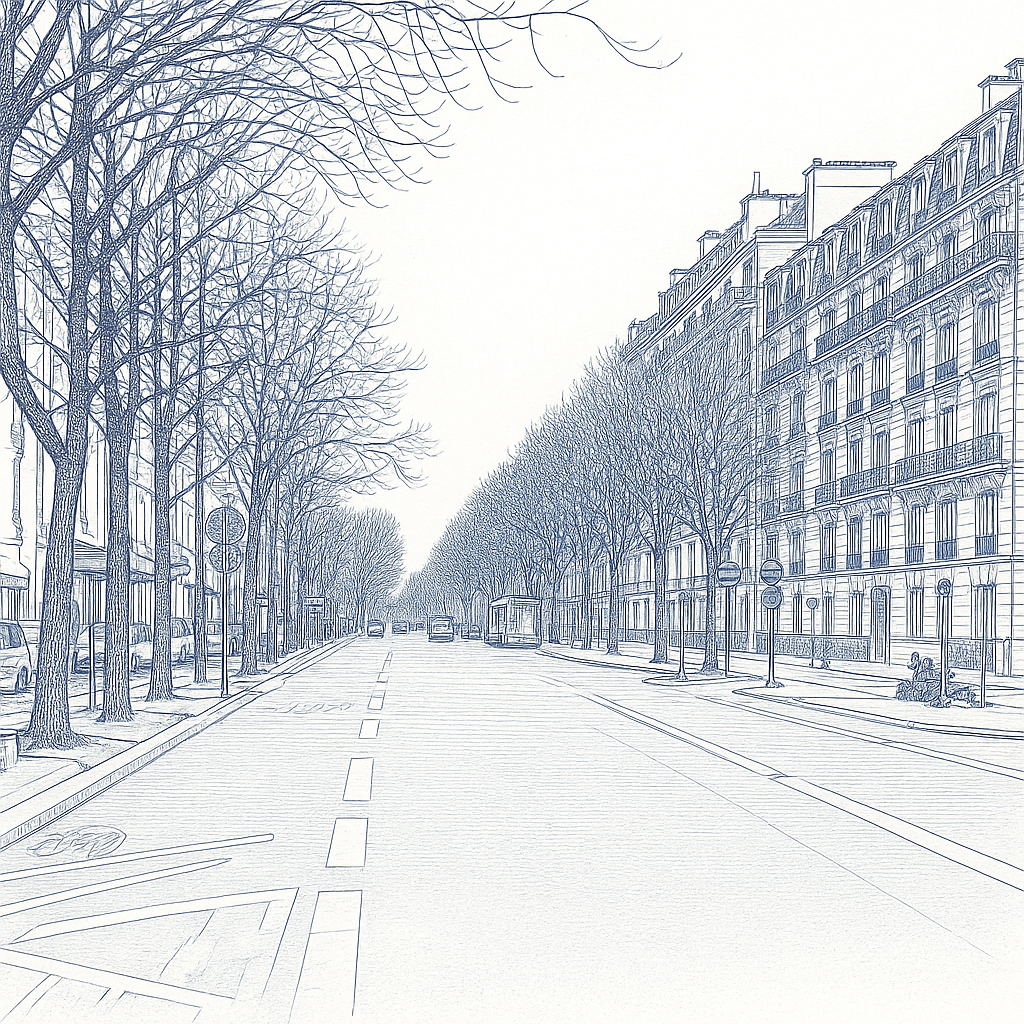
Avenue Montaigne traces a straight, majestic line between the Champs-Élysées and the Pont de l'Alma, in the chic 8th arrondissement. Lined with century-old plane trees and impeccably maintained Haussmann-era façades, it has established itself since the second half of the 20th century as the ultimate showcase for international haute couture. Unlike the Avenue des Champs-Élysées, which is more popular and touristic, Avenue Montaigne cultivates a hushed discretion, an almost silent elegance reserved for a knowing clientele. Here one encounters more tinted-window limousines than noisy crowds, more logo-emblazoned handbags than selfies. This short avenue — less than 600 meters long — nonetheless concentrates an unmatched density of luxury houses, grand hotels and cultural institutions, making it arguably the most profitable stretch per linear meter in all of Paris.
History
The avenue owes its name to Michel de Montaigne, the illustrious 16th-century philosopher and essayist, although the author never actually walked this street, which did not exist during his lifetime. Originally named Allée des Veuves ('Widows' Lane') in the 18th century — an evocative name linked to the presence of grieving women who came to stroll discreetly, away from society's gaze — it then crossed marshy, sparsely urbanized land on the fringes of the city. It was only in the mid-19th century, spurred by Haussmann's grand urban works and the 1855 Universal Exhibition, that the street took on the name we know today and began developing into an upscale residential thoroughfare.
The true turning point came in the 20th century, when the great couture houses gradually settled there: Christian Dior opened his legendary house in 1946 at number 30, a founding event that drew other prestigious designers in its wake. The Théâtre des Champs-Élysées, inaugurated in 1913 in an innovative Art Deco style designed by the Perret brothers, hosted from its opening Diaghilev's Ballets Russes and the premiere of Stravinsky's The Rite of Spring, triggering one of the most famous artistic scandals of the century. The Hôtel Plaza Athénée, opened in 1911, completes this exceptional trio that made Avenue Montaigne an essential meeting point for fashion, the arts and international luxury hospitality.
Architecture
Avenue Montaigne displays remarkable architectural unity, inherited from the great Haussmann-era building campaigns of the 1860s-1880s. Buildings of golden cut stone line up in classical façades punctuated by wrought-iron balconies, zinc mansard roofs and carved cornices. Luxury boutiques occupy carefully restored ground floors, where the interior architects of major fashion houses compete in creativity to elevate spaces that are sometimes small but always prestigious. The Théâtre des Champs-Élysées breaks from this Haussmann ensemble with its reinforced-concrete Art Deco architecture, adorned with bas-reliefs by Antoine Bourdelle — a precious testament to early 20th-century architectural modernity within an otherwise resolutely classical avenue.
Neighborhood Life
Avenue Montaigne pulses to the hushed rhythm of international luxury. From the late-morning opening of the boutiques, an international clientele — often from the Gulf, Asia or the United States — strolls between the Chanel, Dior, Louis Vuitton and Prada houses. Gourmet restaurants and tea salons, some tucked within the surrounding grand hotels, offer refined breaks between fittings. In the evening, the avenue comes alive differently, with theater-goers leaving the Théâtre des Champs-Élysées and elegant diners heading to the Plaza Athénée. The neighborhood benefits from convenient access via the Alma-Marceau and Franklin D. Roosevelt metro stations, as well as proximity to the Seine's banks and the Trocadéro gardens, offering residents green breathing spaces just steps from the commercial bustle.
Real Estate Market
The real estate market on Avenue Montaigne ranks among the most expensive and most restricted in the capital. Buyers are almost exclusively international and wealthy, often seeking a secondary pied-à-terre or a wealth-preservation investment rather than a primary residence. Available properties are rare: high-end apartments on the upper floors of Haussmann-era buildings, featuring generous ceiling heights, running balconies and sometimes unobstructed views of the Eiffel Tower or surrounding gardens. Ground-floor commercial spaces, meanwhile, trade at rent and valuation levels with no equivalent elsewhere in Paris. For a standard residential apartment requiring renovation, prices range between €15,000 and €18,000 per square meter; for a renovated property with high-end finishes, the range climbs to between €20,000 and €23,000; and exceptional properties, on high floors with views and outstanding features, can exceed €25,000 to €30,000 per square meter. The scarcity of supply often results in very short marketing times for quality properties, some of which sell even before officially hitting the market, purely through word of mouth among professionals.
Conclusion
An absolute symbol of Parisian luxury, Avenue Montaigne combines architectural prestige, international fashion influence and extreme real estate scarcity. It caters to a very wealthy, cosmopolitan clientele for whom the address itself constitutes as much a wealth argument as a mark of belonging to an exceedingly select circle. Whether for a prestige investment, a discreet pied-à-terre, or the acquisition of a rare asset at the heart of the Golden Triangle, Avenue Montaigne remains a safe-haven asset whose value has historically known only one direction: up.
Thomas Herremans