
Avenue Niel
Introduction
Avenue Niel stretches for about 800 meters in the 17th arrondissement of Paris, connecting Place Pereire to Place des Ternes. This residential and commercial thoroughfare, less well-known to the general public than its illustrious neighbors on the Champs-Élysées, nevertheless appeals to a discerning clientele seeking an authentic Haussmannian living environment, quiet yet perfectly connected to the heart of the capital. Nestled in the Ternes neighborhood, one of the most sought-after areas of the 17th arrondissement, Avenue Niel stands out for its atmosphere that is both bourgeois and lively, punctuated by renowned food shops, bustling terraces, and high-quality housing. Unlike Avenue de Wagram, wider and busier, or Rue de Courcelles, more geared toward luxury, Avenue Niel retains a village-like character within the city, prized by Parisian families established there for generations.
History
Avenue Niel takes its name from Marshal Adolphe Niel, Minister of War under the Second Empire, architect of several important military reforms and a close advisor to Napoleon III. It was opened in the 1860s as part of the great urban works undertaken by Baron Haussmann, which profoundly transformed the landscape of the then-expanding western Paris. The Ternes neighborhood, until then composed of villages and farmland at the gates of Paris, was annexed to the capital in 1860 and then experienced rapid, methodical urbanization, in line with the overall Haussmannian plan. Avenue Niel fits fully into this dynamic, designed as an upscale residential street intended to house the rising bourgeoisie of the late 19th century: industrialists, high-ranking officials, and professionals found in this new neighborhood a modern, airy, and prestigious living environment, in immediate proximity to Parc Monceau and the booming fashionable districts. Unlike some neighboring axes marked by a more turbulent history, Avenue Niel has retained, since its creation, an essentially residential and local commercial vocation, largely escaping the great urban upheavals of the 20th century. The covered market of the Ternes, located in the immediate vicinity, testifies to this bourgeois and family neighborhood vocation, where quality commerce and comfortable housing developed in perfect harmony for over 150 years. The avenue has also retained many old shops, some over a century old, which today still contribute to its strong commercial identity and continued appeal to residents.
Architecture
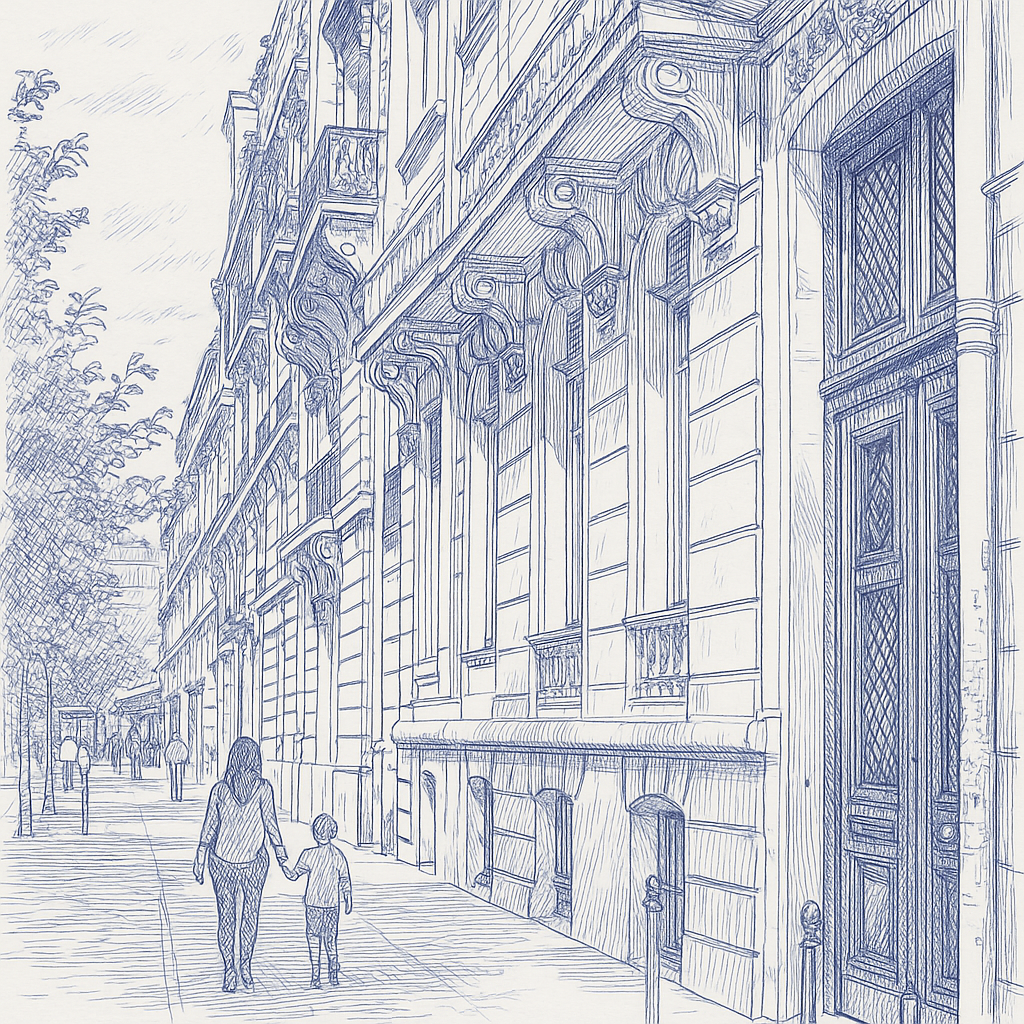
Avenue Niel features typically Haussmannian buildings, constructed as a whole between 1865 and 1890, with cut-stone buildings of six to seven stories, punctuated by continuous wrought-iron balconies on the second and fifth levels, in accordance with the strict architectural codes imposed by the urban planning regulations of the era. The façades, sober and elegant, reflect great care given to finishes: sculpted cornices, zinc mansard roofs, imposing carriage doors opening onto paved inner courtyards. The apartments in these buildings generally offer beautiful ceiling heights, original moldings, marble fireplaces, and herringbone parquet flooring, particularly sought after by lovers of authentic Haussmannian heritage. A few more recent buildings, constructed between the wars in a streamlined Art Deco style, punctuate the avenue, adding a touch of architectural diversity without disrupting the overall harmony.
Neighborhood Life
Avenue Niel enjoys particularly rich and convivial neighborhood life. In the morning, food shops - artisan bakeries, cheesemongers, greengrocers, and fishmongers - attract a loyal clientele of residents seeking quality and freshness. The avenue is known for its upscale restaurants and traditional brasseries, which liven up evenings and weekends with a family-oriented, bourgeois clientele. The immediate proximity of the covered market of the Ternes, a true neighborhood institution since 1898, reinforces the commercial appeal of this thoroughfare. The Pereire metro station (line 3) and the Ternes station (line 2) efficiently serve the avenue, as does the Pereire-Levallois RER C station, offering quick connections to La Défense and central Paris. Parc Monceau, a few minutes' walk away, is a green space prized by neighborhood families for Sunday walks. The population of Avenue Niel is mostly made up of wealthy families, senior executives, and professionals, often long-established in the neighborhood, with a high proportion of owner-occupants attached to the stability and residential calm of this thoroughfare.
Real Estate Market
The real estate market on Avenue Niel appeals to a family-oriented, heritage-minded clientele seeking a quality Haussmannian living environment combining prestige and practicality. Available properties are mostly spacious family apartments, from 70 to 180 sqm, spread across upper floors offering good natural light and sometimes unobstructed views over the Parisian rooftops. Sought-after amenities include original moldings, herringbone parquet flooring, marble fireplaces, and generous ceiling heights characteristic of Haussmannian buildings. Prices per square meter range as follows: for a standard property requiring renovation, expect between €9,800 and €10,800/sqm; for a high-end renovated property, prices range between €11,200 and €12,800/sqm; for an exceptional property - an upper floor with unobstructed views, a dual-aspect corner apartment, or a duplex with terrace - prices can reach €13,500 to €15,000/sqm. The market on Avenue Niel remains stable and sought after, driven by constant demand from Parisian families seeking a quality residential environment, human-scale and well connected. Selling times for quality properties remain reasonable, generally between one and two months, reflecting a healthy and balanced market.
Conclusion
Avenue Niel elegantly embodies the discreet charm of the fashionable neighborhoods of the 17th arrondissement. With preserved Haussmannian heritage, quality shops, and a sought-after family living environment, it represents a prime address for families and heritage-focused investors seeking stability and prestige. A safe bet for those seeking authentic Parisian bourgeois life far from tourist bustle.
Thomas Herremans