
Boulevard Haussmann: The Emblematic Artery of Second Empire Paris
Introduction
Boulevard Haussmann is undoubtedly one of the most recognizable arteries of the French capital, running through the 8th and 9th arrondissements over nearly 2,530 meters, making it one of the longest boulevards in Paris. It connects the Saint-Augustin district to the Opéra quarter, offering an urban journey where commerce, business, and upscale residential living intertwine. Unlike the winding little streets of the Marais or the Montorgueil district, Boulevard Haussmann impresses with its width, its straightness, and the majesty of its façades. It is a place where one comes as much to window-shop at the great department stores as to admire the typical architecture of Imperial Paris. Its atmosphere changes radically depending on the hour: bustling and noisy during the day with the flow of tourists and office workers, more subdued in the evening when shops close and traffic eases. This duality makes it a unique address, both an international showcase and a genuine Parisian living space.
History
The boulevard owes its name to Baron Georges Eugène Haussmann, prefect of the Seine under Napoleon III, who orchestrated the great urban transformation of Paris between 1853 and 1870. Paradoxically, the boulevard bearing his name was only completed long after his political fall, with works stretching from 1857 to 1927, given the complexity of expropriations and negotiations with property owners. This slow realization alone illustrates the scale of the Haussmannian project, which transformed the face of Paris by cutting wide, straight avenues through the medieval fabric of the city. Boulevard Haussmann quickly became a commercial axis of prime importance with the establishment of department stores that would mark the history of Parisian retail: Printemps, founded in 1865 by Jules Jaluzot, and later the Galeries Lafayette, opened in 1912 with their famous Art Nouveau glass dome designed by Ferdinand Chanut, which became a symbol of Parisian luxury and commerce recognized worldwide. The boulevard was also the setting for intense literary life: Marcel Proust lived there from 1906 to 1919 at number 102, in his aunt's apartment, where he wrote much of "In Search of Lost Time." The building, now occupied by a bank branch, still bears a commemorative plaque recalling this illustrious presence. Other figures from the world of business and finance also chose to establish their headquarters there, making the boulevard a strategic location for the Parisian business bourgeoisie from the late 19th century onward.
Architecture
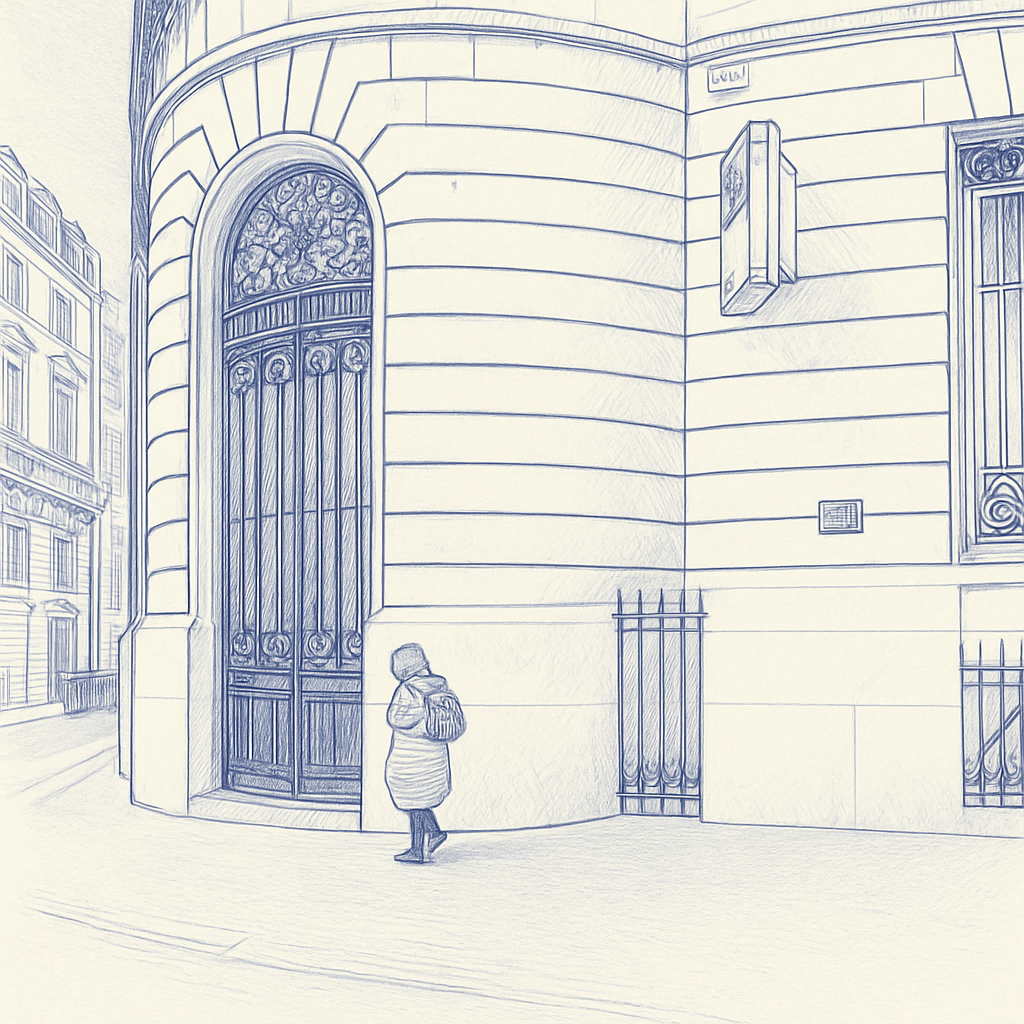
The architecture of Boulevard Haussmann is the very archetype of the eponymous style: façades in cut limestone, continuous balconies on the second and fifth floors, mansard roofs covered in zinc, and building heights strictly regulated by the urban planning rules of the time, generally around six stories. The façades display sober yet careful ornamentation: molded cornices, wrought-iron railings, sculpted pediments above carriage entrances. Some buildings stand out for their singularity, notably the Galeries Lafayette headquarters with its spectacular Art Nouveau glass dome, a true architectural gem visible from inside the store. The contrast between these sumptuous interiors and the relative uniformity of the exterior façades is one of the architectural curiosities of the boulevard.
Neighborhood Life
Life on Boulevard Haussmann is punctuated by intense commercial and professional activity. From early morning, office workers flock to the numerous corporate headquarters and bank branches lining the avenue, while the department stores open their doors to an international clientele from around the world. At lunchtime, brasseries and restaurants fill quickly, offering varied cuisine ranging from traditional bistros to more contemporary establishments. The neighborhood benefits from exceptional public transport access, with several metro stations (Chaussée d'Antin-La Fayette, Havre-Caumartin, Saint-Lazare) and the immediate proximity of Gare Saint-Lazare, one of the busiest stations in the capital. In the evening, commercial bustle gives way to a more residential atmosphere, particularly in the adjacent streets where bourgeois buildings and small tree-lined squares are tucked away.
Real Estate Market
The real estate market of Boulevard Haussmann is distinguished by its duality between ground-floor commercial spaces and offices with very high rental value, and residential apartments located on upper floors, particularly prized for their authentic Haussmannian charm: moldings, Versailles parquet floors, marble fireplaces, generous ceiling heights. Buyers are predominantly institutional investors for commercial spaces, and affluent individuals, often international, for residential apartments seeking a prestigious address in immediate proximity to business districts and department stores. Prices per square meter thus range as follows: approximately €11,000 to €13,000/m² for a standard property requiring renovation, €14,000 to €16,000/m² for a fully renovated high-end apartment with modern amenities, and beyond €18,000/m² for an exceptional property, particularly on noble floors with unobstructed views of the Opéra Garnier or the boulevard itself. Marketing times remain relatively short, generally between two and four months, given the sustained demand for this legendary address.
Conclusion
Boulevard Haussmann remains a timeless symbol of Second Empire urban genius, an address where international commerce and architectural heritage harmoniously combine. It appeals to a demanding clientele seeking a Parisian pied-à-terre combining prestige, standing, and accessibility, at the beating heart of the capital.
Thomas Herremans