
Boulevard Voltaire — Where Enlightenment Meets Modern Elegance
Introduction
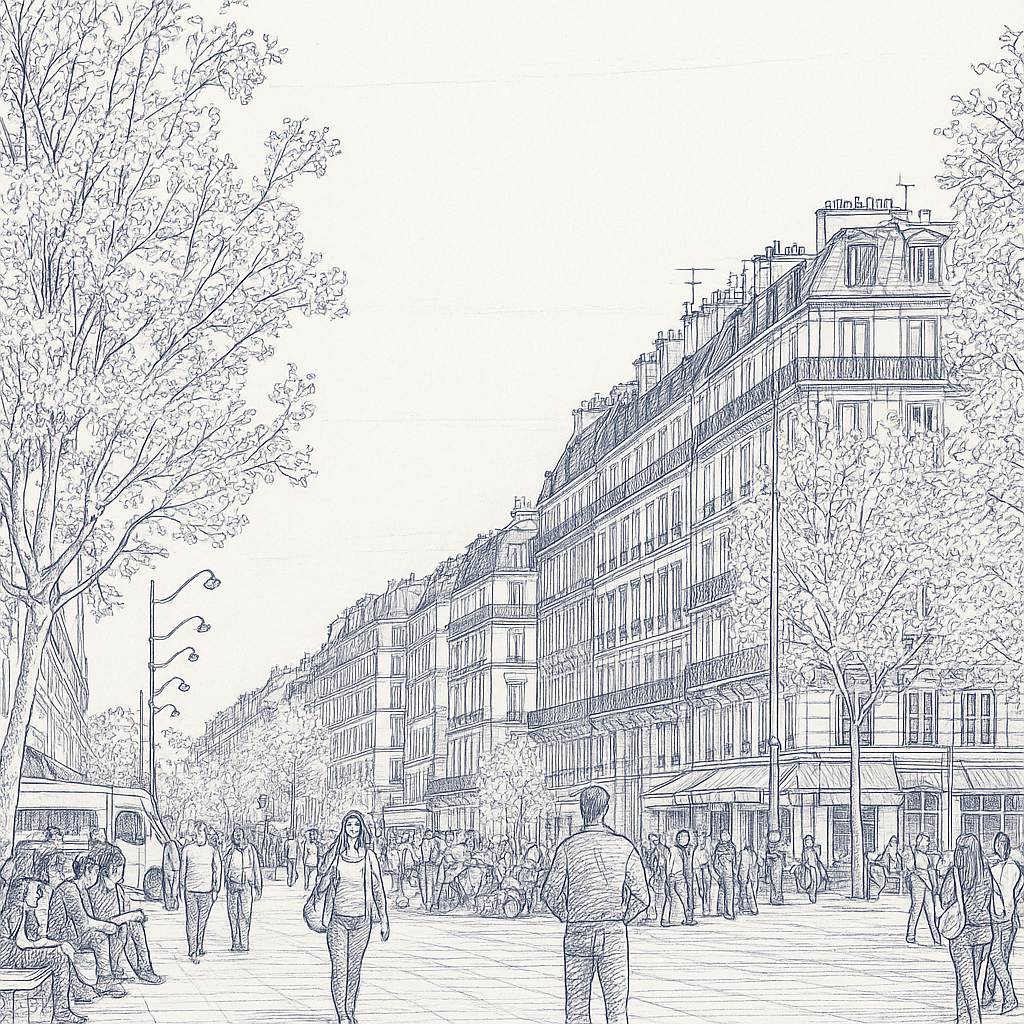
Boulevard Voltaire traces an ample, straight diagonal across the 11th arrondissement, connecting place de la République to place de la Nation over more than two kilometers. A major artery, it stands out for its generous width, inherited from the great Haussmannian works, and for its resolutely urban and popular character, far from the hush of chic neighborhoods but rich with precious Parisian authenticity. Unlike the winding little streets of the nearby Marais, boulevard Voltaire imposes its monumental scale, its double rows of trees, and its continuous flow of traffic, while still maintaining pockets of calm in its adjacent streets. Here one encounters a mixed population: young professionals, long-established families, and artists and creatives drawn by the cultural dynamism of the 11th arrondissement. The boulevard embodies Paris's unique ability to make functional major roadways coexist with warm neighborhood life, amid local shops, republican institutions, and a nightlife buzz that has only grown in recent years.
History
Boulevard Voltaire was cut through between 1862 and 1866 as part of the great urban planning works carried out under the Second Empire by Baron Haussmann, which aimed to open up eastern Paris and facilitate military and commercial movement between the capital's strategic squares. Its name, given upon its opening, pays tribute to François-Marie Arouet, known as Voltaire (1694-1778), an emblematic figure of the Enlightenment, philosopher, writer, and tireless defender of freedom of expression and religious tolerance. This choice was no accident: it reflects the regime's wish to celebrate great French intellectual figures while modernizing a neighborhood then undergoing heavy industrialization, populated by workers and craftsmen. The boulevard crosses an arrondissement that was long a working-class stronghold, marked by the social struggles of the 19th and 20th centuries, the furniture workshops of the Faubourg Saint-Antoine, and a strong tradition of political engagement. Over time, boulevard Voltaire has housed various administrative institutions, schools, and barracks, reflecting its structuring role in the neighborhood's civic life. More recently, the boulevard was tragically marked by the November 13, 2015 attacks, with the Bataclan located in the immediate vicinity on rue Voltaire, an event that profoundly marked the neighborhood's contemporary history and strengthened its residents' sense of solidarity and resilience. The boulevard remains today a place of memory as much as an axis of daily life, blending revolutionary history, working-class past, and embraced modernity.
Architecture
The architecture of boulevard Voltaire is typically Haussmannian in its oldest section, with six-story stone buildings rigorously aligned, featuring continuous balconies, steeply pitched zinc roofs, and classical facades adorned with sober moldings. However, the boulevard also displays greater architectural heterogeneity than other Parisian arteries, with early 20th-century constructions, more functional 1960s-1970s buildings, and some contemporary developments reflecting the various phases of urban densification. This diversity gives the boulevard a less fixed, more lively character, reflecting the successive transformations of eastern Paris. The often-wide commercial ground floors host a multitude of businesses, reinforcing the artery's visual dynamism.
Neighborhood life
Boulevard Voltaire lives at a sustained pace throughout the day. In the morning, residents flock to the bakeries and cafés that line the artery, while numerous bus lines and the Oberkampf, Saint-Ambroise, Voltaire, and Nation metro stations ensure exceptional connectivity to the rest of the capital. During the day, varied shops, from local businesses to specialty boutiques, attract a loyal local clientele. In the evening, the neighborhood takes on a more festive atmosphere, particularly near rue Oberkampf and rue Jean-Pierre Timbaud, prime spots for Parisian nightlife, with bars, restaurants, and concert venues. The proximity of square Maurice-Gardette and Père-Lachaise cemetery offers green spaces appreciated by families and strollers alike. The boulevard's population is diverse, mixing young professionals, long-established families, and a creative community drawn by the energy of the 11th arrondissement.
Real estate market
The real estate market on boulevard Voltaire mainly attracts young professionals, first-time buyers, and investors drawn by prices still accessible compared to other Parisian sectors, as well as an attractive rental yield driven by sustained rental demand. Available properties range from compact studios to large Haussmannian-style family apartments, including two and three-room apartments highly sought after by young couples. Upper floors, often equipped with continuous balconies and good natural light, are particularly prized, as are properties overlooking the quiet streets perpendicular to the boulevard. Prices per square meter currently stand between 8,900 and 9,800 euros for a standard property, between 10,200 and 11,300 euros for a high-end renovated apartment with beautiful finishes, and can reach 12,500 to 13,500 euros for an exceptional property, particularly a top floor with unobstructed views or a fully renovated through corner apartment. The market is currently experiencing renewed interest, driven by the general revaluation of the 11th arrondissement, with average marketing periods of four to six weeks for well-positioned properties.
Conclusion
Boulevard Voltaire, through its history rich in revolutionary and popular symbolism, its varied architecture, and its intense neighborhood life, stands out as a prime address for those seeking to settle in an authentic and vibrant Paris. It particularly appeals to young professionals, families, and investors looking for a good balance between financial accessibility, cultural dynamism, and excellent transport connections.
Thomas Herremans