
🏙️ Buying Property in the Goutte d’Or Area: Urban Edge with Village Soul in Paris’s 18ᵗʰ Arrondissement
.Paris has always thrived on its contrasts — aristocratic façades beside artisans’ workshops, high culture meeting street rhythm. Few neighborhoods embody this dialogue as vividly as the Goutte d’Or, tucked between Barbès, Château Rouge, and the slopes of Montmartre. Long viewed through the prism of clichés — dense, noisy, defiant — this patch of northern Paris is in the midst of a quiet transformation. Behind its mosaic storefronts and courtyards, a new generation of Parisians, creatives, and investors is discovering a rare blend of authenticity, accessibility, and urban village charm.
Buying property in the Goutte d’Or today means engaging with a district that still pulses to the human tempo of the city — a place where the real Paris lives, works, sings, and slowly reinvents itself.
1️⃣ A District Born of Migration and Craft
The Goutte d’Or’s name — “drop of gold” — once referred to the color of the local wine produced here before Haussmann annexed the neighborhood to Paris in 1860. The vines are gone, but the metaphor endures: under its rough surface, this corner of the 18ᵗʰ hides golden veins of culture and community.
Throughout the 19ᵗʰ century, the area filled with stonecutters, cabinetmakers, and masons who built Haussmann’s new boulevards. After WWII, successive waves of immigration — North African, Sub-Saharan, and later Asian — shaped its character, giving the quarter a cosmopolitan heartbeat still felt today in its markets, cafés, and music.
2️⃣ Geography: Between Montmartre and La Chapelle
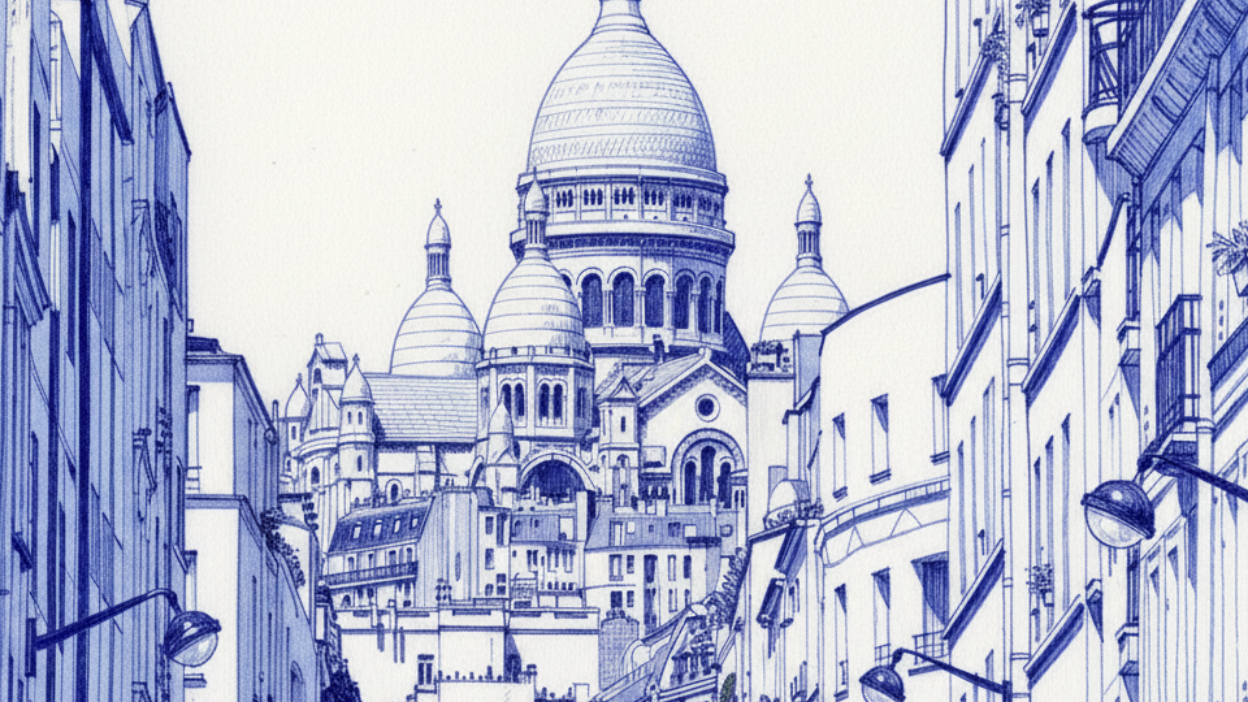
Bordered by Boulevard Barbès, Rue Ordener, Boulevard de la Chapelle, and Rue Stephenson, the Goutte d’Or forms a compact triangle of dense streets, courtyards, and passages. It sits literally in the shadow of Sacré-Cœur yet feels worlds apart from postcard Montmartre — more textured, more lived-in, more diverse.
Within a few blocks you move from the bustle of Barbès-Rochechouart station to the calm of Square Léon or Rue des Poissonniers. The nearby Halle Saint-Pierre, Marché de la Chapelle, and the 18ᵗʰ arrondissement town hall anchor the community. The Boulevard de la Chapelle viaduct — now partly pedestrianised and landscaped — connects the district seamlessly to Gare du Nord and La Chapelle International, both under major redevelopment.
In short: the Goutte d’Or stands at the northern crossroads of Paris, equally close to central arrondissements and the new creative hubs of Greater Paris.
3️⃣ The Cultural Identity: Market, Music, and Mosaic
On a Saturday morning, Rue Myrrha and Rue Polonceau overflow with market stalls. Sellers call out in Arabic, Wolof, and French; shoppers haggle over spices, textiles, and fruit. The Marché Dejean, named after a colonial governor but wholly reinvented by African traders, is legendary for its colors and scents.
But culture here isn’t just commercial — it’s musical and artistic. The Institut des Cultures d’Islam on Rue Stephenson offers exhibitions, concerts, and workshops bridging traditions and modernity. Jazz echoes from cafés, rap from windows, gospel from churches. This plural identity is the Goutte d’Or’s soul — and increasingly, its attraction.
4️⃣ Urban Renewal: From Neglect to Renaissance
For decades, the Goutte d’Or suffered from under-investment. Many buildings dated from the 19ᵗʰ century and were poorly maintained. That began to change in the 1990s, when the Mairie de Paris launched a vast program of rehabilitation through the OPAH Goutte d’Or – Château Rouge.
Results are now tangible:
- Restored façades and restructured co-ownerships along Rue de la Goutte d’Or and Rue Myrrha.
- New social and mixed-income housing around Square Léon.
- Pedestrian upgrades on Rue Poulet and Rue Polonceau.
- A flourishing of cafés, concept stores, and design ateliers near Château Rouge.
The Grand Projet de Renouvellement Urbain (2021-2030) extends this momentum with greener streets, new community centers, and incentives for private renovation. What was once labeled “difficult” is evolving into one of Paris’s most dynamic transitional markets — still authentic, but increasingly aspirational.
5️⃣ Property Prices and Market Dynamics
In 2025, the average price per square meter in the Goutte d’Or is around €8,000 – €9,500, depending on street and condition — well below Montmartre’s €13,000+ and under the Paris average (~€10,200).
Key micro-markets:
- Rue Polonceau / Rue Myrrha — renovated small flats in classic buildings fetch €9,500 /m².
- Rue de la Goutte d’Or — ongoing upgrades; still opportunities near €8,000 /m².
- Boulevard Barbès / Boulevard de la Chapelle — Haussmannian stock with higher ceilings, €9,000–€10,000 /m².
Rental demand is strong, driven by students, artists, and professionals commuting via Gare du Nord. Yields between 3.5 % and 4.5 % remain realistic — exceptional for intra-muros Paris.
The area’s mix of improving reputation and accessible pricing creates a compelling medium-term capital-growth story.
6️⃣ Architecture: Parisian Bones with Local Ornament
Architecturally, the Goutte d’Or offers a fascinating mosaic. Haussmannian buildings with wrought-iron balconies coexist with brick-and-stone worker housing, Art Deco schools, and modern infill projects. Courtyards often conceal small workshops or artist studios.
The renovation of heritage blocks such as Ilot Stephenson-Myrrha has preserved façades while modernising interiors. Buyers can find well-proportioned apartments (40–70 m²) with original parquet and fireplaces, or loft-style conversions in former ateliers — rarities in northern Paris.
For architecture lovers, it’s a district where Paris’s 19ᵗʰ-century skeleton meets 21ᵗʰ-century creativity.
7️⃣ Everyday Life: Village Scale, Global Flavor
Despite its density, the Goutte d’Or feels intimate. Streets are narrow, neighbors chat from balconies, and children play in small squares. The Square Léon — recently redesigned with gardens and playgrounds — acts as the neighborhood’s living room.
Cafés like La Goutte Rouge or Chez Aida blend local roots with modern aesthetics. The Brasserie Barbès, though slightly grander, draws both locals and newcomers under its glass dome.
Grocery stores, halal butchers, organic bakeries, and Afro-Caribbean restaurants coexist naturally — a diversity that defines daily life here. It’s this sense of coexistence and continuity that many buyers find irresistible after years in more anonymous districts.
8️⃣ Transport and Accessibility
Connectivity is exceptional:
- Metro 4 (Château Rouge) links directly to Châtelet in 10 minutes.
- Metro 2 (Barbès-Rochechouart) crosses to Père-Lachaise and the west.
- Gare du Nord is a 5-minute walk, offering Eurostar, Thalys, and RER B/D/E lines.
- Extensive bus and bike lanes complement the picture.
This accessibility makes the Goutte d’Or a perfect base for professionals moving across the city — and for investors seeking liquid, easily rentable assets.
9️⃣ Schools, Services, and Future Improvements
Over the last decade, public investment has expanded schools, nurseries, and health centers. The École Élémentaire de la Goutte d’Or and Collège Cavanna have been modernized; several bilingual and Montessori options exist within a 15-minute radius.
Upcoming projects (2025–2030):
- A new cultural and social hub near Rue Ordener.
- Upgraded lighting and greenery along Boulevard de la Chapelle.
- Conversion of disused railway property from the Petite Ceinture into pedestrian paths and gardens.
Each initiative reinforces the area’s transition from overlooked to integrated — and desirable.
🔟 The Buyer Profile
Who’s buying in the Goutte d’Or today?
- Young professionals and creatives priced out of the 9ᵗʰ and 10ᵗʰ arrondissements.
- First-time buyers leveraging lower prices with a long-term view.
- Foreign investors attracted by yields and multicultural ambiance.
- Developers and architects spotting potential in under-renovated co-ownerships.
Many buyers share a mindset rather than a demographic: they’re looking for authentic neighborhoods where community still outweighs commercialism. They sense that what Montmartre was in 1890, the Goutte d’Or might become in 2030.
11️⃣ Social Image vs. Reality
No analysis would be complete without acknowledging perceptions. The Goutte d’Or has long been caricatured in the media as unsafe or chaotic. In reality, crime rates have declined sharply thanks to urban renewal and increased municipal presence.
Like any lively inner-city area, it remains diverse and energetic — but far from dangerous. The mix of cultures, ages, and incomes forms a living social experiment: one of Paris’s last genuinely mixed neighborhoods.
Those who live here describe not insecurity, but human proximity — an urban warmth missing from sanitized quarters.
12️⃣ The Emotional Landscape: Texture and Truth
The Goutte d’Or resists simplification. One minute you’re passing a 19ᵗʰ-century church; the next, a mural celebrating African heritage or a start-up incubator in a restored factory.
For photographers and writers, it’s endlessly inspiring. For investors, it’s proof that Paris’s future growth lies in authenticity, not imitation. The district’s edge, soundscape, and color create a sense of place impossible to replicate elsewhere.
Buying here isn’t just owning property — it’s buying into a narrative of renewal.
13️⃣ Long-Term Outlook
Urban economists see parallels between the Goutte d’Or today and neighborhoods like Canal Saint-Martin in 2000 or Belleville in 2010. With proximity to major transport hubs, ongoing public investment, and a creative population, appreciation potential remains high.
As the Grand Paris Express reshapes commuting patterns and as remote work allows more lifestyle-driven choices, districts offering identity and connection will thrive.
Within five years, expect continued price normalization toward €10,000 – €11,000/m², still below the central average but reflecting its maturing profile.
14️⃣ The Investor’s Advantage
Investing in the Goutte d’Or requires discernment. Success depends on:
- Selecting well-maintained or renovated buildings (co-ownership governance is key).
- Focusing on transport corridors (Myrrha, Stephenson, Polonceau).
- Valuing architecture and light — top floors with balconies or unobstructed views remain undervalued.
- Respecting the social fabric — properties that integrate rather than displace maintain stronger community acceptance and stability.
Handled intelligently, a purchase here can outperform more saturated luxury sectors while contributing to sustainable urban revitalization.
🕊️ Conclusion: A Drop of Gold, Still Shining
The Goutte d’Or’s story mirrors Paris itself: layered, diverse, and constantly renewing. It may not have the marble facades of Saint-Germain or the river views of Île Saint-Louis, but it offers something rarer — sincerity.
This is Paris without makeup: sounds, smells, laughter, debate, rhythm. For buyers willing to look past old prejudices, the reward is a neighborhood alive with humanity — and an investment in a district whose best years are clearly ahead.
A century ago, Paris expanded north to house its builders. Today, the north is building Paris anew — and the Goutte d’Or gleams again, a small drop of gold in the city’s beating heart.
Thomas Herremans