
Place des Vosges — Where Parisian Elegance Echoes Through Four Centuries
**Introduction**
In the heart of the Marais, in the fourth arrondissement, Place des Vosges unfolds its perfect symmetry of brick and stone pavilions, arranged around a square garden planted with century-old lime trees. The oldest of Paris's royal squares, it forms an architectural ensemble of absolute rarity, preserved almost intact since the early seventeenth century. A place for Sunday strolls for Parisians, a showcase for art galleries beneath its arcades, and one of the capital's most prestigious residential addresses, Place des Vosges embodies a rare balance between a living historical monument and an everyday neighborhood, where tourists from around the world and discreet residents have crossed paths under the same arcades for over four centuries.
**History**
Built on the orders of Henri IV starting in 1605, on the site of the former Hôtel des Tournelles where King Henri II died during a jousting tournament in 1559, the Place Royale — its original name — was conceived as a showcase of monarchical power and a residence for the nobility of the robe and sword. Inaugurated in 1612 on the occasion of the double royal wedding celebrations between Louis XIII and Anne of Austria, and between Élisabeth of France and the future Philip IV of Spain, the square quickly became the stage for Parisian aristocratic life, hosting tournaments, carousels and famous duels, including one in 1614 between noble favorites that remained notorious. It took its current name in 1800, under the Consulate, in tribute to the Vosges department, the first to pay its revolutionary taxes — a symbolic gesture that Napoleon Bonaparte chose to reward. The square was home to many illustrious figures: Cardinal Richelieu lived at number 21 before moving to the Palais-Royal, and above all Victor Hugo, who lived for sixteen years at number 6, in the Hôtel de Rohan-Guéménée, now transformed into a museum dedicated to the writer, where he wrote part of Les Misérables. Other notable figures stayed there, including Madame de Sévigné, born on Place des Vosges, and Théophile Gautier. During the Revolution, some mansions were looted or transformed, before the nineteenth century saw the square gradually regain its aristocratic, then bourgeois, residential vocation. Listed as a historic monument as early as 1954, the square has benefited from major restoration campaigns that restored its original splendor, notably the renovation of the arcades and central garden in the 1990s.
**Architecture**
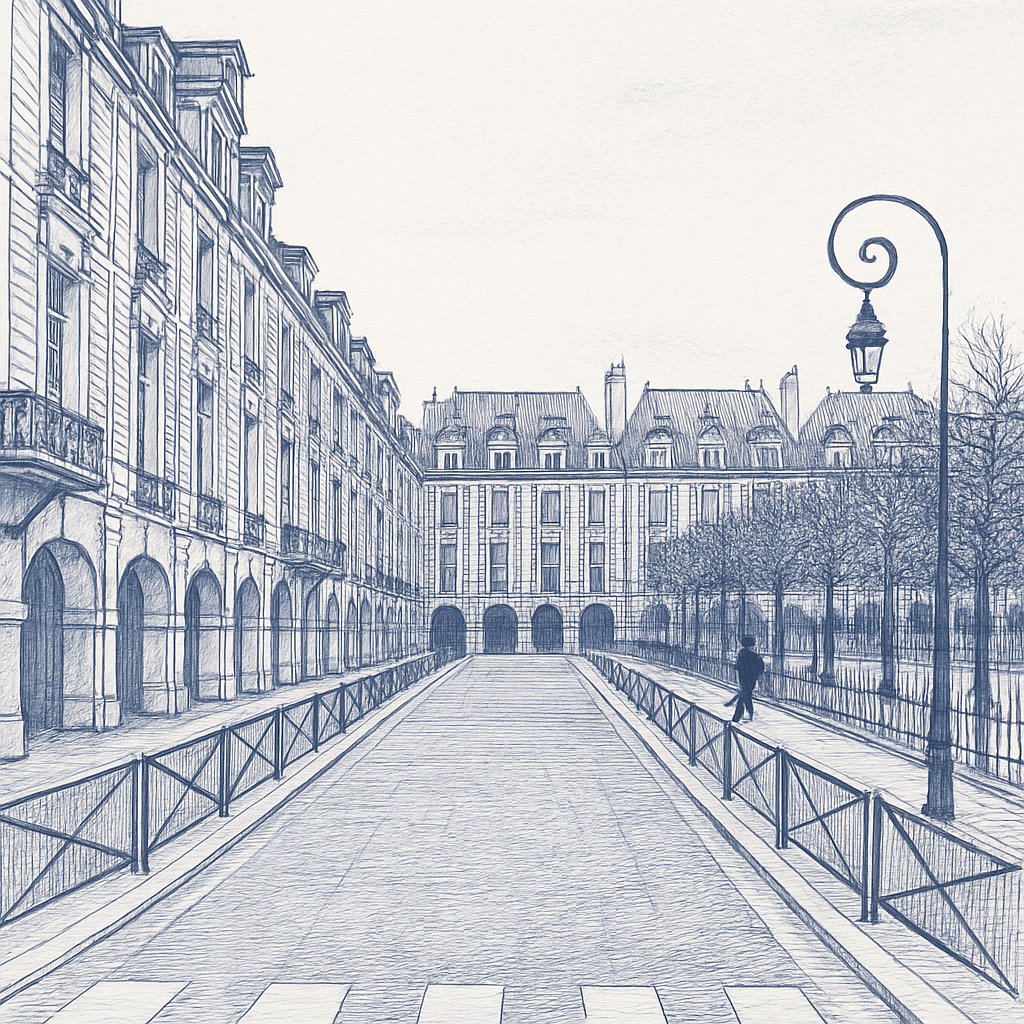
The architecture of Place des Vosges is a unique model of French classical urbanism: thirty-six identical pavilions, nine on each side, built of red brick accented with white stone quoins, topped with tall slate roofs pierced by dormer windows. The façades, punctuated by round-arched arcades on the ground floor forming a continuous pedestrian gallery, follow a principle of strict symmetry and architectural unity extremely rare for the period, each owner being required to comply with precise architectural specifications. The King's Pavilion, to the north, and the Queen's Pavilion, to the south, taller than the other buildings, mark the square's compositional axes and recall its initially royal vocation. Apartments on the noble floors often retain French-style ceilings, period fireplaces and old parquet floors, while seventeenth-century vaulted cellars survive beneath many buildings, a precious architectural testament to the site's authenticity.
**Neighborhood life**
Place des Vosges lives at the rhythm of the seasons and the hours: in the morning, residents cross the central garden on their way to work, while during the day, tourists and Parisians mingle under the arcades, among contemporary art galleries, decoration shops and renowned tearooms. The garden, closed at night, welcomes children and families around its lawns and central fountain, creating a cherished green island in this dense Marais neighborhood. Gourmet restaurants and chic bistros nestled under the arcades attract a loyal clientele, while the immediate proximity of Rue des Francs-Bourgeois and Rue Saint-Antoine guarantees easy access to the Marais's shops. Transport links are excellent, with the Bastille, Saint-Paul and Chemin Vert stations in the immediate vicinity. The population mixes affluent families established for several generations, liberal professionals and a wealthy international clientele seeking a prestigious Parisian pied-à-terre.
**Real estate market**
The real estate market on Place des Vosges is among the rarest and most prestigious in Paris, the number of properties available for sale being extremely limited due to the protected historical character of the ensemble and the low turnover of owners, often attached to their property for several generations. Buyers are mostly art collectors, wealthy international families and personalities seeking an address that is both historic and discreet. Available properties range from small 50-70 sqm attic apartments, with exposed beams and views over the Marais rooftops, to vast 200 to 400 sqm apartments occupying an entire pavilion or a significant part of a noble floor, some directly overlooking the central garden. Prices, among the highest in Paris, range between €16,000 and €18,500/sqm for a standard apartment requiring renovation, between €20,000 and €23,000/sqm for a renovated high-end property with fine finishes, and can exceed €28,000 to €32,000/sqm for exceptional apartments with a direct view of the square and garden, or occupying an entire listed historic pavilion. Given the scarcity of supply, properties that come onto the market generally find a buyer in less than two months, often even before the official listing is published, through word of mouth among professionals specializing in this ultra-confidential sector.
**Conclusion**
Place des Vosges remains an absolute pinnacle of Parisian residential heritage, where monumental history and everyday life blend with unmatched grace. The ultimate address for an international clientele seeking heritage exceptionality, it appeals to those for whom Paris can only be conceived through its finest architectural jewels, lived daily rather than merely contemplated.
Thomas Herremans