
Place Vendôme — Where Elegance Meets Eternity
Introduction
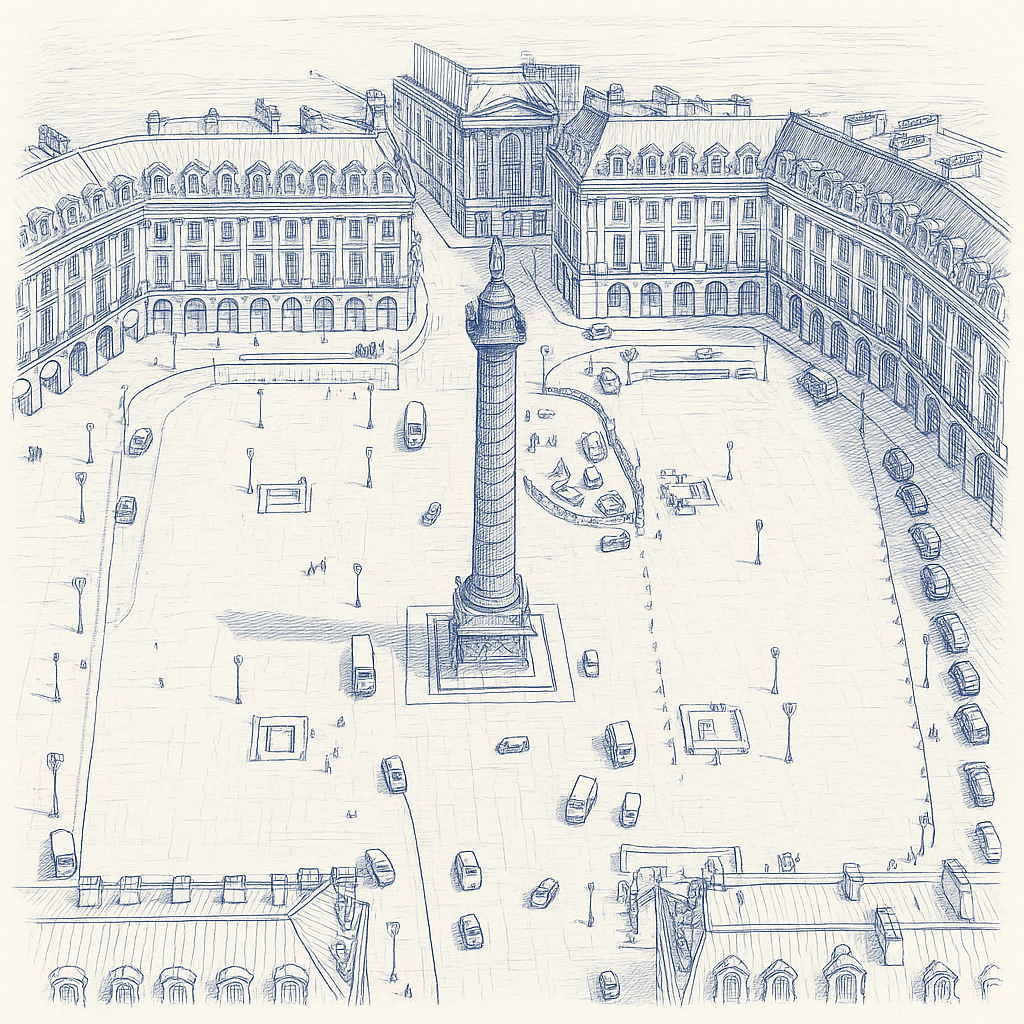
At the heart of the 1st arrondissement, between Rue de la Paix and Rue de Castiglione, Place Vendôme forms one of the most prestigious urban ensembles in Paris. This perfect octagon, drawn with classical rigor, stands radically apart from the surrounding commercial streets through its almost solemn calm and controlled monumentality. Here, no garish shop windows or disorderly tourist flows: the square breathes discreet luxury, that of the great jewelry houses and the Ritz, whose main entrance opens onto this very square. Few places in Paris combine so clearly past political power, architectural refinement, and contemporary commercial prestige.
History
Place Vendôme owes its name to the hôtel of the Duke of Vendôme, legitimized son of Henri IV, which once occupied this plot before its demolition at the end of the 17th century. It was Louis XIV who, through Louvois and then Louis Le Peletier de Souzy, commissioned the development of a royal square intended to house his equestrian statue, a work by sculptor Girardon, erected in 1699 in the center of the esplanade. Jules Hardouin-Mansart designed the uniform façades, imposing strict architectural unity on plot buyers while leaving interior layouts free. The royal statue was destroyed during the Revolution in 1792, and the square was briefly renamed Place des Piques. Napoleon I had the Vendôme Column erected in 1810, inspired by Trajan's Column in Rome, celebrating the victories of the Grande Armée, cast from the bronze of enemy cannons. This column was toppled in 1871 during the Paris Commune, a decision notably influenced by the painter Gustave Courbet, before being rebuilt in 1875 under the Third Republic. Throughout the 19th and 20th centuries, the square housed the Ministry of Justice, still present today, as well as the prestigious Hôtel Ritz, opened in 1898 by César Ritz, which made it one of the most legendary palace hotels in the world, frequented by Marcel Proust, Coco Chanel, and Ernest Hemingway.
Architecture
The architectural unity desired by Mansart remains today one of the great achievements of French classical urbanism. Cut-stone façades, punctuated by colossal pilasters, triangular pediments, and Mansart-style slate roofs, frame the octagon with almost mathematical regularity. The ground-floor arcades, originally intended for commerce, now house the windows of the world's greatest jewelry houses. The Vendôme Column, 44 meters high, dominates the ensemble and forms the unavoidable focal point of the composition, visible from Rue de la Paix as from Rue Castiglione.
Neighborhood life
Place Vendôme lives at a hushed pace, far from the bustle of neighboring commercial streets. Passersby are often clients of Boucheron, Chaumet, Van Cleef & Arpels, or Cartier, or travelers staying at the Ritz. The atmosphere is elegant, almost silent, punctuated by the discreet ballet of luxury cars. Tuileries or Opéra metro stations provide quick access, while the nearby Tuileries Garden offers a welcome green escape. Few food shops here, aside from the Ritz's Bar Hemingway, a true nighttime institution.
Real estate market
Residential properties on Place Vendôme are exceptionally rare, as most of the space is occupied by luxury boutiques, corporate law offices, or institutions. When an apartment becomes available, it is generally a large unit, often over 150 square meters, with high ceilings, period moldings, and a direct view of the column. Prices range between 20,000 and 24,000 euros per square meter for a property requiring renovation, between 25,000 and 30,000 euros for a renovated apartment with high-end amenities, and beyond 35,000 euros per square meter for an exceptional property with a direct view of the square and palace-level amenities. Buyers are almost exclusively major international fortunes, often via real estate holding companies, for pied-à-terre use. Transactions rarely happen openly, most sales going through confidential networks of specialized advisors.
Conclusion
Place Vendôme remains one of the most prestigious addresses in the world, a symbol of timeless luxury where royal history, imperial splendor, and contemporary refinement intersect. It caters to an extremely limited international clientele, for whom the address itself already constitutes a form of heritage.
Thomas Herremans