
Quai de Valmy — Where Urban Romance Meets Waterside Elegance
Introduction
Quai de Valmy runs along the western bank of the Canal Saint-Martin, in the 10th arrondissement, from the Bassin de la Villette to Place de la République. An atypical street by its very nature—a quay without a river, lining an artificial waterway from the early 19th century—it today embodies one of the most sought-after and most photographed sectors of Paris. Between picturesque locks, iron footbridges, and century-old plane trees, Quai de Valmy has managed to preserve a unique atmosphere, halfway between popular authenticity and contemporary bobo effervescence. Made world-famous by cinema and literature, it now attracts a young, creative, urban population seeking an alternative Parisian way of life, far from the more classical codes of the central historic arrondissements.
History
Quai de Valmy owes its name to the famous Battle of Valmy, fought on September 20, 1792, the first decisive victory of the French revolutionary armies against Austro-Prussian forces, a founding event of the young First Republic. This patriotic choice fits within the naming tradition of quays lining the Canal Saint-Martin, whose construction was ordered by Napoleon Bonaparte in 1802 to supply Paris with drinking water and facilitate the transport of goods, notably from the Bassin de la Villette to the Seine. The works, completed in 1825 under Charles X, durably transformed this then-largely industrial and working-class sector, where warehouses, factories, and workshops multiplied, benefiting from the navigable waterway. For over a century, Quai de Valmy remained a typical working-class neighborhood of northeastern Paris, marked by intense port and commercial activity, far from the bucolic image it conveys today. It was truly from the 1990s and 2000s onward that the sector underwent a radical transformation, driven notably by the international success of Jean-Pierre Jeunet's film "Amélie," released in 2001, several iconic scenes of which were filmed along the canal, durably popularizing the romantic image of Quai de Valmy and its locks among international audiences. This cinematic fame accelerated an already-underway gentrification, transforming former industrial workshops into sought-after lofts and attracting an urban, creative population, generally more affluent than in the past. Today, Quai de Valmy retains visible traces of its industrial past, particularly in certain rehabilitated buildings, while having fully embraced its new identity as a trendy, international neighborhood.
Architecture
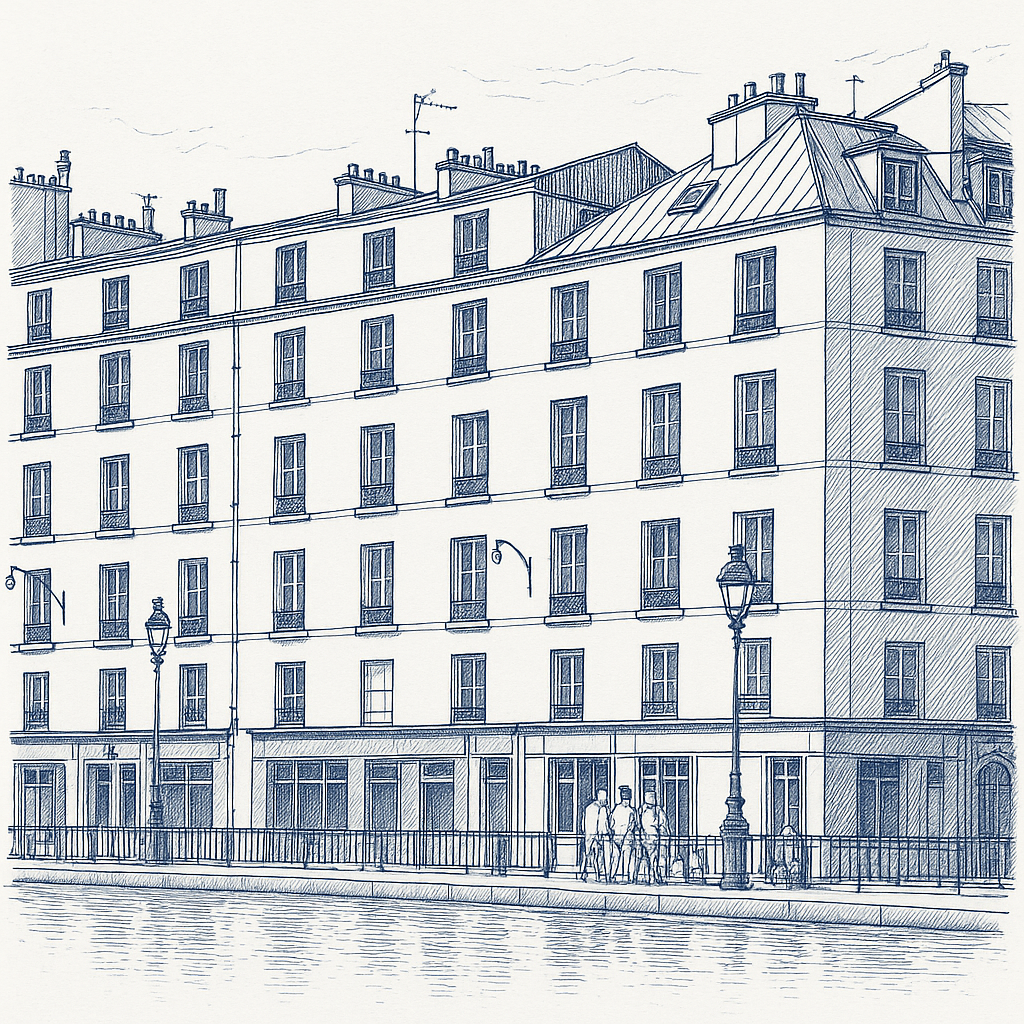
The architecture of Quai de Valmy is characterized by great heterogeneity, reflecting its eventful history. One finds 19th-century rental buildings, with sober façades in millstone or modest cut stone, typical of the popular Parisian housing of the era, alongside former industrial buildings now rehabilitated, their large workshop windows transformed into highly sought-after luminous lofts. The canal's locks, with their characteristic metal footbridges dating from the Second Empire, constitute elements of small-scale industrial heritage now protected and enhanced. A few more recent constructions, from the 1970s to today, complete this eclectic architectural ensemble, without disturbing the overall harmony of the site, partially protected under picturesque site classification.
Neighborhood Life
Quai de Valmy lives at an intense, cosmopolitan pace, particularly on sunny evenings and weekends, when the canal banks become a popular gathering spot for impromptu picnics. The wine bars, trendy restaurants, and concept stores lining the quay attract a young, international clientele, while more traditional shops, bakeries and fine groceries, coexist harmoniously with this new urban offering. Nearby markets, notably the one at République station, and easy access to metro lines 5, 8, 9, and 11, as well as the RER, make the sector a very well-served crossroads. The proximity of Square des Récollets and the landscaped banks also offers a pleasant living environment, appreciated by families as well as young professionals who make up the bulk of the resident population in this rapidly changing sector.
Real Estate Market
The real estate market on Quai de Valmy primarily attracts young professionals, creative executives, and investors drawn by the high rental potential of this sector, which has seen strong value appreciation over the past fifteen years. The supply consists of an atypical mix of classic apartments in 19th-century rental buildings and industrial lofts resulting from the rehabilitation of former workshops, particularly sought after for their generous volumes and exceptional light. Standard apartments, sometimes requiring refreshing works, trade between €9,500 and €10,800/m², while renovated properties with careful finishes reach €11,500 to €13,000/m². Exceptional lofts, with direct views of the canal and locks, can exceed €14,000 to €15,500/m², these rare properties generating strong competition among buyers as soon as they come to market. The average time on market remains particularly short, often under four weeks for properties with canal views, reflecting the sector's persistent appeal to a young, dynamic urban clientele. The recent trend confirms a continuous rise in values, driven by the lasting transformation of the neighborhood's image.
Conclusion
A former industrial neighborhood turned one of the hotspots of contemporary Parisian life, Quai de Valmy embodies Paris's ability to reinvent itself without denying its history. It appeals to a young, creative, international population seeking urban authenticity and a lively waterside living environment.
Thomas Herremans