
Quai Voltaire — Where Enlightenment Meets the Seine
**Introduction**
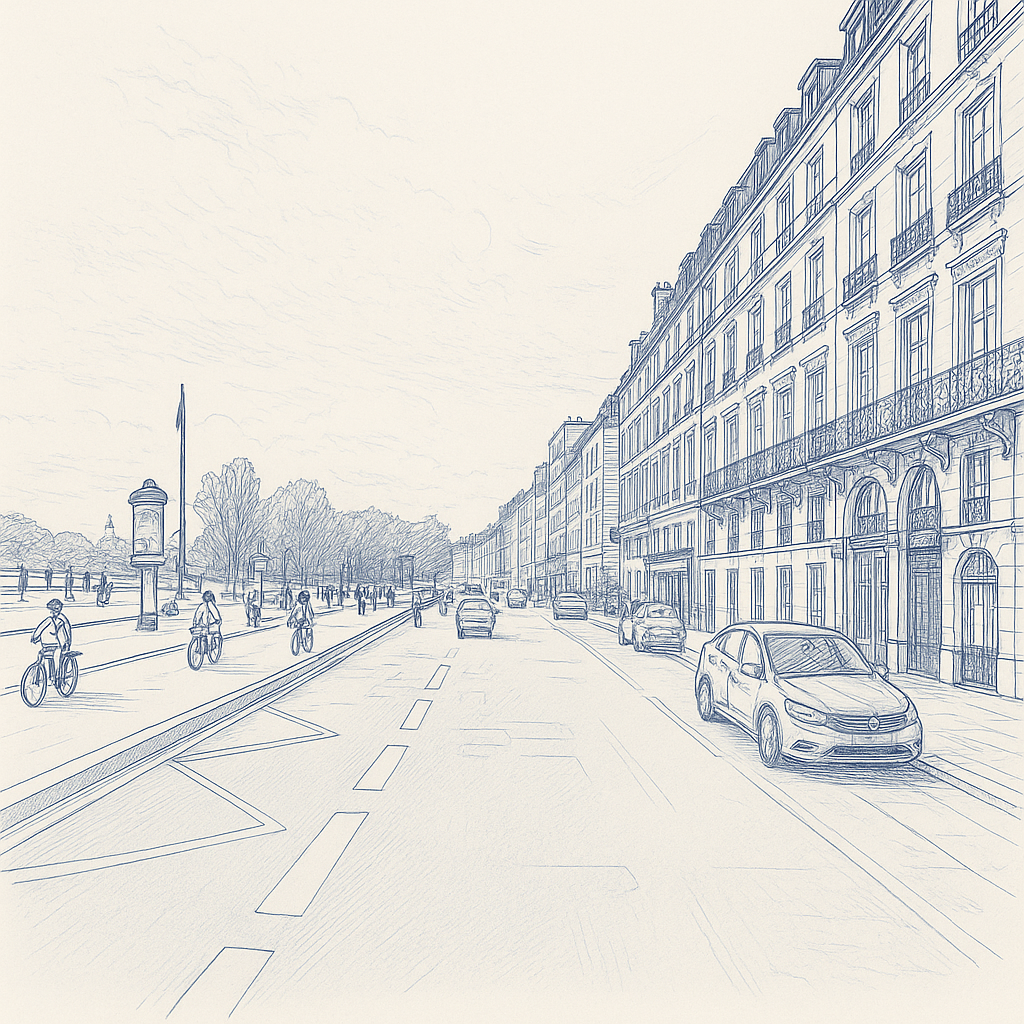
Facing the Louvre, across the Seine, Quai Voltaire unfurls its continuous façade of old buildings between Pont Royal and Pont du Carrousel, in the seventh arrondissement. Few riverbanks offer such a dialogue between the two sides of the capital: on one side, the majesty of the royal palace turned museum; on the other, a row of seventeenth- and eighteenth-century mansions and buildings that have seen the greatest names in literature, music and the arts pass through. Quai Voltaire is not merely a thoroughfare: it is a place of literary memory, a historic haunt of booksellers and antique dealers, and today one of the most coveted addresses in Paris for its unobstructed view and its intact eighteenth-century atmosphere.
**History**
The quay, created in the seventeenth century under the name Quai des Théatins, in reference to the convent of Theatine monks located there, took its current name in tribute to Voltaire, who died there in 1778 at the Hôtel de la Villette, located at number 27 — an event that permanently marked the Parisian imagination and gave the quay an almost mythical renown. This place of Voltairian memory subsequently attracted numerous writers and artists eager to inscribe themselves in this intellectual lineage. Charles Baudelaire lived there in 1856 at the nearby Hôtel Lauzun, Richard Wagner composed part of his work there during a Parisian stay, and Jean Sibelius also resided there. Painter Jean-Auguste-Dominique Ingres had his studio in the immediate vicinity. The quay also owes its fame to its booksellers, established since the nineteenth century in their characteristic green boxes along the parapet, perpetuating a tradition of secondhand book trading now inscribed on UNESCO's intangible heritage list. In the twentieth century, Quai Voltaire also became a major hub for art and antique dealing, attracting dealers and collectors from around the world, a tradition that continues with the prestigious galleries now occupying the ground floors. The Hôtel du Quai Voltaire, opened in the nineteenth century, also hosted Wagner, Baudelaire, Sibelius and Oscar Wilde, consolidating the place's literary reputation over the decades.
**Architecture**
The buildings of Quai Voltaire, built mostly between the late seventeenth and eighteenth centuries, display classical cut-stone façades, punctuated by wrought-iron balconies with delicate motifs and mansard zinc roofs characteristic of the Parisian landscape. The regularity of heights and strict alignment along the quay create a homogeneous and elegant perspective, particularly highlighted by the changing light on the Seine. Some buildings retain remarkable original features: sculpted carriage doors, staircases with wrought-iron railings, French-style ceilings on the noble floors. Apartments overlooking the Seine benefit from wide small-paned windows offering unobstructed views of the Louvre, Pont Royal and the Île de la Cité, a rare configuration that gives these properties exceptional heritage and scenic value.
**Neighborhood life**
Quai Voltaire lives at the pace of strollers, tourists and residents who cross paths along the booksellers' stalls and art galleries. During the day, lovers of old art and eighteenth-century furniture wander among the windows of renowned antique dealers, while in the late afternoon, the golden light on the Seine attracts photographers and walkers. In the evening, the quay regains a calm conducive to contemplation, punctuated by the lights of the Louvre reflecting on the water. Local shops, rare on the quay itself, are found in the adjacent streets — Rue des Saints-Pères, Rue du Bac — offering bakeries, cafés and gourmet restaurants. Transport links are excellent, with the Rue du Bac station (line 12) in the immediate vicinity and several bus lines running along the Seine. The Tuileries Garden, accessible via Pont Royal, offers a green space just minutes away on foot.
**Real estate market**
The real estate market on Quai Voltaire is among the most coveted and rarest in Paris, due to the limited number of buildings directly overlooking the Seine with a view of the Louvre. Buyers are mostly collectors, international executives or wealthy families seeking an exceptional pied-à-terre. Available properties range from small 40 to 60 sqm apartments with a partial view of the Seine to vast 150 to 250 sqm through-apartments occupying an entire noble floor, sometimes with a direct, unobstructed view of the river. Prices vary greatly depending on exposure: between €14,000 and €16,500/sqm for a standard apartment without a direct view, between €18,000 and €21,000/sqm for a renovated high-end property with a partial view, and beyond €26,000 to €30,000/sqm for exceptional apartments benefiting from a frontal view of the Louvre and the Seine. These exceptional properties, extremely rare on the market, generally sell very quickly, sometimes in less than two months, once properly positioned, as demand far exceeds available supply. Foreign buyers, particularly American, Swiss and Asian, represent a significant share of transactions on this mythical quay.
**Conclusion**
Quai Voltaire embodies an absolute rarity in the Parisian real estate landscape: that of living opposite the Louvre, in a setting steeped in literary and artistic history. A prestigious address for collectors and aesthetes, it appeals to an international clientele seeking exceptionality and unobstructed views, for whom Paris sometimes boils down to this single panorama over the Seine.
Thomas Herremans