
Rue Christine: The Discreet Charm of a Historic Lane in the 6th Arrondissement
Introduction
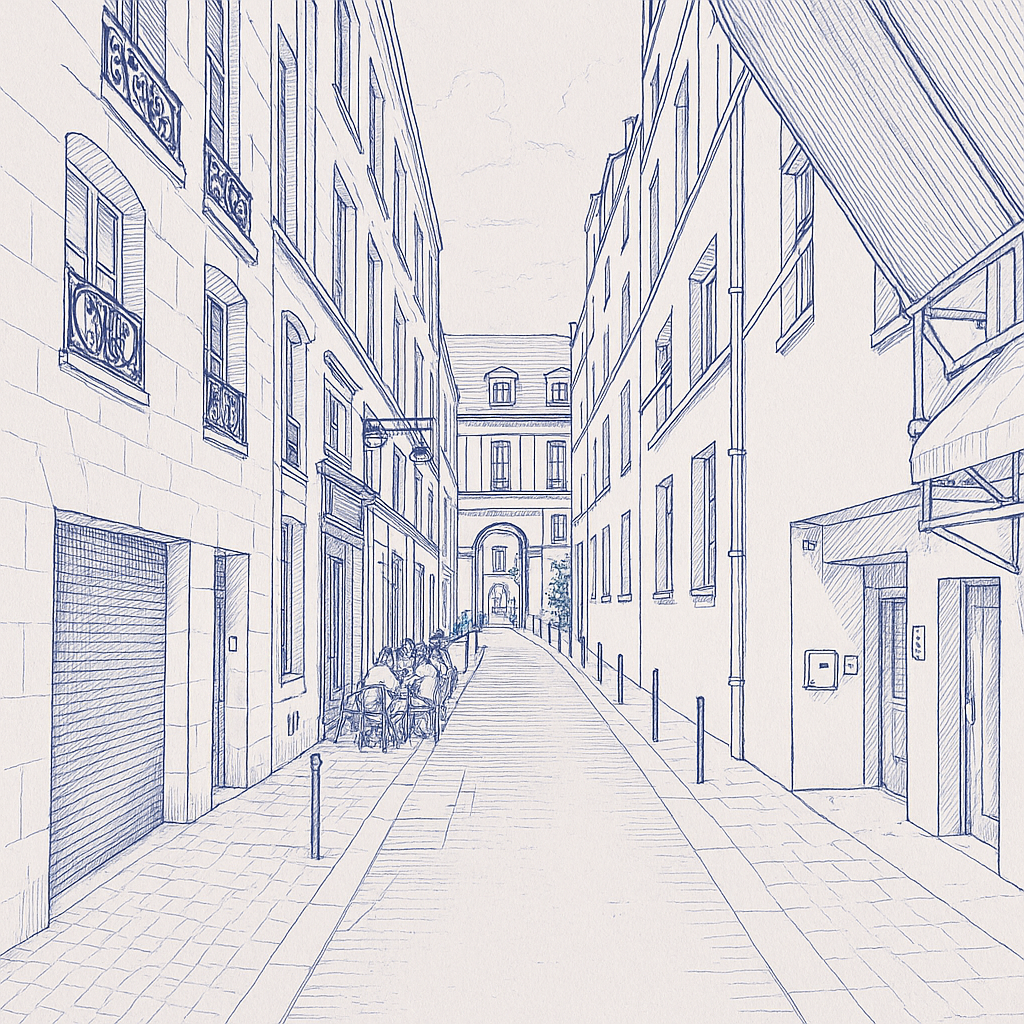
Nestled between Rue Dauphine and Rue des Grands-Augustins, Rue Christine is one of those small streets in the 6th arrondissement that, despite their modest size of barely 150 meters, concentrate remarkable heritage richness and a rare bohemian atmosphere. Paved in the old style, lined with old buildings with irregular façades, it offers a striking contrast to the bustle of nearby Rue Dauphine or Boulevard Saint-Germain. It is a street that Parisians themselves rediscover with pleasure, having preserved an intimate, almost village-like character in the very heart of Saint-Germain-des-Prés. One immediately feels that particular atmosphere of literary and artistic Paris, made of rediscovered silence and ancient stones telling a story several centuries old.
History
Rue Christine was laid out in 1607 by order of Marie de Médicis, as part of the development of the neighborhood following the destruction of the old Hôtel de Nesle. Its name pays tribute to Christine of France, daughter of Henri IV and Marie de Médicis, born in 1606, who would later become Duchess of Savoy. This street was one of the first in Paris to be built along a planned straight layout, testifying to the beginnings of modern urban planning well before the great Haussmannian works of the 19th century. The street still retains several remarkable buildings dating from the 17th century, notably at number 4 where the Cercle Volney once stood, a meeting place for artists and writers. Over the centuries, the street became a favored residence for artists and intellectuals drawn by the proximity of the Académie des Beaux-Arts and the artists' studios in the neighborhood. In the 20th century, Rue Christine acquired particular notoriety thanks to the presence of Pablo Picasso, who set up his studio at number 7 from 1938 to 1955, a period during which he painted some of his most famous works, with "Guernica" having been prepared in a nearby studio on Rue des Grands-Augustins. Gertrude Stein and Alice B. Toklas, emblematic figures of interwar literary Paris, also resided on this street, helping make it a hub of 20th-century Parisian intellectual and artistic life.
Architecture
The architecture of Rue Christine is characterized by old and heterogeneous buildings, blending 17th-century structures with irregular stone façades and later 18th and 19th-century constructions. The narrow, often asymmetrical façades reflect the original medieval plot layout, while massive wooden carriage doors and small-paned windows give the street a highly sought-after picturesque charm. The buildings, generally low compared to Haussmannian standards, rarely exceed four to five stories, thus preserving a human and intimate scale characteristic of old Paris.
Neighborhood Life
Rue Christine benefits from particularly lively neighborhood life, driven by the immediate proximity of Rue Dauphine, Rue de Buci and its market, and Boulevard Saint-Germain. The cafés and small restaurants dotting the street attract a clientele mixing longtime residents and newcomers drawn by the neighborhood's charm. The art-house cinema La Clef, although closed and later reopened under a new associative form, long marked the cultural identity of the street. The Odéon metro station, in immediate proximity, allows quick access to both the Left Bank and the Right Bank.
Real Estate Market
The real estate market on Rue Christine is marked by limited supply, consisting essentially of small old apartments, often atypical, with exposed beams, old parquet floors, and picturesque courtyard views. Buyers are predominantly art lovers, professionals, and investors drawn by the street's historical and literary character. Prices per square meter range between €12,500 and €14,000/m² for a standard property, between €15,000 and €17,000/m² for a tastefully renovated apartment, and can reach over €19,000/m² for an exceptional property, notably a former artist's studio with a glass roof. Marketing times vary between two and five months, the rarity of properties sometimes offsetting a slightly more targeted demand than on neighboring major thoroughfares.
Conclusion
Rue Christine embodies that literary and artistic Paris we thought was gone, where Picasso rubbed shoulders with Gertrude Stein in an architectural setting preserved from time. It appeals to a clientele seeking authenticity, discretion, and an extra soul rarely matched elsewhere in the capital.
Thomas Herremans