
Rue d'Anjou — Where Discretion Meets Distinction
Introduction
In the 8th arrondissement, Rue d'Anjou connects Boulevard Malesherbes to Rue du Faubourg Saint-Honoré, crossing a neighborhood both residential and commercial, located a few steps from the Madeleine church. This elegant and relatively little-known street nonetheless offers a condensed slice of Parisian history, between discreet mansions, confidential luxury boutiques, and notable religious institutions. Less touristy than the nearby Rue Royale, Rue d'Anjou charms with its hushed atmosphere, conducive to bourgeois neighborhood life, while remaining in immediate proximity to the major commercial axes of the Madeleine district. It is a transitional street, halfway between the splendor of the grand boulevards and the residential intimacy of the Europe district.
History
Rue d'Anjou was laid out in the eighteenth century, as part of the urbanization of the Madeleine district and the suburb then developing around the new royal axis. Its name pays tribute to the House of Anjou, an illustrious branch of the French royal family. The street experienced sustained architectural development under the reign of Louis XV and then Louis XVI, with the construction of several mansions intended for nobility and the great Parisian bourgeoisie seeking a residential setting close to the elegant new Paris taking shape around the Madeleine. One of the most notable buildings on the street is the Chapelle Expiatoire, erected by order of Louis XVIII on the site of the former Madeleine cemetery where Louis XVI and Marie-Antoinette were buried after their execution in 1793, before their transfer to the Basilica of Saint-Denis. This chapel, completed in 1826 to plans by architect Pierre-François-Léonard Fontaine, gives the street a unique memorial dimension in the Parisian landscape. In the nineteenth century, Rue d'Anjou also saw the establishment of numerous embassies and legations, benefiting from proximity to the Élysée Palace. Several writers and artists resided there, drawn by the calm and prestige of the emerging neighborhood. The street also retained, until the twentieth century, a local commercial vocation with traditional food shops, witnesses of an authentic neighborhood life at the heart of an otherwise very administrative and diplomatic sector.
Architecture
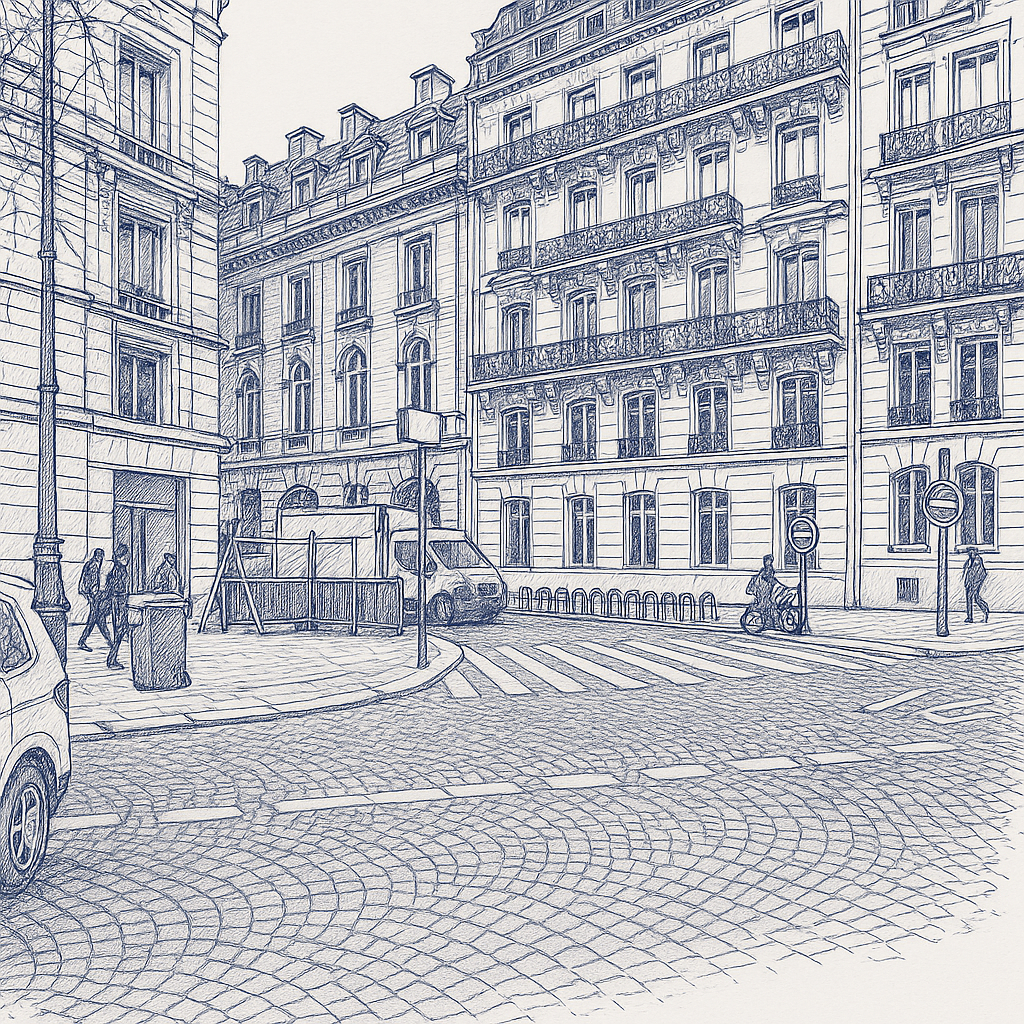
The architecture of Rue d'Anjou harmoniously combines eighteenth-century mansions with nineteenth-century Haussmannian buildings. The classical façades, in light cut stone, present regular ordering, running balconies on the second floor, and mansard roofs characteristic of Parisian style. The Chapelle Expiatoire, with its sober neoclassical architecture and Doric peristyle, constitutes the architectural highlight of the street, surrounded by an enclosed garden that offers valuable green breathing space in this otherwise very mineral sector. The late nineteenth-century buildings, built during the Haussmannian piercing of Boulevard Malesherbes, complete the ensemble with more ornamented façades, adorned with wrought-iron balconies and sculpted pediments.
Neighborhood life
Neighborhood life on Rue d'Anjou is characterized by measured but constant activity, punctuated by the presence of several renowned restaurants and quality food shops. In the morning, residents enjoy the bakeries and fine caterers along the street, while employees of the many companies and firms located in surrounding buildings converge toward their offices. In the afternoon, the garden of the Chapelle Expiatoire offers a haven of peace appreciated by residents seeking calm amid the bustle of the 8th arrondissement. In the evening, several gastronomic restaurants and chic bistros attract a business clientele and affluent residents. The proximity of the Madeleine, Boulevard Malesherbes, and Saint-Lazare station ensures quick access to public transport, with Saint-Augustin and Madeleine stations a few minutes' walk away. The neighborhood's population, composed of senior executives, diplomats, and affluent families, gives the street a resolutely bourgeois and polished atmosphere.
Real estate market
The real estate market on Rue d'Anjou caters to an affluent clientele composed of senior executives, professionals, and international investors drawn by proximity to the Madeleine and the business district. Available properties are mainly two- to four-room family apartments in Haussmannian buildings or former divided mansions, with original parquet, moldings, and marble fireplaces. Properties overlooking the garden of the Chapelle Expiatoire are particularly sought after for their open view and calm. Prices per square meter are as follows: between 11,000 and 12,500 euros for a standard property to be renovated, between 13,500 and 15,500 euros for a high-end renovated apartment, and above 17,000 euros, reaching up to 19,500 euros, for an exceptional property with a garden view or in a former mansion. The market remains dynamic with average marketing times of six to eight weeks for correctly priced properties, demand remaining strong from an international clientele seeking discretion and prestige.
Conclusion
Rue d'Anjou, between royal memory and bourgeois elegance, constitutes a prime address for those seeking calm, prestige, and immediate proximity to the major axes of the 8th arrondissement. A street for lovers of history and high-standing residential discretion.
Thomas Herremans