
Rue de Babylone: Bourgeois Tranquility in the Heart of the 7th Arrondissement
Introduction
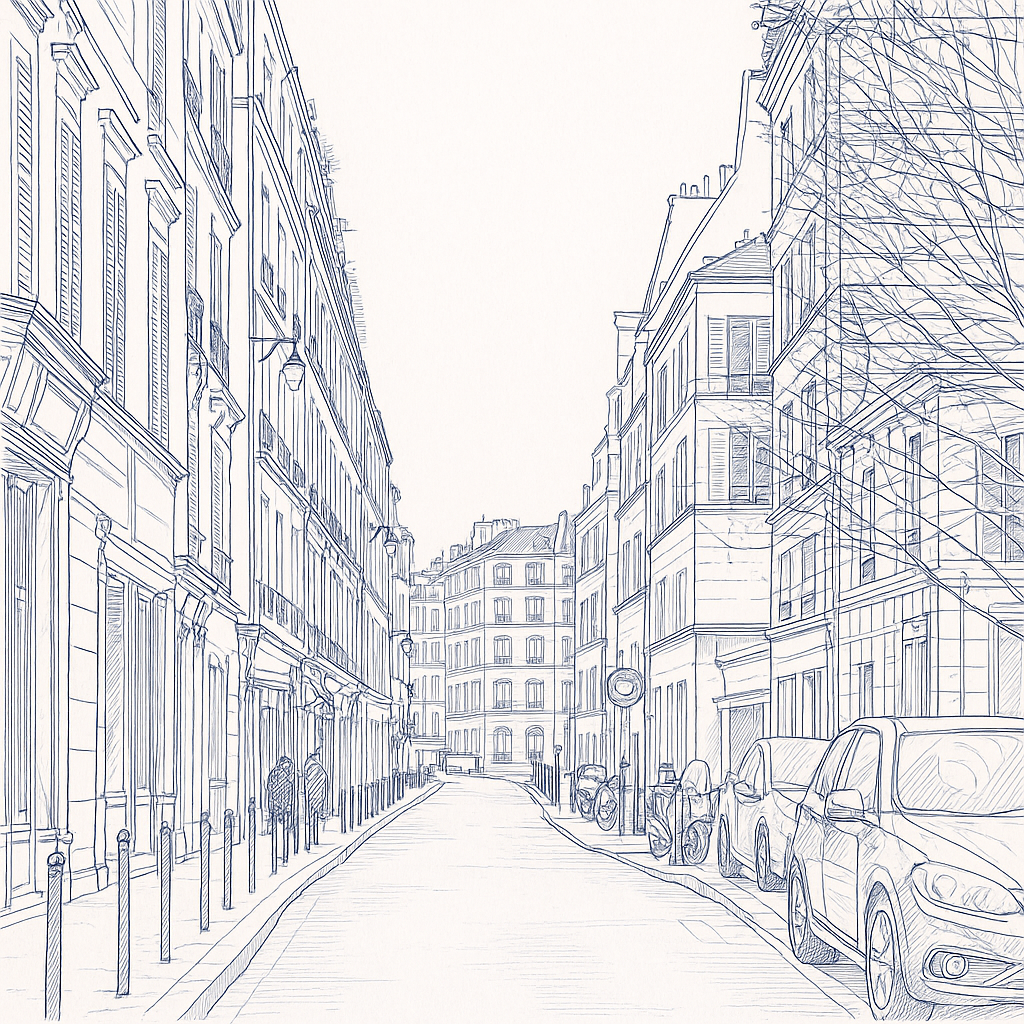
Rue de Babylone runs through the 7th arrondissement, connecting Rue de Sèvres to Boulevard des Invalides, in one of the most sought-after neighborhoods of the Left Bank. This relatively short street, barely 400 meters long, nonetheless exudes a discreet elegance that clearly distinguishes it from the commercial bustle of the nearby Rue de Sèvres. Lined with private mansions and bourgeois buildings, it embodies a certain idea of quality residential Paris, far from tourist crowds yet a stone's throw from the capital's most prestigious institutions. Here one finds a curious blend of aristocratic discretion and peaceful neighborhood life, punctuated by the presence of the Catherine Labouré garden, a little-known green haven that adds further to its secret charm. It is a street often discovered by chance, and never forgotten.
History
The street's name, attested since the 17th century, is said to refer to former lands or gardens that were compared, in a poetic image typical of the era, to the famous hanging gardens of Babylon, one of the seven wonders of the ancient world. This explanation remains debated among historians, some seeing it simply as a reference to an old shop sign or to land belonging to a religious community. The street crosses a sector that once largely belonged to the lands of the Convent of the Daughters of Saint Thomas of Villanova, as still evidenced today by the presence of the Chapel of Our Lady of the Miraculous Medal, founded in 1830 on Rue du Bac, a short distance away. The 7th arrondissement, a favored territory of the aristocracy since the 18th century, saw private mansions multiply along Rue de Babylone during the 18th and 19th centuries, notably driven by great noble families seeking to settle near the Faubourg Saint-Germain, then the beating heart of Parisian high society. The Catherine Labouré garden, laid out on the site of a former convent, opened to the public in 1985, offering residents a rare green space in this dense neighborhood. The street was also home to artists and writers drawn by its calm, far from the bustle of the grand boulevards, while remaining at the geographic and symbolic center of Parisian power.
Architecture
The architecture of Rue de Babylone is characterized by great stylistic homogeneity, blending 18th-century private mansions with classical façades enhanced by wrought-iron balconies, and 19th-century bourgeois buildings of elegant proportions. Massive wooden carriage doors, often adorned with antique door knockers, testify to the street's aristocratic past. The cut-stone façades, sometimes embellished with horizontal rustication, exude a refined sobriety typical of the Faubourg Saint-Germain. Some buildings retain paved interior courtyards and private gardens, a precious rarity within inner Paris.
Neighborhood Life
Neighborhood life around Rue de Babylone is marked by serenity, contrasting with the bustle of the nearby Bon Marché, the first Parisian department store, founded in 1852. Residents enjoy quick access to the refined food shops of Rue de Sèvres and Boulevard Raspail, as well as to the numerous art galleries and bookshops that give the 7th arrondissement its reputation. The Vaneau and Duroc metro stations efficiently serve the neighborhood, while the Catherine Labouré garden offers a relaxing space appreciated by families and retirees. The population is predominantly composed of affluent families, diplomats, and professionals, drawn by the residential calm and proximity to major institutions.
Real Estate Market
The real estate market on Rue de Babylone attracts a very high-end, often international clientele, seeking large family apartments or rare private mansions. Properties on offer range from charming studios to through-apartments of 150 to 300 m², often with exceptional features: period parquet floors, moldings, marble fireplaces, ceiling heights sometimes exceeding 3.20 meters. Prices per square meter range between €13,000 and €15,000/m² for a standard property requiring renovation, between €16,000 and €18,000/m² for a fully renovated high-end apartment, and can exceed €20,000/m² for a private mansion or exceptional apartment with a private garden. Demand remains strong, with marketing times generally between three and six months for the highest-quality properties, as buyers prioritize discretion and building quality over transaction speed.
Conclusion
Rue de Babylone embodies a Parisian art of living marked by discretion and heritage elegance. It appeals to a demanding clientele seeking a refined, peaceful living environment, without straying far from the beating heart of the capital and its most prestigious institutions.
Thomas Herremans