
Rue de Beaujolais: Arcaded Elegance, Palais-Royal Exclusivity and Ultra-Scarce Prime Residential Value in Paris’s 1st Arrondissement
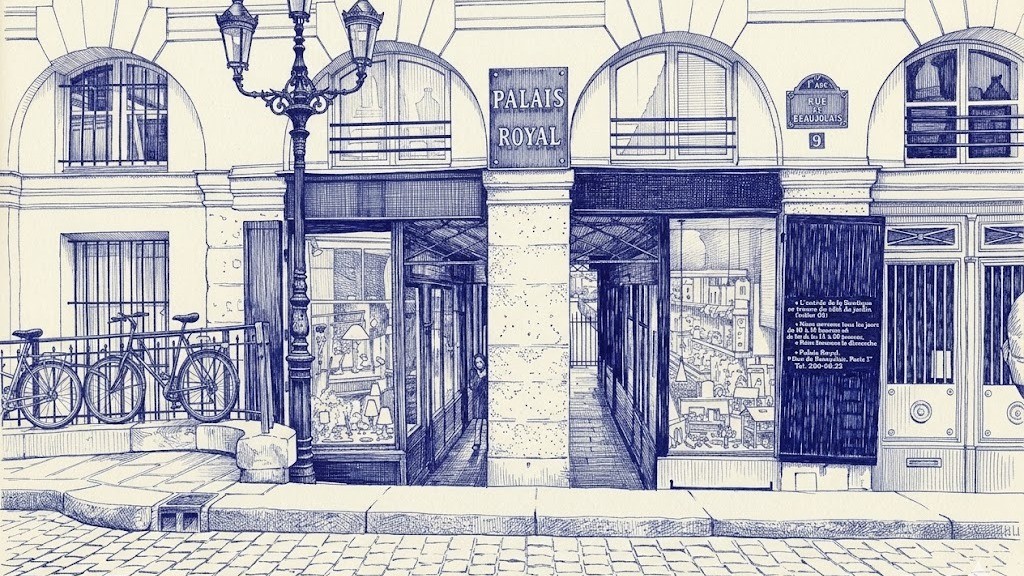
Rue de Beaujolais is one of the most architecturally refined and residentially exclusive streets in the 1st arrondissement of Paris. Located along the northern arcades of the Palais-Royal, it forms part of a rare urban ensemble that blends 17th-century aristocratic planning with contemporary prime real estate scarcity.
Unlike Rue de Rivoli, characterized by commercial scale, or Rue des Pyramides, shaped by imperial symbolism, Rue de Beaujolais operates as a contained, semi-private residential micro-environment. Its identity is inseparable from the Palais-Royal complex, whose arcades and gardens define both its architectural coherence and its market positioning.
The street takes its name from the Count of Beaujolais, son of Philippe d’Orléans. This dynastic reference reflects the royal lineage that shaped the development of the Palais-Royal quarter.
This article examines the historical formation, architectural uniformity, documented associations and price-per-square-meter segmentation of Rue de Beaujolais.
1. Historical Formation and Royal Context
Rue de Beaujolais was created in the 18th century as part of the expansion of the Palais-Royal gardens under the Orléans family.
The Palais-Royal itself was originally built for Cardinal Richelieu in 1633 before becoming the residence of the Orléans branch of the French royal family. Under Louis Philippe I, the Palais-Royal arcades were opened to commercial and social life, creating one of the earliest mixed-use environments in Paris.
Rue de Beaujolais formed part of this structured perimeter. Unlike organically developed medieval streets, it was conceived with architectural discipline and symmetry.
Its aristocratic origins directly influence its current valuation.
2. Architectural Identity
The defining feature of Rue de Beaujolais is its integration into the arcaded perimeter of the Palais-Royal.
Architectural characteristics include:
• Continuous stone façades • Arcaded ground floors • Strict cornice alignment • Five- to six-story elevation • Symmetrical window distribution
The arcades create a semi-private transitional space between public garden and residential façade.
Residential units often feature:
• Ceiling heights between 3.00 and 3.50 meters • Large windows overlooking gardens or inner courtyards • Boutique-scale building structures • Limited inventory
Because of heritage protection, façade modifications are highly regulated.
3. Urban Position and Environmental Quality
Rue de Beaujolais benefits from one of the rarest combinations in central Paris:
• Direct adjacency to Palais-Royal gardens • Immediate proximity to Musée du Louvre • Walking distance to Place Vendôme • Reduced traffic intensity
Unlike surrounding arteries, it experiences limited vehicular flow.
Noise exposure is minimal compared to Rue de Rivoli.
Green adjacency generates measurable residential premiums.
4. Documented Associations
The broader Palais-Royal quarter has historically hosted intellectual and political figures.
While Rue de Beaujolais itself is not widely documented as a long-term residence of internationally recognized figures, its architectural and historical context links it to the Orléans dynasty and to the political sphere associated with the Palais-Royal.
The street’s prestige is therefore structural and dynastic rather than celebrity-driven.
5. Residential Market Profile
Rue de Beaujolais is not a volume market.
Buyer profiles include:
• Ultra-high-net-worth individuals • Long-term wealth holders • Cultural sector elites • Secondary residence purchasers
Primary residence occupancy is relatively limited.
Supply is extremely scarce.
Transactions are infrequent and often discreet.
6. Market Structure and Price per Square Meter
Rue de Beaujolais belongs to the ultra-prime micro-segment of the 1st arrondissement.
Indicative pricing:
• Standard units: €22,000 – €26,000 / m² • Renovated premium units: €26,000 – €30,000 / m² • Rare garden-facing or high-ceiling properties: €32,000+ / m²
Key value drivers:
• Direct Palais-Royal garden adjacency • Floor level • Ceiling height • Architectural preservation quality • Light exposure
Compared to Rue Cambon, pricing may be similar or higher for garden-facing units due to scarcity and environmental calm.
Liquidity is low due to supply scarcity, but pricing resilience is strong.
7. Comparative Position within the 1st Arrondissement
Compared to:
• Rue Cambon (couture-driven visibility) • Rue de Castiglione (imperial axis) • Rue du Mont-Thabor (discreet ultra-central)
Rue de Beaujolais represents:
• Garden-adjacent exclusivity • Architectural coherence • Ultra-scarce supply • Stability-driven ultra-prime valuation
It is one of the most insulated micro-markets in central Paris.
Rue de Beaujolais exemplifies how architectural continuity, garden adjacency and historical lineage create ultra-prime stability in Paris’s 1st arrondissement.
Its value derives from structural scarcity rather than commercial branding.
Within central Paris, it stands as a benchmark for discreet, heritage-based luxury.
Thomas Herremans