
Rue de Chabrol
Introduction
In the 10th arrondissement, Rue de Chabrol connects Rue d'Hauteville to Rue La Fayette, in a quiet residential area often overlooked, set back from the bustle of the Gare de l'Est and Boulevard Magenta. Less known than its commercial neighbors, this street nonetheless offers remarkable architectural heritage and a peaceful residential atmosphere, highly prized by families and professionals drawn by the neighborhood's relative calm while remaining close to the heart of Paris.
History
Rue de Chabrol takes its name from Count Gilbert-Joseph-Gaspard de Chabrol de Volvic, prefect of the Seine under the First Empire and the Restoration, known for modernizing Parisian infrastructure, notably regarding water supply and sanitation. The street was laid out in the early 19th century as part of the urbanization of the neighborhood around the new Gare de l'Est, then in full expansion with the development of the railway. The neighborhood, long considered peripheral relative to historic Paris, experienced strong demographic growth throughout the 19th century, with the construction of numerous bourgeois buildings intended to house a growing middle class—shop employees, engineers and civil servants drawn by proximity to the Parisian train stations. Rue de Chabrol thus retains an eminently residential character, less marked by great Haussmannian transformations than by progressive, pragmatic urbanization. In the 20th century, the neighborhood saw its population diversify, with the arrival of numerous communities from North Africa and sub-Saharan Africa, contributing to the current cosmopolitan identity of the 10th arrondissement. The street nonetheless remains relatively sheltered from the intense commercial bustle characterizing neighboring arteries such as Rue du Faubourg-Saint-Denis.
Architecture
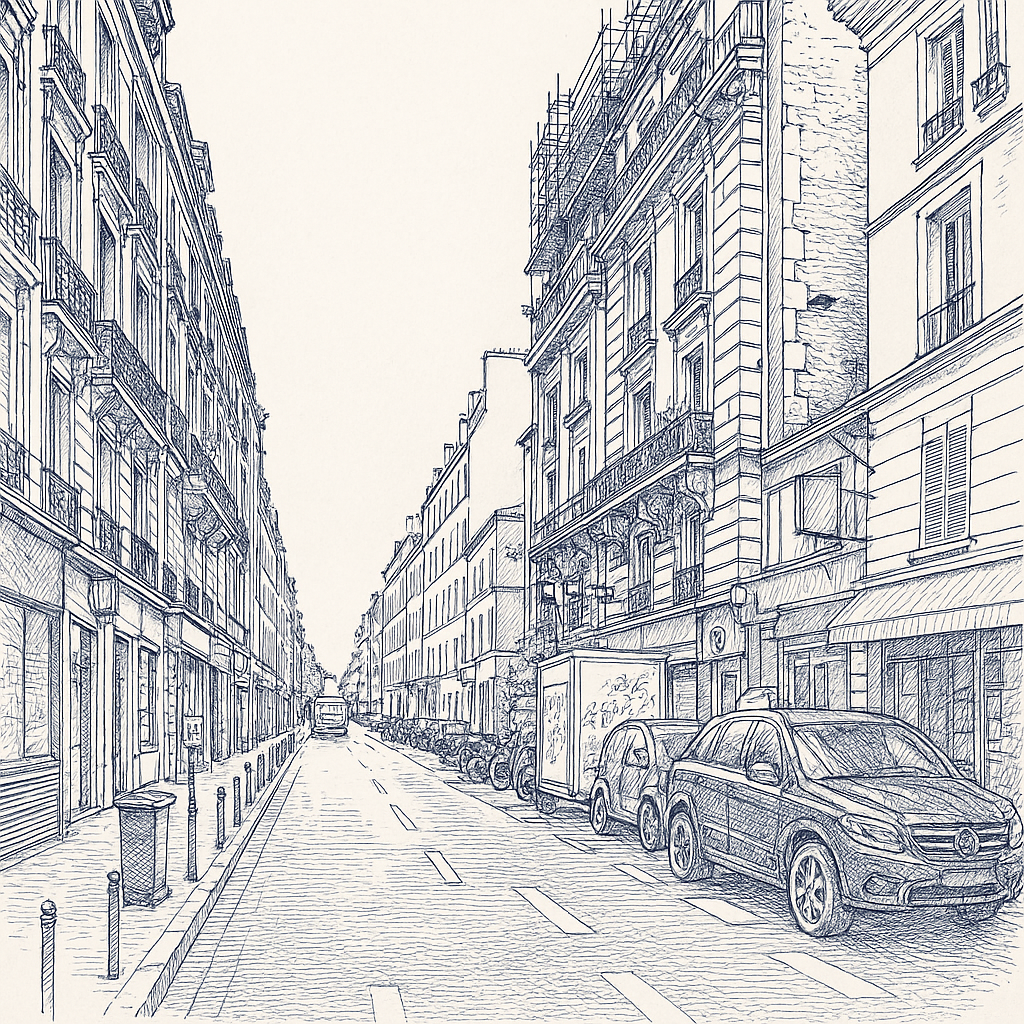
The architecture of Rue de Chabrol is representative of 19th-century bourgeois urbanization, with four- to six-story buildings in cut stone or rendered rubblestone, with sober but elegant facades. There are decorative elements characteristic of the post-Haussmannian period, such as continuous balconies on the second floor, wrought-iron railings and sculpted wooden carriage doors. A few more modest brick buildings testify to a more functional architecture intended for the era's middle classes.
Neighborhood life
Rue de Chabrol retains a peaceful residential atmosphere, with a few neighborhood shops, bakeries and local cafés punctuating local life. Proximity to the Gare de l'Est and Gare du Nord ensures exceptional transport access, while the nearby Square Alban-Satragne offers a green space appreciated by families. The neighborhood, undergoing gentrification for the past fifteen years, attracts an increasingly young and diverse population.
Real estate market
The real estate market on Rue de Chabrol appeals to young professionals and families seeking a compromise between residential calm and accessibility to central Paris. Available properties are mainly two- to four-room apartments in old buildings, with parquet and moldings for the higher-quality ones. Prices range from €7,800 to €8,800/m² for a standard property, €9,500 to €10,800/m² for a high-end renovation, and up to €11,500 to €12,800/m² for an exceptional property, top floor with an open view. Sale timelines are two to three months, in a dynamic market driven by the ongoing revaluation of the 10th arrondissement.
Conclusion
Rue de Chabrol represents a safe bet for buyers seeking a calm, residential living environment at still-accessible prices, in an arrondissement undergoing positive transformation.
Thomas Herremans