
Rue de l'Odéon — Where Vision Meets Heritage
Introduction
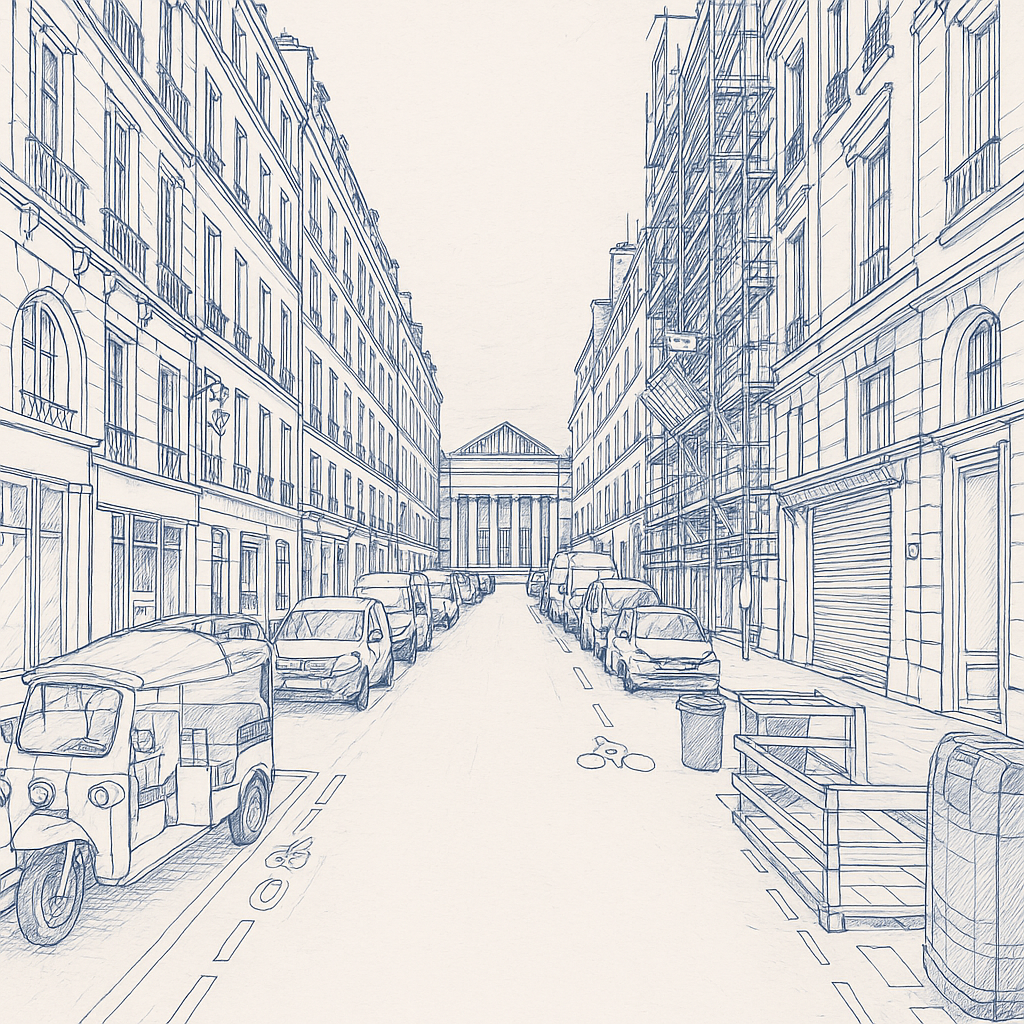
Short but iconic, Rue de l'Odéon connects the Odéon crossroads to the national theater of the same name, in the 6th arrondissement. Laid out along a rigorously straight axis, it was one of the first Parisian streets designed according to a modern urban plan, equipped from the outset with sidewalks, a rarity for the time. Even today, this classical perspective strikes with its harmony and calm, contrasting with the bustle of nearby Boulevard Saint-Germain. A literary address par excellence, it continues to embody the elegance and intellectualism characteristic of the Odéon neighborhood.
History
Rue de l'Odéon was cut through between 1779 and 1782 as part of the development of the surroundings of the new Comédie-Française theater, which has since become the Théâtre de l'Odéon, built according to the plans of architects Charles De Wailly and Marie-Joseph Peyre. This street was designed as a ceremonial avenue leading to the theater, with an exceptionally straight layout for the time and sidewalks lined with bollards, a major urban planning innovation inspired by emerging hygienist theories. It quickly became a place of fashionable sociability, frequented by all of Paris society heading to performances. But it was in the 20th century that the street acquired its most lasting reputation, thanks to the famous Shakespeare and Company bookshop, founded in 1919 by the American Sylvia Beach at number 12. This legendary place became the gathering point for the entire American Lost Generation settled in Paris: James Joyce published Ulysses there in 1922 after being rejected everywhere else, while Ernest Hemingway, Ezra Pound, F. Scott Fitzgerald, and Gertrude Stein frequented the shop assiduously, borrowing books, discussing literature, and sometimes receiving discreet financial help from the bookseller. The bookshop closed its doors in 1941 under the German Occupation, Sylvia Beach having refused to sell her last copy of Finnegans Wake to a German officer. The street subsequently retained its literary aura, remaining associated with the history of publishing and Parisian intellectual life in the 20th century.
Architecture
Rue de l'Odéon displays remarkable architectural unity, the result of its overall design in the late 18th century. The buildings, constructed simultaneously according to a coordinated plan, feature classical cut-stone façades, with a regular rhythm of windows and harmonized heights along the entire length of the street. This homogeneity, rare in Paris for a street of this period, gives the perspective a sober elegance, reinforced by the view of the neoclassical colonnaded façade of the Théâtre de l'Odéon that magnificently closes the axis.
Neighborhood life
Rue de l'Odéon today lives at a peaceful, essentially residential pace, punctuated by a few bookshops and galleries that perpetuate the neighborhood's literary heritage. The Théâtre de l'Odéon continues to animate the street during performance evenings, while the nearby Luxembourg Gardens offer an exceptional green space appreciated by residents. The Odéon metro station provides direct access, and proximity to Boulevard Saint-Germain allows easy access to the neighborhood's shops and restaurants. The population mainly consists of wealthy families, academics, and intellectual professionals attracted by the character and tranquility of the place.
Real estate market
The real estate market on Rue de l'Odéon appeals to a demanding clientele seeking authenticity and literary prestige, in an exceptionally preserved architectural setting. Available properties are mostly well-crafted apartments, with old parquet flooring, moldings, and period fireplaces, in human-scale buildings mostly without elevators. Prices range between 13,000 and 15,000 euros per square meter for a standard property, between 15,500 and 18,000 euros for a high-end renovated apartment, and up to 20,000 euros per square meter for an exceptional property with a view of the Théâtre de l'Odéon or a top-floor unit with exposed beams. Demand remains very strong, fueled by an international clientele sensitive to the literary prestige of the place, with generally short marketing periods, around four to six weeks for the best-located properties.
Conclusion
Rue de l'Odéon remains a rare address, where 18th-century avant-garde urbanism and 20th-century literary memory harmoniously meet. It appeals to a cultured and refined clientele, seeking an authentic intellectual Paris, in an architectural setting of rare elegance.
Thomas Herremans