
Rue de l'Université — Where Parisian Elegance Meets Timeless Prestige
Introduction
A long thoroughfare in the 7th arrondissement, Rue de l'Université stretches parallel to the Seine, from Quai Anatole-France to the edges of Boulevard Saint-Germain, crossing the heart of the Faubourg Saint-Germain, one of the most aristocratic neighborhoods in the capital. This street, straight and austere at first glance, actually holds an exceptional concentration of eighteenth-century mansions, today transformed into embassies, ministries, or headquarters of prestigious institutions. Unlike the nearby Boulevard Saint-Germain, more commercial and lively, Rue de l'Université cultivates an almost diplomatic discretion, made of austere façades, imposing carriage doors, and hushed silences. It is a street of power and knowledge, where senior officials, diplomats, and Sciences Po students mingle, in an urban setting of thoroughly classical elegance.
History
Rue de l'Université was laid out from the early seventeenth century, as part of the urbanization of the Faubourg Saint-Germain initiated under the reign of Henri IV and then intensified under Louis XIV and Louis XV. Its name comes from the University of Paris, which owned land in this area before its progressive subdivision. From the eighteenth century onward, the noblesse de robe and the high aristocracy had sumptuous mansions built there, benefiting from proximity to royal power and the relative tranquility of the Left Bank. Thus was born one of the most upscale neighborhoods of the Ancien Régime, rivaling the declining Marais. Among the notable mansions, the Hôtel de Seignelay, the Hôtel de Broglie, and the Hôtel de Villeroy bear witness to this prosperous period. After the Revolution, many of these residences were requisitioned or sold, before finding, in the nineteenth century, a new vocation hosting administrations and diplomatic representations. Today, the street houses several embassies, including those of various European countries, as well as services attached to the Ministry of Foreign Affairs, whose Quai d'Orsay headquarters forms a natural extension toward the Seine. The proximity of the Paris Institute of Political Studies, known as Sciences Po, located on nearby Rue Saint-Guillaume just to the south, has moreover given this area a reinforced intellectual and political vocation since the twentieth century. The street has seen many political figures, diplomats, and writers pass through, some of whom resided in its mansions before their administrative conversion.
Architecture
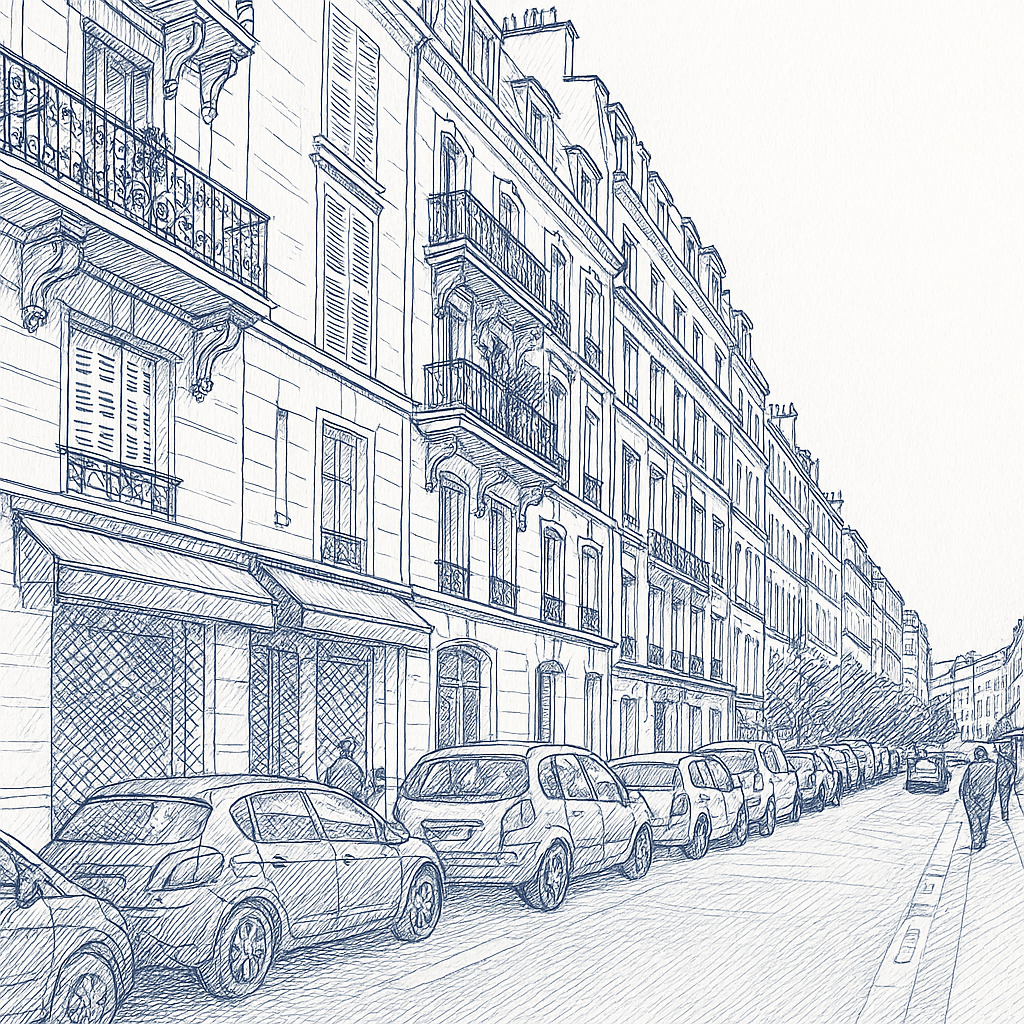
The architecture of Rue de l'Université is marked by the enduring presence of eighteenth-century classical style. The mansions, built between courtyard and garden according to the distributive principle dear to the aristocratic architecture of the time, present sober façades punctuated by tall small-paned windows, wrought-iron balconies, and rusticated portals topped with a pediment. The carriage porches, often impressive, open onto paved courtyards where miniaturized French-style gardens sometimes remain. The nineteenth century completed this ensemble with a few Haussmannian rental buildings, respectful of the scale and sobriety of the neighborhood. The entire street is today protected as the surroundings of historic monuments, guaranteeing the preservation of these exceptional façades and proportions, rare in the contemporary Parisian fabric.
Neighborhood life
Neighborhood life on Rue de l'Université is marked by discreet elegance, almost silent outside office hours. In the morning, officials, diplomats, and Sciences Po students converge toward their respective institutions, while a few elegant cafés welcome a hurried clientele. In the afternoon, the street regains a calm conducive to strolling, between majestic façades and gardens glimpsed behind gates. In the evening, a few gastronomic restaurants and chic bistros, nestled in the adjacent streets of Boulevard Saint-Germain, take over. The proximity of the Musée d'Orsay, the Palais Bourbon, and the Seine embankments gives this area a first-rate touristic and cultural appeal. The Assemblée Nationale, Solférino, and Rue du Bac metro stations allow quick access to the rest of the capital. The neighborhood's population, mainly composed of affluent families, diplomats, and senior officials, contributes to the street's hushed and polished atmosphere.
Real estate market
The real estate market on Rue de l'Université ranks among the most prestigious on the Left Bank, catering to a wealthy international clientele, diplomatic or from the senior civil service and professionals. Available properties are rare, mainly large family apartments in former divided mansions, with exceptional ceiling heights, original moldings, and marble fireplaces. Garden-level apartments opening onto a courtyard or private garden are particularly sought after and rarely put on the market. Prices per square meter are as follows: between 14,000 and 15,500 euros for a standard property to be renovated, between 16,500 and 19,000 euros for a high-end renovated apartment, and above 21,000 euros, reaching up to 25,000 euros or more, for an exceptional property such as a noble floor of a mansion with a private garden. The rarity of transactions and strong international demand result in variable marketing times, often two to four months for the most exceptional properties, the time needed to find a buyer matching the prestige of the property.
Conclusion
Rue de l'Université remains one of the most prestigious addresses in the Faubourg Saint-Germain, combining exceptional architectural heritage with immediate proximity to the seats of power. A street for an international and diplomatic clientele, in search of discretion, history, and a living environment of rare elegance.
Thomas Herremans