
Rue de Lévis
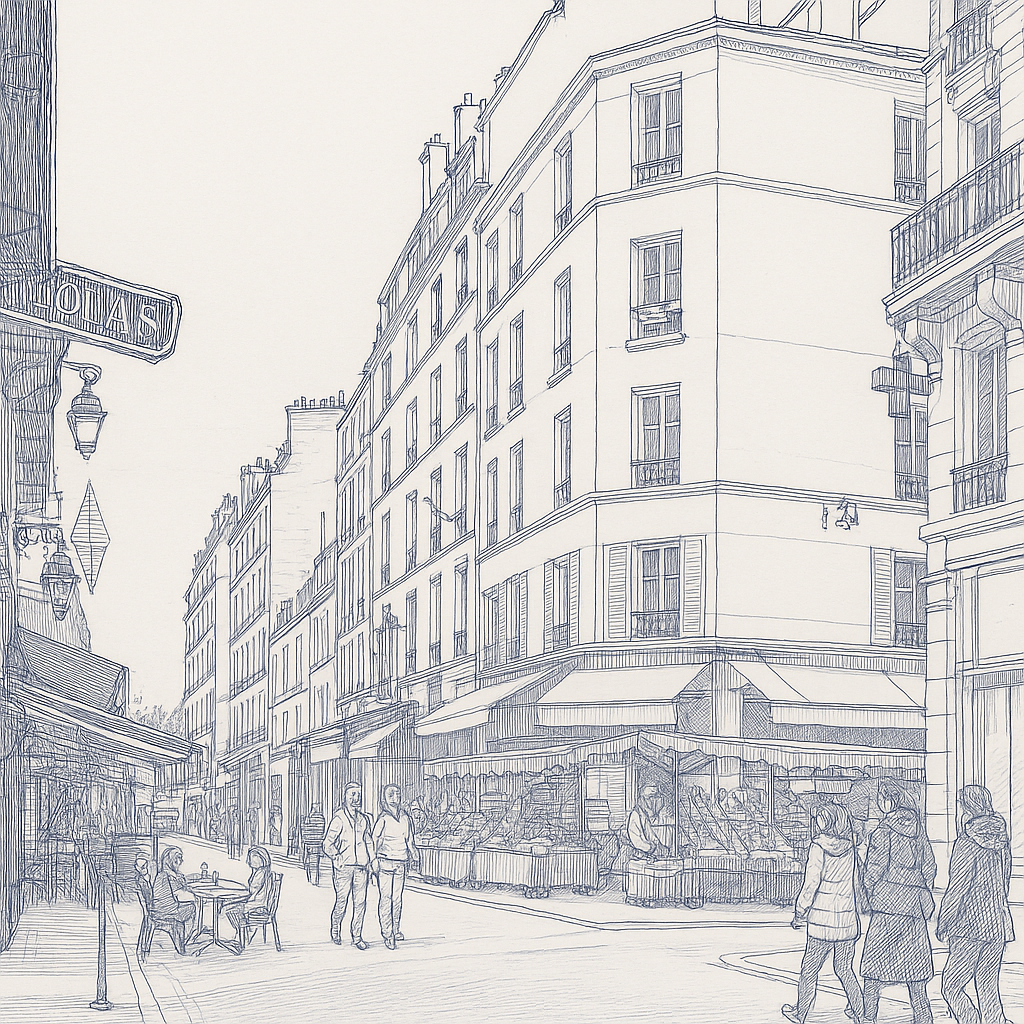
In the 17th arrondissement, between Parc Monceau and Place de Wagram, Rue de Lévis stands out as one of the liveliest and most authentic shopping streets in western Paris. Partially pedestrianized, it unfolds its colorful stalls, gourmet storefronts, and daily market each morning, drawing both local residents and food lovers from further afield. Unlike the calm, bourgeois avenues surrounding it, Rue de Lévis buzzes with constant activity, blending traditional food shops with more contemporary establishments. This commercial vibrancy, combined with an elegant residential setting, gives the street the identity of a 'village within the city', particularly prized by families and lovers of the French art de vivre.
The history of Rue de Lévis dates back to the 19th century, a period during which the Batignolles-Monceau district developed rapidly following the annexation of the Batignolles-Monceau commune to Paris in 1860. The street takes its name from the illustrious Lévis family, a distinguished lineage of French nobility, several members of which distinguished themselves in the kingdom's military and political history, notably Marshal François-Gaston de Lévis, a comrade-in-arms of Montcalm during the Seven Years' War in North America. The development of the Monceau district, championed by Baron Haussmann and driven by developers such as the Pereire brothers, rapidly transformed this previously rural area into an affluent residential neighborhood, intended for the Parisian bourgeoisie seeking space and greenery near the newly landscaped Parc Monceau. Rue de Lévis naturally became the commercial artery of this new upscale district, a role it has never ceased to play since. From the early 20th century, it hosted a renowned food market, which survives today as a semi-pedestrian market street, offering greengrocers, cheesemongers, fishmongers, and renowned bakers.
Architecturally, Rue de Lévis features typically Haussmannian and post-Haussmannian buildings, built mostly between 1860 and 1900: cut-stone façades, continuous balconies, zinc roofs, and elegant wrought-iron window guards. The commercial ground floors, with their sometimes old, carefully preserved storefronts, add a picturesque charm to the whole, pleasantly contrasting with the rigor of the upper floors.
Neighborhood life on Rue de Lévis revolves largely around its daily market, particularly busy on Wednesday, Friday, and Sunday mornings. Cheesemongers, wine merchants, quality butchers, and greengrocers line up in succession, forming a commercial ensemble much sought after by residents of the 17th arrondissement. The street's cafés and restaurants welcome a loyal clientele, family-oriented on weekends and more hurried during the week. The proximity of Parc Monceau offers a precious green space, while the Villiers and Monceau metro stations (lines 2 and 3) ensure excellent connections to central Paris.
The real estate market on Rue de Lévis mainly attracts affluent families and senior executives, drawn by the 'village' lifestyle just steps from Parc Monceau. Properties on offer are mostly family apartments of three to five rooms, located in Haussmannian buildings with elevators, featuring moldings, parquet floors, and original fireplaces in the finest examples. Prices per square meter break down as follows: standard properties between €10,000 and €11,200/m², high-end renovated properties between €11,500 and €12,800/m², and exceptional properties—a through-apartment with a view of Parc Monceau or a top floor with a terrace—between €13,200 and €14,800/m². Demand remains strong, with marketing times generally between two and three months for the best-positioned properties.
Ultimately, Rue de Lévis embodies an authentic Parisian art de vivre, between its daily market and residential elegance. It will particularly appeal to families seeking a lively, reassuring, and gourmet neighborhood, just steps from green spaces and the major thoroughfares of western Paris.
Thomas Herremans