
Rue de Monceau — Where Parisian Elegance Whispers Softly
Introduction
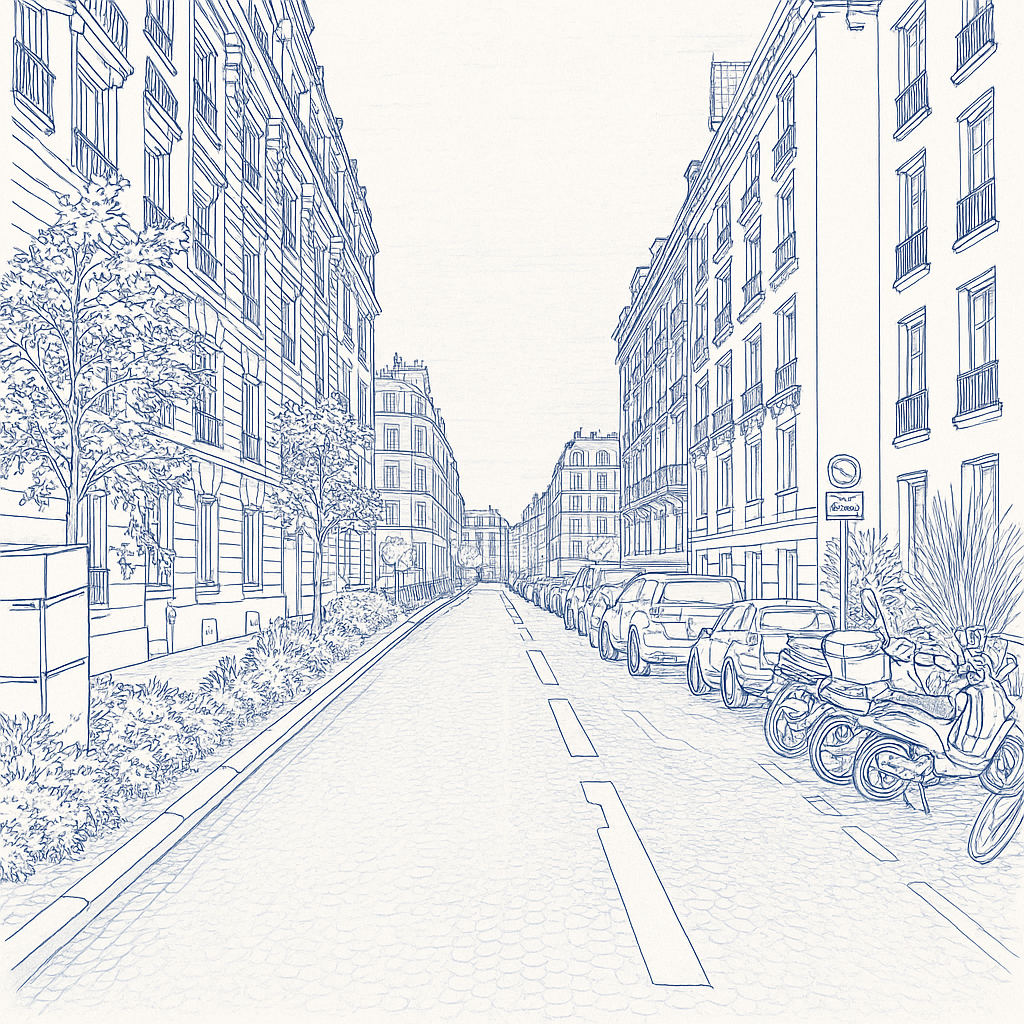
Rue de Monceau unfurls its straight, discreet course through the heart of the 8th arrondissement, running between Boulevard Malesherbes and the immediate surroundings of Parc Monceau, from which it borrows both its name and, in a sense, its spirit. Here one finds no flashy shopfronts nor tourist crowds: Rue de Monceau cultivates a hushed elegance, that of the great industrial and financial bourgeois families who shaped it at the end of the nineteenth century. The honey-coloured stone façades, the carriage porches, the wrought-iron gates all tell a story of fortune and refinement that continues today in the muffled silence of its pavements. Unlike the nearby Rue de Courcelles, more commercial in character, or Boulevard Malesherbes, busier with traffic, Rue de Monceau retains an almost exclusively residential vocation, sought after by an international clientele in search of discretion and exceptional architectural heritage, just steps from the leafy groves of Parc Monceau.
History
The street's name refers to the hamlet of Monceau (or Mousseaux), a former village that once stretched outside the walls of Paris, to the northwest of the capital, before being gradually absorbed by urban expansion under the Second Empire. The « Plaine Monceau », as it was then called, was a territory of market gardens and aristocratic follies, the most famous of which remains Parc Monceau itself, laid out as early as 1769 by the Duke of Chartres (the future Philippe Égalité) according to plans by the painter and designer Louis Carrogis, known as Carmontelle, later remodelled by Baron Haussmann and the engineer Alphand in the nineteenth century. Rue de Monceau as we know it today took shape in the wake of this development, at a time when the neighbourhood became the chosen ground of the great Jewish and Protestant Parisian bourgeoisie—merchants, bankers and art collectors who commissioned sumptuous private mansions here. The name Camondo remains inseparable from this street: it was at number 63 that Count Moïse de Camondo had built, between 1911 and 1914, the mansion that today houses the Musée Nissim de Camondo, a tribute to his son who died during the First World War, and a genuine showcase of eighteenth-century French taste. Not far away, the Cernuschi family also left its mark on the neighbourhood, as did the Ephrussi family, whose story was immortalised by Edmund de Waal in « The Hare with Amber Eyes ». The street thus saw artists, patrons and senior state officials mingle, in a neighbourhood that embodied, during the Belle Époque, the social success and aesthetic refinement of a triumphant bourgeoisie. Several private mansions have since been converted into embassies, foundations or institutional headquarters, perpetuating the prestigious vocation of the address.
Architecture
The architecture of Rue de Monceau consistently illustrates the neoclassical and eclectic vocabulary favoured by the bourgeoisie of the Second Empire and the Third Republic. Here one finds genuine freestanding private mansions, set back from the street behind a courtyard of honour or a garden, their façades punctuated by pilasters, wrought-iron continuous balconies and sculpted pediments, as well as fine Haussmannian rental buildings, built of light-coloured cut stone, with their Mansard-style zinc roofs, elaborate ironwork and generous ceiling heights. Stone dominates overwhelmingly, in the warm hue characteristic of Parisian limestone, enhanced by discreet sculptures around carriage doors and dormer windows. The Musée Nissim de Camondo is in itself a lesson in eighteenth-century architecture reinterpreted in the early twentieth century, with its façade inspired by the Petit Trianon. The whole street bears witness to an urbanism designed for social representation, where every façade was meant to signal its patron's success without ever lapsing into vulgar ostentation.
Neighbourhood life
Rue de Monceau lives at the peaceful pace of an upscale residential neighbourhood. In the morning, the pavements see the passage of children from nearby private schools and household staff heading to market; in the afternoon, calm returns, barely disturbed by a few strollers heading towards the nearby Parc Monceau, a haven of greenery prized for its shaded paths, its colonnade and its rotunda. Shops are rare and carefully chosen: a few renowned bakeries, art galleries, antique dealers who perpetuate the neighbourhood's aesthetic tradition. For everyday shopping, residents turn to Rue de Lévis, a lively market street just steps away, or to Boulevard Malesherbes with its more varied shops. Transport links are excellent: the Monceau (line 2) and Villiers (lines 2 and 3) metro stations flank the street, offering quick access to Étoile, Saint-Lazare or the Grands Boulevards. The population consists of well-off families, diplomats housed in nearby embassies, and an international clientele particularly sensitive to the neighbourhood's exceptional heritage setting.
Real estate market
The real estate market on Rue de Monceau ranks among the highest in the capital, in keeping with its heritage reputation. The properties on offer are mainly large family apartments, located on the upper floors of Haussmannian buildings, with mouldings, herringbone parquet floors, marble fireplaces and double through-reception rooms sometimes overlooking Parc Monceau. More rarely, one also finds entire private mansions or portions of mansions converted into very high-end apartments, with private gardens or interior courtyards. Prices per square metre break down as follows: for a standard property requiring refreshing works, expect between €11,000 and €12,500 per square metre; for a renovated high-end apartment with refined finishes, prices range between €13,500 and €15,500 per square metre; for exceptional properties—large apartments with park views, noble floors of private mansions, or properties with private gardens—transactions can reach €17,000 to €19,000 per square metre, or even more for unique configurations. Demand comes from an international, often family-oriented clientele seeking discretion, security and authentic architectural heritage. Marketing periods remain short for quality properties, generally between two and four months.
Conclusion
Rue de Monceau consistently embodies the French art of living as shaped by the great bourgeoisie of the Belle Époque, amid sumptuous private mansions and exceptional Haussmannian buildings. Its residential calm, its immediate proximity to Parc Monceau and its remarkable architectural heritage make it a top-choice address for a wealthy, international clientele seeking a prestigious and discreet living environment. It is aimed above all at well-off families, collectors and lovers of Parisian history, eager to inhabit a living piece of French heritage.
Thomas Herremans