
Rue de Rome — Where Haussmannian elegance meets the world's heartbeat of sound
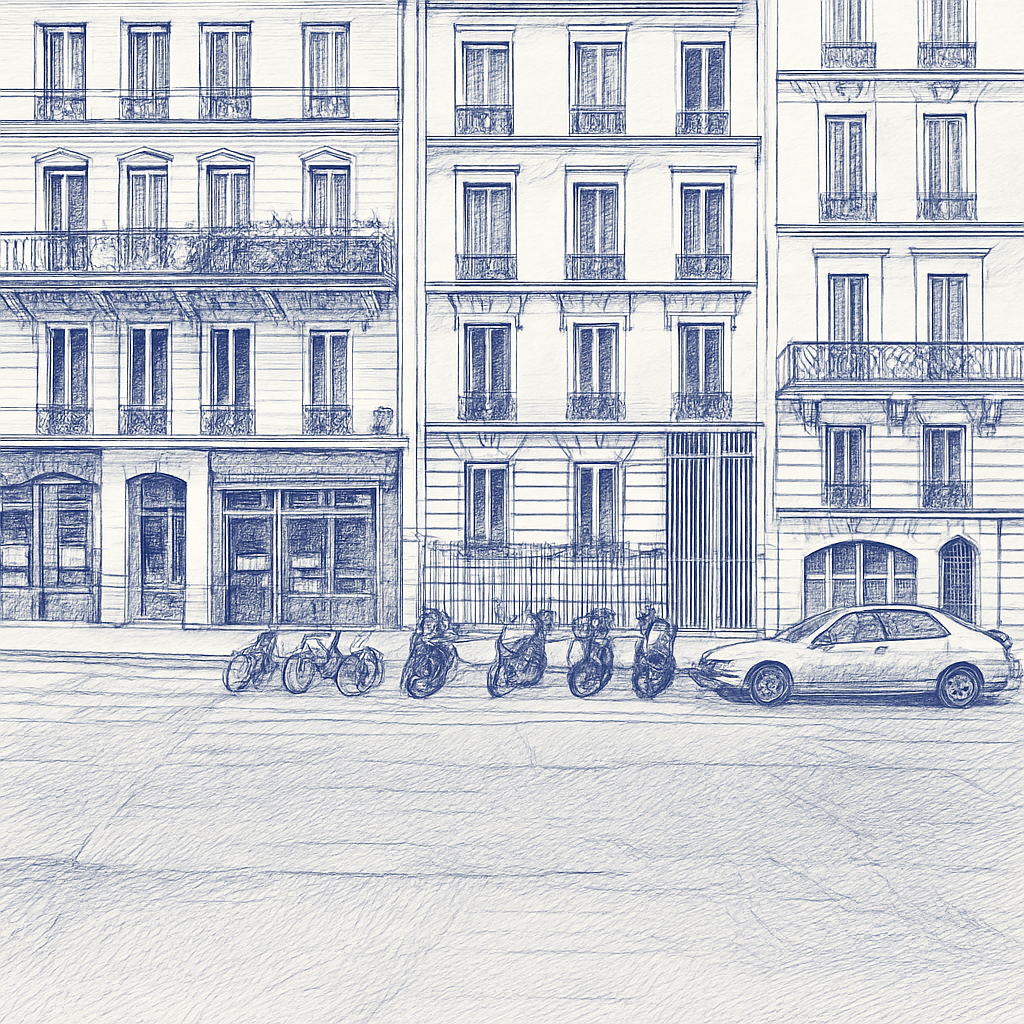
Rue de Rome runs through the eighth arrondissement along a north-south axis linking the edges of Parc Monceau to Gare Saint-Lazare, offering a dual character made up of elegant Haussmannian residential living and commercial effervescence around a specialty that has earned it worldwide renown: instrument-making and the musical instrument trade. A long, straight street, it crosses several distinct atmospheres depending on the section, from the residential calm near Parc Monceau to the more urban bustle near the station. This diversity gives it a complex personality, appreciated both by families seeking large Haussmannian apartments and by musicians from around the world coming to find a rare instrument or have their violin repaired in one of the historic workshops lining the street.
Rue de Rome was pierced in the mid-nineteenth century as part of the great urbanisation plan for the Europe district, conceived under the impetus of the Compagnie du chemin de fer de Saint-Germain and the great Haussmannian works. Like many streets in this area, it owes its name to a European capital, echoing the streets of London, Vienna, Moscow or Milan that make up the Europe district, laid out in a star pattern around the square of the same name. From the moment it was opened, Rue de Rome attracted a bourgeois population settling into the new Haussmannian buildings, taking advantage of the proximity to Gare Saint-Lazare, then one of the busiest in the capital. The street's specialisation in the musical instrument trade dates back to the late nineteenth century, when several piano makers and luthiers settled in the neighbourhood to take advantage of the surrounding bourgeois clientele and the proximity of the national music conservatory, then located nearby. This musical vocation has continued to strengthen throughout the twentieth century, making Rue de Rome a world reference for professional and amateur musicians seeking quality instruments, rare sheet music or expert repairs. Several century-old houses still perpetuate this know-how today, some having advised and equipped generations of international virtuosos. The street has also retained its bourgeois residential character in the section near Parc Monceau, where several exceptional buildings testify to the prosperity of the Europe district at the turn of the twentieth century.
The architecture of Rue de Rome perfectly illustrates Haussmannian style at its most accomplished, with buildings constructed between 1860 and 1900 featuring cut-stone façades, continuous balconies on the second and fifth floors, and characteristic mansard zinc roofs. Some buildings closer to Gare Saint-Lazare display a more commercial architecture, with widely glazed ground floors adapted to musical instrument shops. The regularity of the alignment and the quality of the built fabric testify to the rigorous planning of the Europe district.
The neighbourhood life of Rue de Rome is punctuated by the street's dual vocation: in the morning and afternoon, luthier and piano-maker shops welcome a specialised clientele from around the world, while the vicinity of Gare Saint-Lazare generates a constant flow of travellers and commuters. The section near Parc Monceau, on the other hand, regains a residential calm favourable to families, who make use of the nearby park for outdoor activities. Transport links are exceptional, with Gare Saint-Lazare offering connections to numerous metro lines, RER and suburban trains.
The real estate market of Rue de Rome attracts a mixed clientele, family-oriented in its northern section near Parc Monceau, more mixed with investors in its southern section near the station. Properties on offer range from large Haussmannian family apartments to more modest surfaces suited to rental investors. Standard prices range from €10,500 to €11,800 per square metre for a property requiring renovation, between €12,500 and €14,000 for a high-end renovated apartment, and can reach €15,500 to €16,500 per square metre for an exceptional noble floor near Parc Monceau with an unobstructed view. Marketing periods vary by section, faster near Parc Monceau, slightly longer near the station, generally ranging between five and ten weeks.
Rue de Rome embodies a dual-faced Haussmannian Paris, between residential quietude and internationally recognised musical effervescence. It appeals equally to families seeking a classic bourgeois setting and to music lovers and professionals from around the world drawn by its unique instrument-making expertise.
Thomas Herremans