
Rue de Tocqueville — Where Parisian refinement meets serene elegance
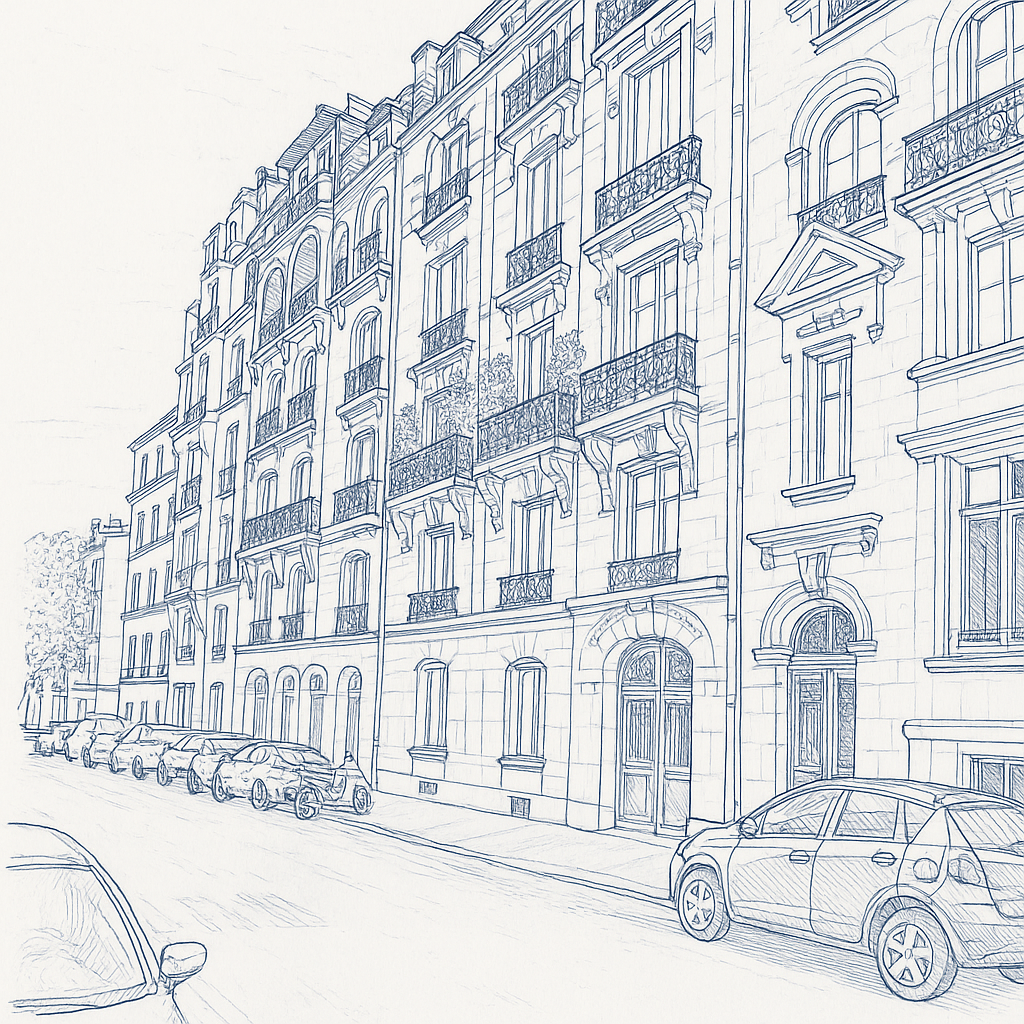
In the chic and peaceful Plaine Monceau district, at the heart of the 17th arrondissement, Rue de Tocqueville stretches its elegant length between Boulevard Malesherbes and Rue de Prony. Over eight hundred meters long, it crosses one of the most sought-after residential sectors on the Right Bank, in immediate proximity to Parc Monceau, that green jewel prized by the Parisian upper bourgeoisie since the Second Empire. Rue de Tocqueville stands out for its remarkable calm, architectural coherence, and almost provincial atmosphere, rare in this dense Paris. Unlike neighboring commercial thoroughfares, it favors a residential function, offering its inhabitants precious tranquility while remaining just minutes from the major arteries and shops of the neighborhood. It is an emblematic address for families seeking discretion, space, and an elegant living environment.
The history of Rue de Tocqueville is fully part of the grand urbanization project of the Plaine Monceau, initiated under the Second Empire by Baron Haussmann and the Pereire brothers, visionary financiers who transformed this former area of market gardens and quarries into a prestigious residential district intended for the rising business bourgeoisie. The street was cut through in the 1860s and bears the name of Alexis de Tocqueville, the illustrious French political thinker, author of 'Democracy in America,' a foundational work of modern political thought, and a major figure in 19th-century intellectual and parliamentary life. This toponymic choice was no accident: in this new district designed to welcome an enlightened elite, urban planners favored the names of great thinkers, scientists, and statesmen, as seen in the neighboring streets dedicated to Prony, the engineer, or Fortuny, the painter. Rue de Tocqueville developed rapidly in the decades following its opening, attracting wealthy industrialists, bankers, and senior civil servants who had sumptuous private mansions and grand rental buildings constructed. Throughout the 20th century, the street retained this upscale residential vocation, largely escaping the major commercial transformations experienced by other Parisian neighborhoods. It remains today one of the most representative streets of this bourgeois Second Empire Paris, carefully preserved by generations of owners mindful of its architectural heritage.
The architecture of Rue de Tocqueville illustrates with remarkable homogeneity the Haussmannian style in its most accomplished form. The buildings, constructed primarily between 1865 and 1890, feature honey-colored cut-stone façades, punctuated by continuous wrought-iron balconies on the second and fifth floors, sculpted cornices, and zinc roofs with the characteristic slope, adorned with elegant dormer windows. The carriage doors, often monumental, open onto entrance halls with carefully crafted decor: marble, beveled mirrors, decorative ironwork, and sometimes period elevators preserved with their ornate wrought-iron cages. A few private mansions still remain, witnesses to the district's original vocation, with their carved stone façades and discreet interior gardens. The apartments within these buildings generally offer beautiful ceiling heights, refined moldings, carved marble fireplaces, and Hungarian point parquet flooring, all elements that attest to the care taken in these constructions intended for a demanding clientele.
Neighborhood life around Rue de Tocqueville is characterized by a rare tranquility, conducive to family life. In the morning, one mainly encounters residents heading toward the area's reputed schools, as well as toward Parc Monceau for a stroll before work. During the day, the street maintains a residential calm, punctuated by a few local shops: artisan bakeries, dry cleaners, pharmacies, and small fine grocers that meet residents' daily needs. Major chain stores and restaurants are concentrated instead on the nearby Boulevard Malesherbes and Avenue de Villiers, offering a varied choice just minutes away on foot. Transport access is excellent, with the Malesherbes and Wagram metro stations serving lines 3 and 2 respectively, complemented by several bus lines. Parc Monceau, the neighborhood's true green lung, is a major asset for families, offering playgrounds, shaded paths, and an atmosphere conducive to relaxation.
The real estate market on Rue de Tocqueville attracts a primarily family-oriented clientele, composed of senior executives, liberal professionals, and a significant proportion of international buyers drawn by the neighborhood's calm and prestige. Available properties are mostly large family apartments of 80 to 200 sqm, spread across high floors often offering beautiful natural light and, for the best-located buildings, a view over Parc Monceau. There are also a few duplexes and apartments with terraces in the most prestigious buildings. Prices per square meter are as follows: €10,800 to €11,800/sqm for a standard property requiring renovation; €12,800 to €14,000/sqm for a high-end renovated apartment with careful fittings; and up to €15,500 to €17,000/sqm for an exceptional property, a high floor with unobstructed park views or a dual-aspect apartment in a converted private mansion. Demand remains very strong, driven by the structural scarcity of supply and the constant attractiveness of the Monceau sector for affluent families. Marketing periods are generally short, one to three months for quality properties correctly priced.
In conclusion, Rue de Tocqueville elegantly embodies the spirit of bourgeois Second Empire Paris, preserved and cherished across generations. It primarily appeals to families seeking calm, space, and architectural prestige, in an exceptional living environment just steps from Parc Monceau.
Thomas Herremans