
Rue de Viarmes: The Circular Street Around the Bourse de Commerce and the Most Geometrically Perfect Address in the 1st Arrondissement
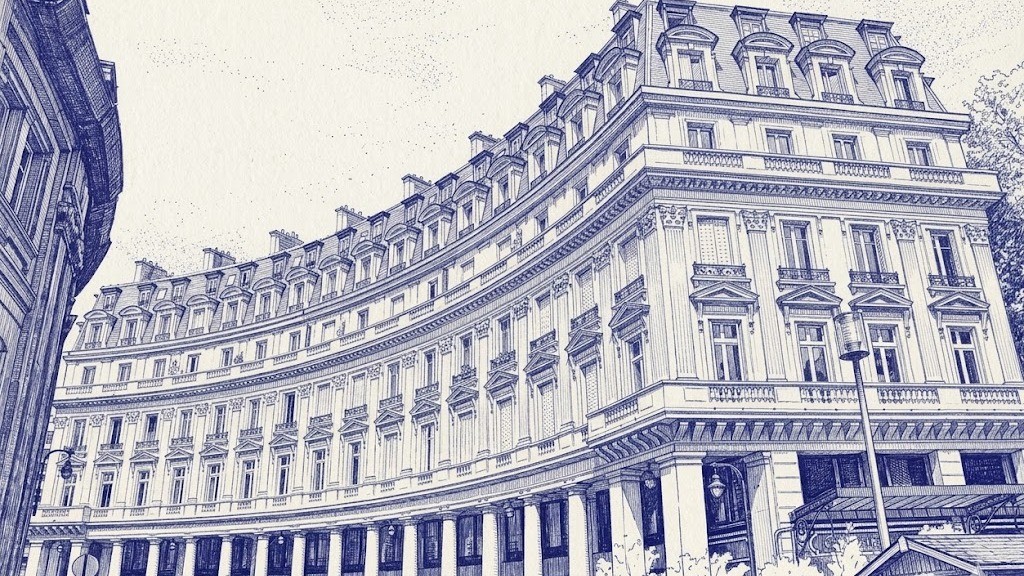
Rue de Viarmes holds a distinction entirely its own among the streets of the 1st arrondissement: it is a circular street, tracing the full circumference of the Bourse de Commerce building — the former grain market and now the home of the Pinault Collection — in a ring of approximately two hundred metres that makes it one of the most geometrically distinctive addresses in Paris. To walk along Rue de Viarmes is to walk in a circle around a building, an experience of urban geometry that is entirely without parallel in this part of the city.
The name derives from Charles Huchet de la Bédoyère, Comte de Viarmes, who served as Prévôt des Marchands — effectively the mayor of Paris — from 1758 to 1764 and was directly responsible for the construction of the Bourse au Blé, the great circular grain market that Rue de Viarmes encircles. His name was given to the street that rings the building he commissioned, creating a perfect symmetry between the administrator, his building and the street that orbits it.
1. The Bourse de Commerce and Its Extraordinary History
The Bourse de Commerce — whose circular form determines the circular form of Rue de Viarmes — was constructed between 1763 and 1769 to designs by Nicolas Le Camus de Mézières as a purpose-built grain market. Its circular form was adapted from ancient models and was ideal for a market where buyers and sellers could circulate continuously around the central display floor.
The building was subsequently given a pioneering cast-iron and glass dome designed by François-Joseph Bélanger — one of the most technically innovative structures in France, anticipating by decades the iron-and-glass architecture of the great railway stations. Most recently, it was converted into the home of the Pinault Collection by Tadao Ando, who inserted a new cylindrical drum of raw concrete within the historic circular shell, creating one of the most discussed museum interiors in recent European architectural history.
2. The Geometry of the Street
The experience of walking along Rue de Viarmes is unlike any other street experience in the 1st arrondissement. The street curves continuously, following the circumference of the building at its centre. This geometric specificity gives the address an identity that is immediately recognisable and entirely its own — a street not simply on a block but in a figure-and-ground relationship of unusual intimacy with its landmark building.
3. Urban Context
Rue de Viarmes forms a complete circle around the Bourse de Commerce building in the 1st arrondissement, with connections to the Rue du Louvre and the Rue Coquillière. The street is served by the Châtelet-Les Halles and Louvre-Rivoli metro stations.
4. The Residential Market and Property Prices
The residential market is shaped by the extraordinary proximity to the Pinault Collection and the geometric uniqueness of the address:
- €15,000 to €19,000 per m² for standard apartments on the outer ring
- €19,000 to €24,000 per m² for renovated properties with quality finishes
- €24,000 per m² and above for exceptional properties with views of the Bourse dome
Rue de Viarmes is the only circular street in this area of central Paris — a street whose geometry is determined entirely by the building it encircles, and whose history connects the eighteenth-century grain trade, the nineteenth-century commodity exchange and the twenty-first-century art museum in a single continuous address in the 1st arrondissement.
Thomas Herremans