
Rue des Rosiers — Where History Whispers Through Cobblestones
Introduction
In the heart of the Marais, in the 4th arrondissement, Rue des Rosiers winds between Rue Vieille-du-Temple and Rue Pavée over roughly three hundred meters that concentrate a rare intensity. Largely pedestrian though not entirely closed to traffic, it lives to the rhythm of a dual identity: that of Paris's historic Jewish quarter, with its synagogues, kosher grocery stores and famous falafel stands, and that of a Marais that has become one of the capital's most sought-after and most visited neighborhoods. Unlike its more residential neighbors such as Rue Pavée or Rue du Roi-de-Sicile, Rue des Rosiers embraces an assertive, almost theatrical commercial vocation, where tourists, longtime residents and neo-Parisians in search of authenticity cross paths. This street is a concentrate of living history, a space where communal memory coexists with fashion and street food, making it an address unlike any other in the Parisian landscape.
History
The name Rue des Rosiers dates back to the 13th century and derives from the wild rose bushes that grew along the old ramparts of Philippe Auguste, a section of which ran precisely along this route. The street ranks among the oldest thoroughfares of the Marais, well predating the aristocratic urbanization of the neighborhood in the 17th century. From the Middle Ages onward it was integrated into the emerging urban fabric, but it was truly from the 19th century, with the arrival of successive waves of Jewish immigration��first Ashkenazi from Central and Eastern Europe, then Sephardic from North Africa after the independence movements of the 1960s—that the street acquired its highly distinctive identity. The neighborhood, nicknamed the "Pletzl" (the little square in Yiddish), became a cultural, religious and commercial hub of exceptional density. The synagogue on Rue Pavée, designed by architect Hector Guimard and completed in 1913, radiates over the immediate surroundings. Rue des Rosiers was also marked by tragedy: on August 9, 1982, an attack targeting the Jo Goldenberg restaurant, an emblematic institution of Ashkenazi gastronomy, killed six people and wounded twenty-two, an event that remains etched in the neighborhood's memory. Jo Goldenberg closed in 2006, but its sign remains in memory as a symbol of an era. Today the street continues to host communal institutions, specialized bookstores, traditional bakeries like the famous Boulangerie Sacha Finkelsztajn, while opening since the 2000s to fashion and ready-to-wear boutiques that have profoundly transformed its commercial face.
Architecture
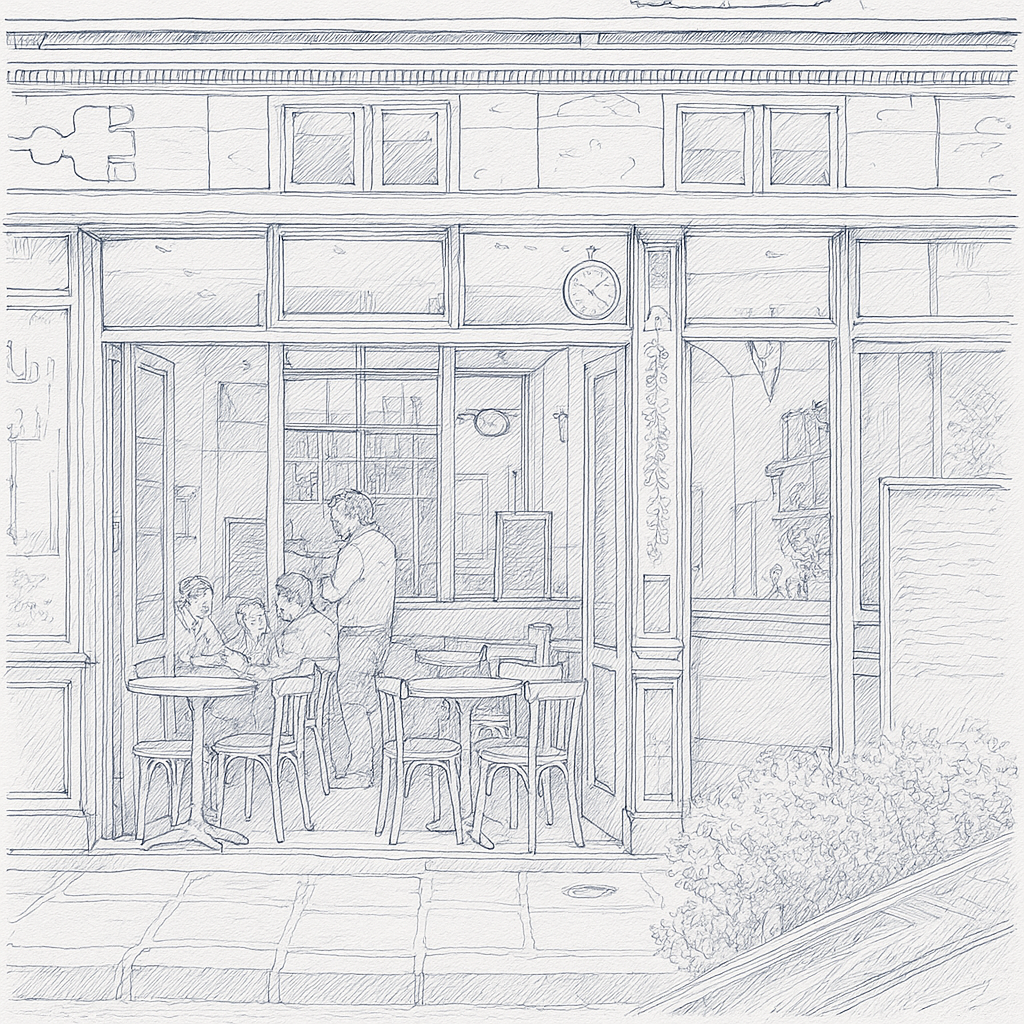
The architecture of Rue des Rosiers reflects the historical stratification of the Marais: low 17th- and 18th-century half-timbered buildings hidden beneath renderings, Louis XIII-style brick and stone facades, and a few later Haussmannian buildings in the immediate periphery. The street retains a narrow scale, with facades rarely exceeding four stories, which accentuates its intimate atmosphere and human scale. Some porches and interior courtyards reveal vestiges of medieval architecture, with exposed beams and spiral staircases. The commercial density at ground level, with its colorful storefronts and signage in Hebrew, French and sometimes English, creates a unique urban landscape where built heritage dialogues with contemporary storefront vitality.
Neighborhood life
From the late-morning opening of shops, Rue des Rosiers comes alive with the scents of falafel, pastrami and Middle Eastern pastries. The afternoon and early evening see a dense crowd flood in, a mix of international tourists, Marais families and young professionals shopping in the designer boutiques that have multiplied over the past fifteen years. On Fridays, as Shabbat approaches, the atmosphere becomes particular, with kosher shops closing earlier. Restaurants like L'As du Fallafel draw impressively long lines, while quieter cafés offer havens of calm. The Saint-Paul metro station, just steps away, provides efficient service, and the neighborhood benefits from the immediate proximity of Place des Vosges and the Musée Carnavalet.
Real estate market
The real estate market on Rue des Rosiers appeals to a very specific, often international clientele, seeking the authenticity of the historic Marais while accepting the street's intense commercial buzz. Available properties are mostly older apartments, mainly studios to two-bedroom units, nestled in characterful buildings with exposed beams, period fireplaces and old parquet flooring. Large family surfaces are rare, as the building typology favors small and medium sizes. Prices per square meter break down as follows: approximately €11,500 to €12,500/m² for a standard property requiring renovation, €13,500 to €15,000/m² for a renovated apartment with high-end finishes, and up to €17,000 to €19,000/m² for an exceptional property, dual-aspect, with an open view or remarkable architectural character. Demand remains supported by seasonal rental investors, the neighborhood being highly sought after for short-term rentals, as well as by foreign buyers drawn to the Marais's charm. Marketing periods are generally short, two to four months for properly priced properties.
Conclusion
Rue des Rosiers remains a place apart in the Parisian landscape, where communal history, painful memory and contemporary commercial vitality compose a living, endearing tableau. It will particularly appeal to lovers of authenticity, savvy investors and all those wishing to live at the beating heart of the historic Marais.
Thomas Herremans