
Rue du Faubourg du Temple — Where Paris pulses with authentic soul
Introduction
Rue du Faubourg du Temple traces a lively, multicoloured diagonal between Place de la République and the heights of Belleville, marking the shifting border between the 10th and 11th arrondissements. A working-class thoroughfare par excellence, it embodies a cosmopolitan, bubbling Paris, far from the Haussmannian splendour of the western neighbourhoods. Here, successive waves of immigration, craft workshops, exotic food shops and a creative youth drawn by still-affordable rents and the neighbourhood's nocturnal energy have always crossed paths. The street undulates from its lower, busy and commercial end, up to its higher, more residential section, where it joins the Belleville district and its legendary slopes. This gradient, rare in Paris, offers changing perspectives and contributes to the distinctive identity of this thoroughfare, which resembles no other.
History
The street's name recalls the former enclosure of the Temple, the Parisian seat of the Knights Templar and later the Hospitallers, whose domain once extended well beyond its current walls, as far as this road which constituted its extramural extension—hence the name « faubourg » (suburb). Historically, this street marked the exit from Paris towards the villages of Belleville and Ménilmontant, then independent of the capital and only annexed in 1860. As early as the eighteenth century, Rue du Faubourg du Temple developed as a commercial and artisanal axis, home to tanners, cabinetmakers and small businesses linked to the nearby Canal Saint-Martin, completed in 1825, which irrigated the neighbourhood with intense river activity. The nineteenth century saw the street densify sharply with rural exodus and the arrival of working-class populations, giving rise to a dense and close-knit social fabric, marked by social struggles: the street was one of the theatres of the barricades during the revolutions of 1830, 1848 and especially the Paris Commune of 1871, where the fighting was particularly fierce in this working-class neighbourhood. The twentieth century saw successive waves of migration, notably Armenian, then North African, Chinese and more recently West African, each leaving its commercial and cultural imprint on the street. The historic « Splendid » theatre, as well as former café-concerts, recall the intense popular and festive life that once animated this thoroughfare, nicknamed in the nineteenth century the poor man's « boulevard du Crime » for its many popular theatres, now disappeared.
Architecture
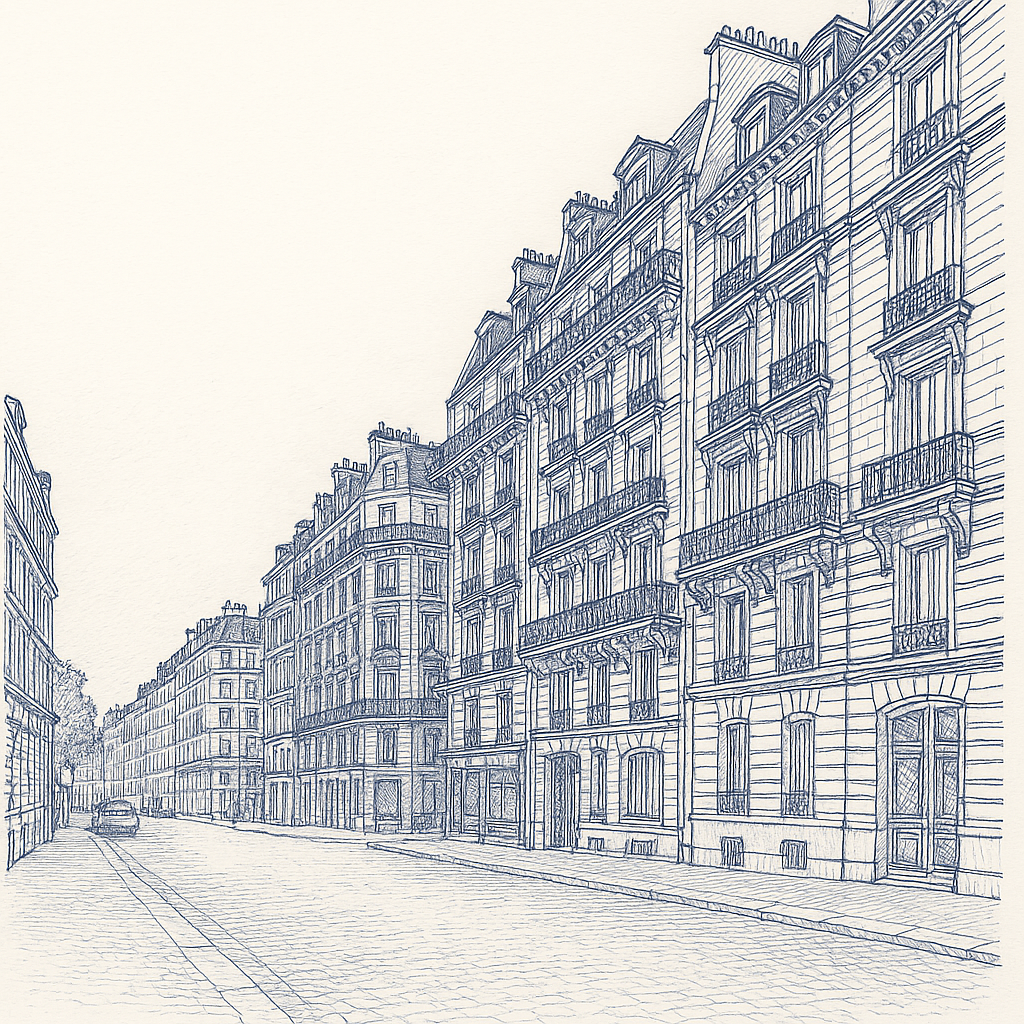
The architecture of Rue du Faubourg du Temple reflects its working-class history and gradual development rather than any concerted urban plan. One finds heterogeneous buildings here, mixing modest nineteenth-century structures with simple, functional façades, former workshops converted into lofts or shops, a few fine Haussmannian buildings in its lower section near République, and more recent constructions resulting from urban renewal in the 1960s-1980s. The interior courtyards, often hidden behind discreet porches, once housed carpentry, leather goods or costume jewellery workshops, activities some of which still persist today in the nearby Sentier district or the Passage du Faubourg-du-Temple. This architectural diversity, far from Haussmannian uniformity, gives the street a raw and authentic charm, particularly appreciated by a creative population seeking atypical spaces.
Neighbourhood life
Rue du Faubourg du Temple lives at a frenetic pace, day and night. From the morning, food shops open their doors: Turkish grocers, greengrocers, halal butchers, Chinese pastry shops make up a commercial landscape of rare diversity in Paris. In the afternoon, the street buzzes with activity around its numerous Afro hair salons and textile shops. In the evening, the upper part of the street, towards Belleville, transforms into a nightlife hub popular with young Parisians, with cocktail bars, fusion restaurants and trendy cafés that have benefited from the neighbourhood's gradual gentrification over the past decade. Public transport is abundant: République (lines 3, 5, 8, 9, 11), Goncourt (line 11), Belleville (lines 2 and 11) serve the street along its entire length. The Canal Saint-Martin, just steps away, offers a relaxation space appreciated by families and young professionals.
Real estate market
The real estate market on Rue du Faubourg du Temple has experienced sustained gentrification dynamics over the past fifteen years, driven by proximity to the Canal Saint-Martin and Place de la République. Available properties are varied: former workshops converted into lofts, family apartments in nineteenth-century buildings, studios for rental investors, but also a few exceptional properties in fully renovated buildings. Prices per square metre remain significantly lower than those of the historic centre. For a standard property requiring work, expect between €8,500 and €9,800 per square metre; for a renovated apartment with fine finishes, prices range between €10,200 and €11,800 per square metre; for exceptional properties, artists' lofts with high ceilings or apartments with terraces, transactions can reach €12,500 to €14,000 per square metre. Sale periods are generally fast, between one and three months.
Conclusion
Rue du Faubourg du Temple embodies a popular, cosmopolitan Paris undergoing rapid transformation, where the authenticity of the working-class past now rubs shoulders with bubbling urban creativity. It attracts a young, dynamic population open to the world, seeking a lively neighbourhood life and real estate potential still accessible compared to central Paris.
Thomas Herremans