
Rue du Faubourg Poissonnière — Where Industrial Heritage Meets Urban Refinement
Introduction
Straddling the 9th and 10th arrondissements, Rue du Faubourg Poissonnière connects the grand boulevards to Rue La Fayette, crossing a historic sector rich in contrasts, between diamond dealer workshops, bourgeois buildings, and repurposed industrial façades. This long thoroughfare, which extends Rue Poissonnière beyond the former walls of Paris, embodies an authentic suburban spirit, blending dense commercial life with quiet residential pockets. Less homogeneous than the streets of the Marais or the 16th arrondissement, Rue du Faubourg Poissonnière charms with its lively, working-class character, undergoing transformation over the past fifteen years, driven by the arrival of new shops, trendy restaurants, and a young, creative population.
History
Rue du Faubourg Poissonnière owes its name to its historic function as a route for transporting sea fish to the Paris markets, used by fish convoys from the Normandy and Picardy coasts as early as the Middle Ages. The term faubourg designates the extension of a street beyond the former fortifications of Paris, here beyond the Porte Poissonnière opened in the Farmers-General wall in the eighteenth century. From the seventeenth century, the street saw intense artisanal and commercial activity develop, reinforced in the nineteenth century by the establishment of numerous workshops linked to jewelry and diamond cutting, an activity that continues today in the area with the presence of several specialized houses, making this neighborhood one of the historic hubs of the diamond trade in Paris, alongside the nearby Rue La Fayette. The street was also marked by the presence of numerous theaters and performance venues in the nineteenth century, in the continuity of the animation of the nearby grand boulevards. The Rex, a famous Parisian performance hall and nightclub inaugurated in 1932 on Boulevard Poissonnière at the corner of the street, testifies to this festive and cultural vocation of the neighborhood, which continues today with its electronic music programming renowned throughout Europe. The neighborhood also experienced intense industrial and artisanal activity in the nineteenth and early twentieth centuries, with numerous garment workshops and small industries installed in the inner courtyards of the street, an activity that gave way, from the 1990s onward, to a progressive conversion toward housing and offices for new creative companies.
Architecture
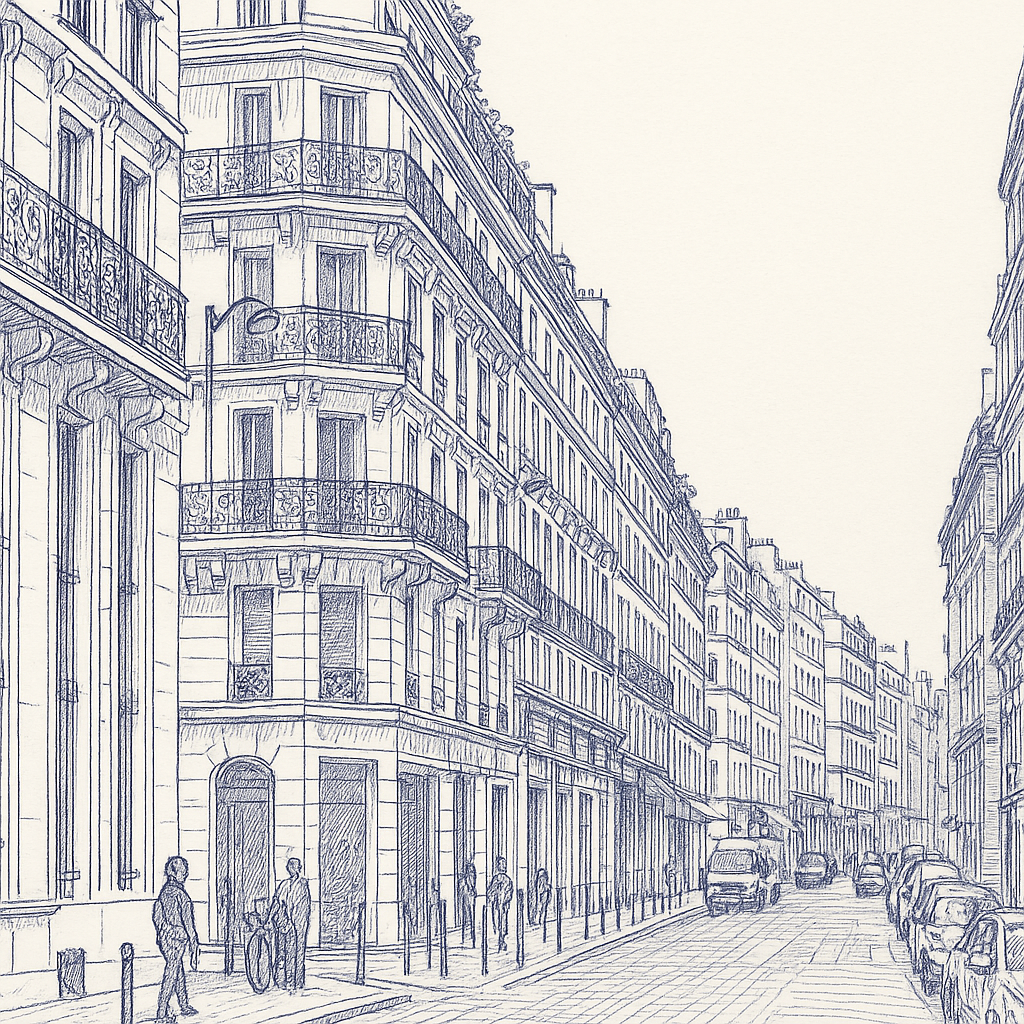
The architecture of Rue du Faubourg Poissonnière offers a heterogeneous ensemble representative of its suburban and commercial history. The buildings, built mostly between the eighteenth and nineteenth centuries, present varied façades, ranging from modest constructions in millstone and brick inherited from the pre-Haussmannian period to more classic rental buildings in cut stone, with running balconies and mansard roofs. Several inner courtyards, formerly occupied by artisan workshops, have been converted into residential spaces or lofts prized by a creative clientele seeking industrial authenticity. The Rex, with its emblematic Art Deco façade designed by architect John Eberson, constitutes a major architectural landmark in the area, testifying to the exuberant style of interwar performance halls.
Neighborhood life
Neighborhood life on Rue du Faubourg Poissonnière is dense and contrasted, reflecting the sociological diversity of the area. In the morning, diamond dealer workshops and wholesale businesses open their discreet doors, while traditional cafés and bakeries welcome a clientele of regulars. In the afternoon, the street comes alive around its many food shops and new trendy dining spots, testifying to the neighborhood's ongoing gentrification. In the evening, the activity shifts toward the nearby grand boulevards and the Rex, which attracts a nighttime clientele from all over Paris for its renowned electronic music nights. The street enjoys privileged access to transport with the Poissonnière, Bonne Nouvelle, and Cadet metro stations in immediate proximity, as well as Gare de l'Est and Gare du Nord a few minutes' walk away, facilitating travel. The neighborhood's population, mixing long-established merchants, young professionals, and a significant international community linked to the diamond trade, gives the street a cosmopolitan and bustling atmosphere, typical of historic Parisian suburbs.
Real estate market
The real estate market on Rue du Faubourg Poissonnière attracts a varied clientele composed of young professionals, rental investors, and families seeking good value for money in a sector undergoing revaluation. Available properties are mostly two- to three-room apartments in old buildings, as well as a few lofts resulting from the conversion of former workshops, offering atypical volumes appreciated by a creative clientele. Prices per square meter are as follows: between 8,800 and 10,000 euros for a standard property to be renovated, between 10,800 and 12,200 euros for a high-end renovated apartment, and above 13,000 euros, reaching up to 14,500 euros, for an exceptional property such as a loft with a glass roof or a top floor with a terrace. The market shows upward dynamics driven by the progressive gentrification of the area, with average marketing times of four to six weeks for correctly presented and priced properties.
Conclusion
Rue du Faubourg Poissonnière embodies a working-class and commercial Paris in full conversion, between artisanal heritage and new creative life. A dynamic and still accessible address, ideal for investors and young buyers seeking authenticity and appreciation potential at the heart of a sector in full effervescence.
Thomas Herremans