
Rue du Faubourg Saint-Martin — Where Paris's pulse meets timeless elegance
Introduction
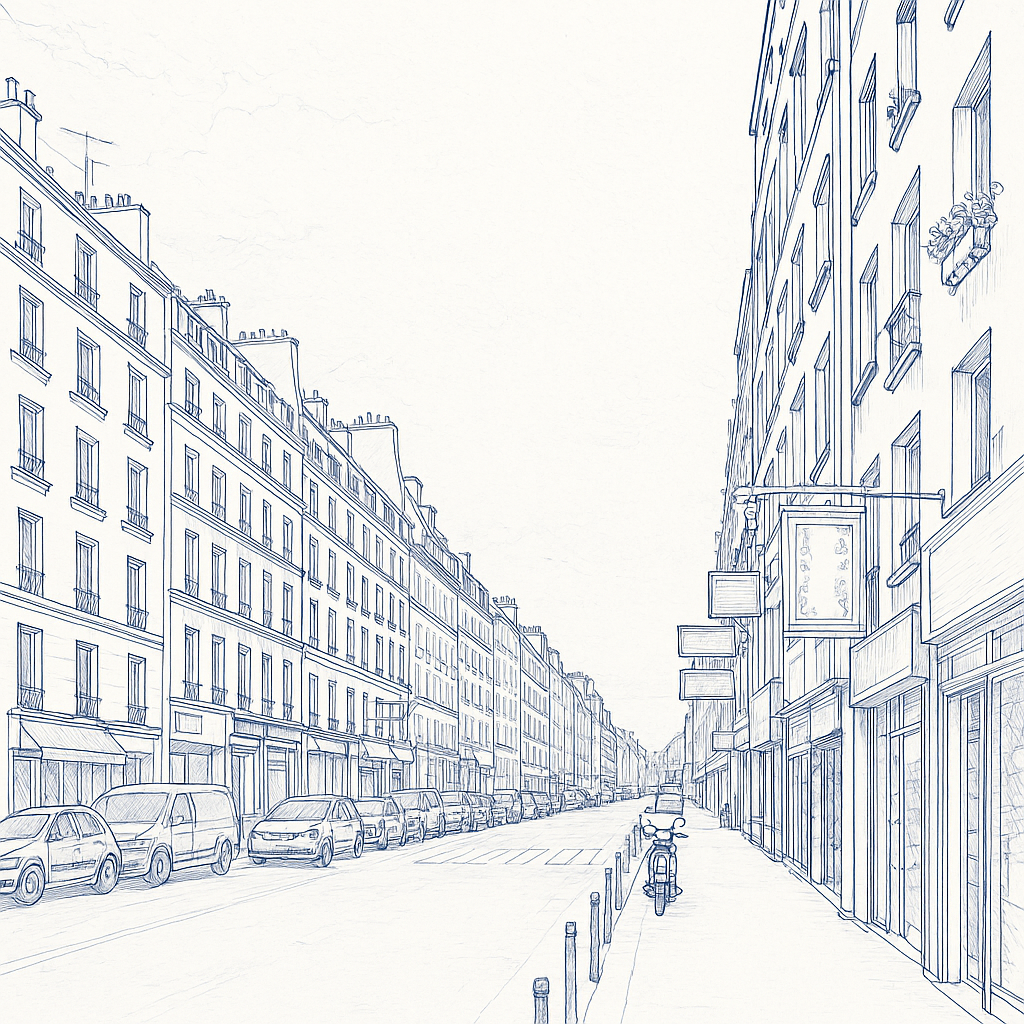
A long thoroughfare crossing the 10th arrondissement from north to south, Rue du Faubourg Saint-Martin historically extends Rue Saint-Martin beyond its former medieval gate. Connecting Place de la République to the Gare de l'Est and beyond, it crosses very diverse atmospheres, from the lively Porte Saint-Martin neighborhood to the more working-class areas near the station, passing through surprising residential sequences. Less upscale than the streets of the golden triangle, this long and lively street today attracts a cosmopolitan population and a new generation of Parisians seeking authenticity and urban diversity.
History
Rue du Faubourg Saint-Martin owes its name to its position as the extramural extension of Rue Saint-Martin, one of the oldest streets in Paris, itself named after the Abbey of Saint-Martin-des-Champs. As early as the Middle Ages, this thoroughfare was a major axis connecting Paris to the territories of the north and east, used by merchants and pilgrims heading toward the fairs of Champagne. The Porte Saint-Martin, a triumphal arch built in 1674 by François Blondel by order of Louis XIV to celebrate the king's military victories, still marks today the symbolic entrance to the street from the grands boulevards. The faubourg that developed beyond this gate welcomed, from the 17th century, a population of craftsmen and merchants, benefiting from lower taxes than intramural Paris. In the 19th century, the arrival of the railway and the construction of Gare de l'Est in 1849 profoundly transformed the neighborhood, drawing a considerable working-class and immigrant population, giving rise to a popular and cosmopolitan identity that persists today. The street also saw, throughout the 20th century, significant wholesale textile and leather goods trade develop, in connection with the nearby Sentier district. This commercial history has left numerous architectural traces, notably passages and inner courtyards once dedicated to merchandise storage.
Architecture
Rue du Faubourg Saint-Martin presents a highly varied built environment, reflecting its eventful history: 18th-century buildings at the entrance near Porte Saint-Martin, Haussmannian buildings in its central section, and more modest 19th- and early 20th-century constructions as one approaches Gare de l'Est. Several converted industrial complexes bear witness to the neighborhood's former commercial and textile vocation, with brick façades and large windows characteristic of former workshops.
Neighborhood life
Rue du Faubourg Saint-Martin lives at an intense urban pace, blending local shops, restaurants offering varied world cuisine, and lively nightlife around Porte Saint-Martin and the nearby Canal Saint-Martin district. The metro stations Château d'Eau, Strasbourg-Saint-Denis, and Gare de l'Est punctuate the street, offering exceptional service. The Canal Saint-Martin, a few hundred meters away, is a green lung and a highly prized living space for young professionals. The neighborhood's population is characterized by great social and cultural diversity, mixing long-established families, young professionals, and historically settled immigrant communities.
Real estate market
The real estate market on Rue du Faubourg Saint-Martin attracts a diverse clientele, from first-time buyers to rental investors, drawn by prices still accessible given the central location. Available properties range from studios intended for student rental investment to large family apartments in the Haussmannian buildings of the street's central section. Prices vary considerably depending on the section of the street, ranging from 7,800 to 9,000 euros per square meter for a standard property, between 9,500 and 11,000 euros for a high-end renovated apartment, and up to 12,500 euros per square meter for an exceptional property near Porte Saint-Martin or the canal. Demand has been clearly rising in recent years, driven by the progressive gentrification of the area and the growing appeal of the Canal Saint-Martin district, with average sale periods of six to ten weeks.
Conclusion
Rue du Faubourg Saint-Martin embodies a popular and cosmopolitan Paris undergoing profound change, where centuries-old commercial history and new residential appeal come together. It attracts a young and dynamic clientele, seeking a high-potential investment in a central yet still reasonably accessible area.
Thomas Herremans