
Rue du Temple
Introduction
Rue du Temple crosses the Marais from north to south, from Rue de Bretagne to Rue de Rivoli, spanning nearly a kilometer that alone condenses several centuries of Parisian history. Unlike the touristy streets of the historic Marais, Rue du Temple retains a more working-class, artisanal character, marked by the persistent presence of costume jewelry workshops, leather goods wholesalers and traditional shops that recall the neighborhood's working vocation before its gradual gentrification. This duality between exceptional architectural heritage and modest commercial activity gives the street a singular atmosphere, both authentic and in full transformation, where 17th-century buildings, family workshops and new generations of trendy shops progressively settling into its last available square meters all coexist.
History
The street's name comes from the Enclos du Temple, a vast fortified domain belonging to the Knights Templar, established as early as the 12th century on this territory then located outside the boundaries of Paris. After the dissolution of the Templar order in 1312, the domain passed into the hands of the Hospitallers, and over the centuries became a place of legal asylum where artisans and merchants escaping Parisian guild regulations took refuge, favoring the early development of dynamic economic activity in this sector.
The Tower of the Temple, the famous prison where Louis XVI, Marie-Antoinette and their children were held during the French Revolution before the king's execution in 1793, stood in the immediate vicinity of the street, before its complete destruction on Napoleon Bonaparte's orders in 1808, intent on erasing this site of royalist memory. The Square du Temple, laid out in the 19th century over the remains of the enclosure, perpetuates today the memory of this tumultuous past.
In the 19th century, Rue du Temple became a major hub of Parisian wholesale trade, particularly in costume jewelry, leather goods and toy manufacturing, activities that partly persist today in certain buildings. The Musée des Arts et Métiers, housed since 1802 in the former priory of Saint-Martin-des-Champs at the northern end of the street, testifies to the scientific and technical vocation this part of the Marais also developed, making Rue du Temple a unique crossroads between medieval religious heritage, revolutionary memory and nascent industrial modernity.
Architecture
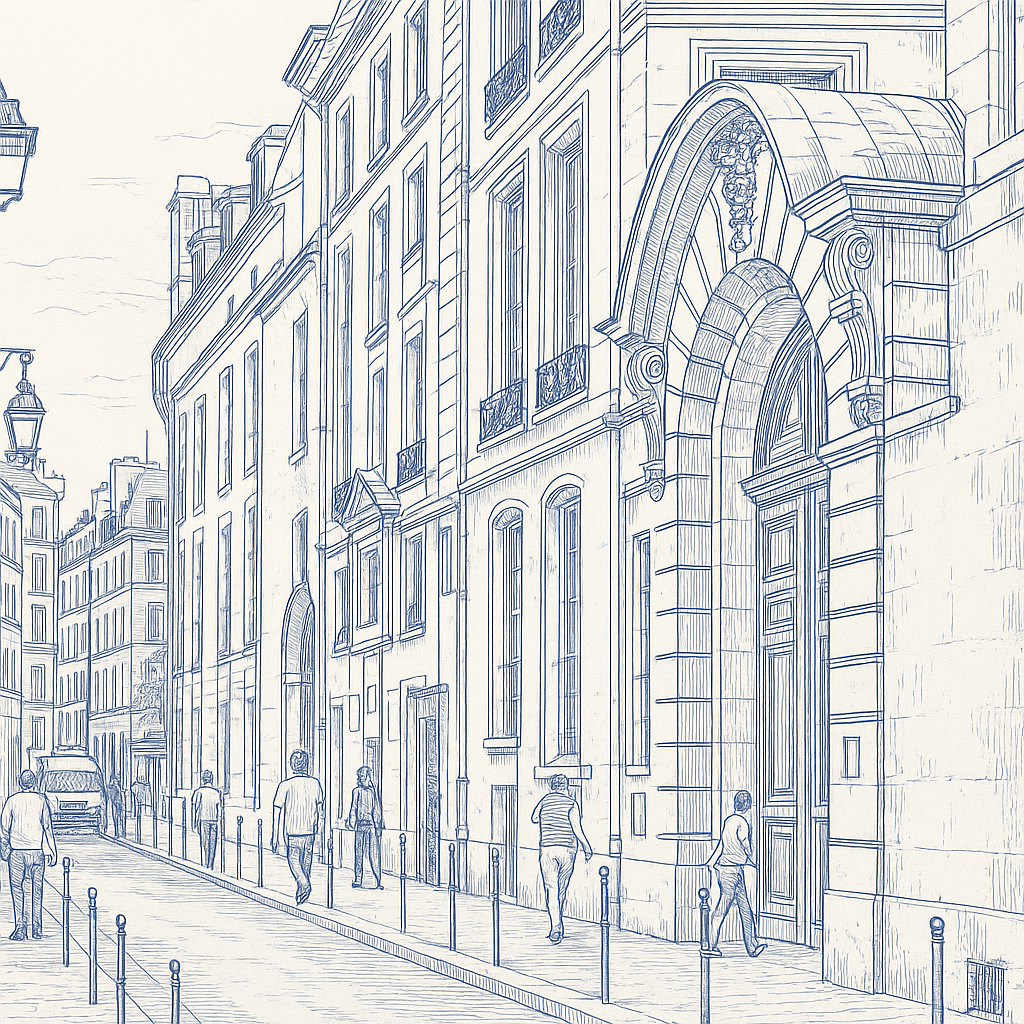
The architecture of Rue du Temple reflects remarkable stylistic diversity, mirroring its eventful history. A few 17th-century private mansions still stand, with classical façades and paved inner courtyards, particularly in its southern section near Rue de Rivoli. Most of the visible buildings, however, date from the 19th century, with stone rental buildings often converted at ground level to house workshops and wholesale shops, recognizable by their wide metal storefronts and period painted signage. A few early 20th-century industrial buildings, with brick façades and wide windows designed to light workshops, punctuate this diversity, offering today a loft-conversion potential particularly sought after by contemporary buyers.
Neighborhood Life
Rue du Temple still largely lives to the rhythm of wholesale trade during the day, with delivery vans and busy workshops, before transforming in the evening into a quieter sector, punctuated by bars and restaurants that benefit from the proximity of the upper Marais and its lively nights. Square du Temple, a green haven appreciated by neighborhood families, offers a welcome break amid the commercial bustle. The street is served by several metro stations, notably Temple, République and Rambuteau, ensuring exceptional accessibility to all of Paris. The neighborhood's population consists of a singular mix of long-standing artisans, recently settled young professionals, and long-time families, creating a social and generational diversity increasingly rare in the central Marais.
Real Estate Market
The real estate market on Rue du Temple attracts a diverse clientele, much like the street itself: young professionals and creatives drawn by the sector's still-authentic atmosphere, rental investors betting on the Marais's continuing appreciation potential, and a few families seeking large volumes at prices still reasonable compared to the historic heart of the district. Available properties are split between classic Haussmann-era apartments in 19th-century buildings and atypical lofts converted from former workshops, the latter particularly sought after for their generous volumes and exceptional natural light. Prices per square meter break down as follows: for a standard property requiring renovation, expect between €10,500 and €12,000; for a renovated apartment with refined finishes, the range sits between €13,000 and €15,000; and exceptional properties, notably artist lofts or apartments overlooking Square du Temple, can reach €16,000 to €18,000 per square meter. The recent trend shows accelerating demand for atypical properties, with marketing times steadily decreasing, now ranging between one and two months for the best-positioned properties.
Conclusion
A street with a complex and endearing identity, Rue du Temple embodies the historical and social richness of the Marais in all its diversity, between Templar memory, revolutionary remembrance and a still-vibrant artisanal vocation. It appeals to an increasingly broad population, from lovers of authentic heritage to savvy investors and creatives seeking atypical spaces. For those wishing to settle in the Marais without succumbing to the touristic museification of its most iconic streets, Rue du Temple offers a credible and promising alternative, whose appreciation potential remains, by all market logic, still substantial.
Thomas Herremans