
Rue du Temple: The Road to the Fortress, Two Thousand Years of Urban History and the Great North-South Axis of the Marais
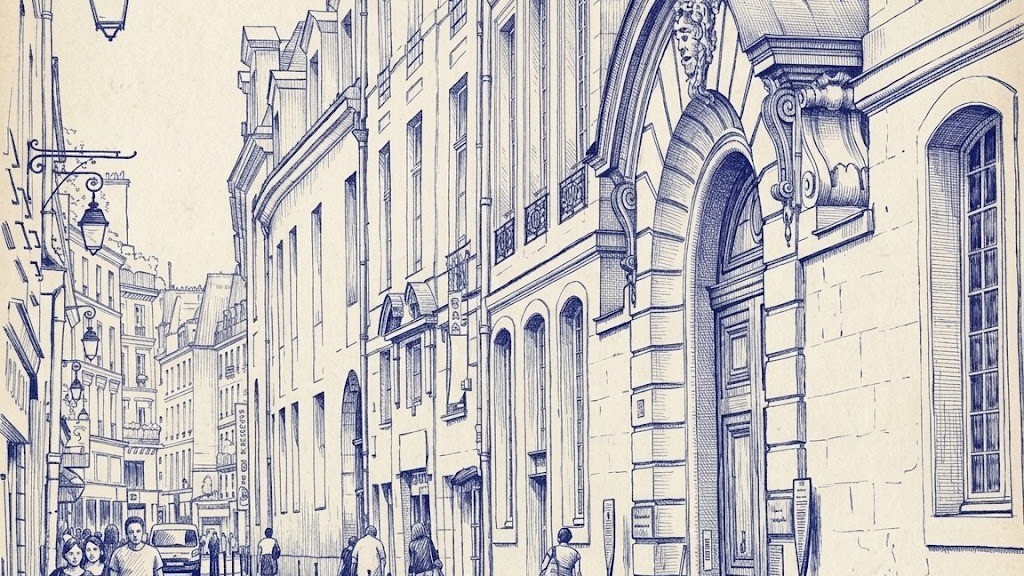
Rue du Temple is the oldest and most historically significant street in the 3rd arrondissement of Paris — a long, ancient north-south artery that has served as one of the principal routes through the Right Bank of the city since the Roman period, carrying in its name the memory of the most powerful and wealthy religious order of medieval France and connecting, along its considerable length, the heart of the Marais to the Grands Boulevards in the north and the Hôtel de Ville in the south.
The name refers to the Temple — the great fortress and headquarters of the Knights Templar that stood on the northern edge of the Marais from the twelfth century until its demolition in 1808. Founded in Jerusalem during the Crusades, the Templars returned to France with immense wealth and influence, establishing their Parisian headquarters on this site and creating a powerful religious, financial and military enclave that operated with considerable independence from both the crown and the church. The fate of the Order — dissolved by Philip IV in 1307, its leaders burned at the stake, its vast wealth confiscated — is one of the most dramatic episodes in medieval French history, and the fortress that gave this street its name was the setting for some of the most extraordinary events of that drama.
1. The Templars and Their Parisian Fortress
The Knights Templar — formally the Poor Fellow-Soldiers of Christ and of the Temple of Solomon — were founded in Jerusalem in 1119 as a military and religious order dedicated to the protection of Christian pilgrims in the Holy Land. Within decades of their foundation, the Templars had become one of the most powerful organisations in Europe: wealthy beyond any individual kingdom, financially sophisticated enough to have invented many of the instruments of modern banking, politically influential enough to challenge both popes and kings.
Their Parisian establishment — the Temple enclosure — was founded in the twelfth century on land to the north of the medieval city and grew into an extraordinary complex of buildings: the great tower or donjon that was the most visible element of the fortress, the church, the palace, the gardens and the outbuildings that made the Temple effectively a city within the city. The enclosure enjoyed its own jurisdiction, separate from the city authorities, making it a refuge for debtors, criminals and anyone else who needed to evade the normal law of the capital.
The suppression of the Order in 1307 by King Philip IV — driven partly by theological suspicion, partly by political calculation and very largely by the enormous debts the crown owed to the Templars — was one of the most consequential acts of medieval state power. The leaders of the Order, including Grand Master Jacques de Molay, were arrested, subjected to years of torture and coerced confession, and eventually burned at the stake on the Île de la Cité in 1314. Jacques de Molay's dying curse on Philip IV and Pope Clement V — both of whom died within the year — gave the suppression of the Templars a legendary dimension that has fuelled speculation and conspiracy theory to the present day.
2. The Tower and the Royal Prisoners
After the suppression of the Templars, the Temple enclosure passed to the Knights Hospitaller and subsequently to the French crown. The great tower — the donjon — became a royal prison, and its most celebrated prisoners were the royal family of France during the Revolution. Louis XVI, Marie-Antoinette and their children were held in the Temple Tower from August 1792 until Louis's execution in January 1793, making the site one of the most emotionally charged addresses in the history of the monarchy's fall.
The Dauphin — the young son of Louis XVI, known to royalists as Louis XVII — died in the Temple in June 1795 under circumstances that generated a century and a half of controversy, as claimants throughout Europe insisted that they were the true Louis XVII who had escaped. The mystery of the Temple and its royal prisoners became one of the defining narratives of the revolutionary period.
Napoleon ordered the demolition of the tower in 1808, partly to prevent it from becoming a royalist pilgrimage site and partly because the urban development of the area required the space. Its disappearance eliminated the most powerful physical monument to the Templar era, leaving only the street name to preserve the memory of the fortress.
3. The Commercial Tradition and the Temple Market
Throughout the Ancien Régime and well into the nineteenth century, the Temple enclosure and its surroundings were associated with a distinctive type of commerce: the second-hand trade. The juridical peculiarity of the enclosure — its independence from normal commercial regulation — made it a centre for the trade in used goods, second-hand clothing, antique furniture and the miscellaneous objects that constitute the floating commerce of a great city. The Temple market, which operated in the former enclosure after the demolition of the fortress, was one of the most animated and socially diverse commercial environments in nineteenth-century Paris, a place where aristocrats came to sell their possessions and the poor came to buy.
This second-hand commercial tradition gave Rue du Temple and its surroundings a distinctive social character that persisted well into the twentieth century and that remains perceptible today in the concentration of wholesale fashion, accessories and leather goods traders that occupy the streets around the Temple neighbourhood.
4. The Marais Location
Rue du Temple runs through the heart of the Marais — the historic neighbourhood on the Right Bank that was the most fashionable residential district in Paris from the sixteenth through the early eighteenth centuries, home to the great aristocratic hôtels particuliers that are now among the most important museums and cultural institutions in the city. The section in the 3rd arrondissement runs from the Boulevard du Temple in the north to the Rue de Bretagne in the south, passing through the Haut Marais — the upper or northern section of the neighbourhood that has in recent decades become one of the most fashionable residential and retail addresses in Paris, known for its concentration of independent fashion boutiques, galleries and restaurants.
5. Urban Context
Rue du Temple runs from the Boulevards du Temple/de Filles-du-Calvaire in the north to the Rue de Rivoli and the Hôtel de Ville in the south, extending through both the 3rd and 4th arrondissements. In the 3rd arrondissement, it is served by the République, Filles-du-Calvaire and Temple metro stations.
6. Architectural Character
The architecture along Rue du Temple in the 3rd arrondissement reflects the varied building history of the Marais — a neighbourhood that retains a remarkable number of pre-Haussmann structures alongside later interventions. Buildings of three to six storeys with varied facades, narrow medieval plots and the irregular alignments of a street whose origins predate formal urban planning create a streetscape of considerable historical texture and authenticity.
Several buildings along the street retain features from the seventeenth and eighteenth centuries, including courtyard arrangements, stone staircases and decorative details that are typical of the hôtel particulier tradition of the Marais. The ground floors are predominantly commercial, with the fashion and accessories wholesale trade occupying much of the commercial stock alongside the restaurants, cafés and specialist retailers that serve the neighbourhood's residential and tourist populations.
7. The Residential Market
The residential market on and around Rue du Temple in the 3rd arrondissement reflects the Haut Marais's position as one of the most desirable residential addresses in Paris:
- creative industry professionals — fashion, art, media — for whom the Haut Marais is both a professional and residential environment
- international buyers drawn by the global reputation of the Marais as one of the great Parisian residential districts
- buyers who value the historical depth of one of the oldest street alignments in Paris alongside the contemporary vitality of the Haut Marais
- investors in one of the most consistently sought-after residential districts in the city
8. Property Prices
Property values on and around Rue du Temple in the 3rd arrondissement reflect the Haut Marais premium:
- €13,500 to €17,000 per m² for standard apartments in older or unrenovated buildings
- €17,000 to €22,000 per m² for well-renovated properties with period features
- €22,000 per m² and above for exceptional properties with courtyard access, high floors or rare architectural character
Rue du Temple is the historical spine of the 3rd arrondissement — a street whose two-thousand-year presence in the urban geography of Paris encompasses the Templar fortress, the royal prison, the second-hand markets and the contemporary fashion district in a continuous thread of urban history. For buyers who seek a central Paris address with genuine historical depth and contemporary vitality, it remains one of the most compelling propositions in the Marais.
Thomas Herremans