
Rue François-Miron — Where Roman Roads Meet Marais Elegance
Introduction
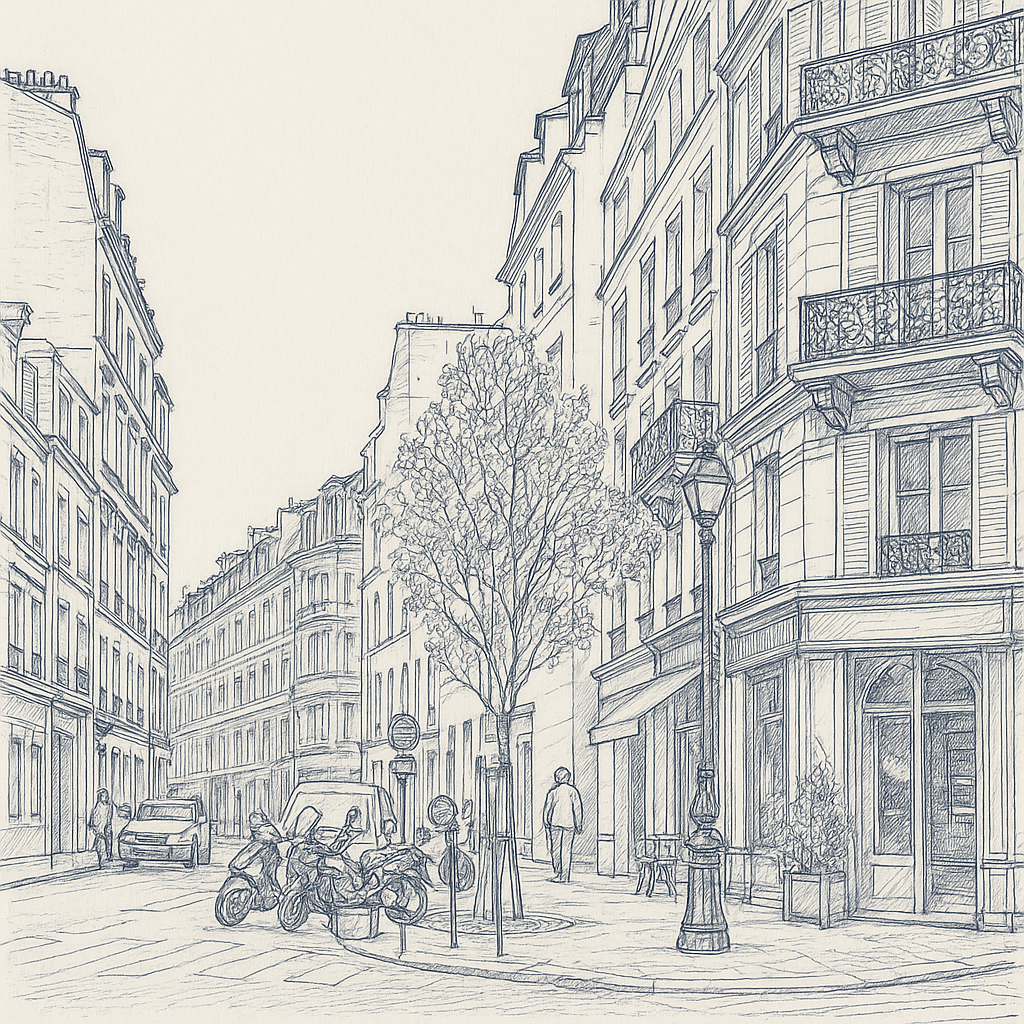
In the heart of the Marais, between Place Saint-Gervais and Rue de Sévigné, Rue François-Miron follows a gently curved path that traces one of the oldest routes in Paris, a Gallo-Roman road once leading east from Lutetia. Few Parisian streets can claim such antiquity of layout, and this is precisely what gives this artery of the 4th arrondissement its timeless atmosphere. Lined with timber-framed houses that have miraculously survived the centuries, Rue François-Miron stands in stark contrast to its more Haussmannian neighbors such as the nearby Rue de Rivoli. Here, visitors wander among ancient shopfronts, seventeenth-century mansions, and meticulously restored medieval façades. It is a street best savored slowly, on foot, eyes raised toward rooftops and half-timbering that tell the story of old Paris better than any museum could. Its atmosphere blends the quiet residential character of the historic Marais with a discreet but dense neighborhood life, punctuated by small shops, galleries, and listed façades.
History
Rue François-Miron owes its current name to a decree of 1832 honoring François Miron, provost of merchants of Paris under Henri IV, a key figure in the city's administration at the turn of the seventeenth century who worked toward the modernization of the capital. Before that date, the street bore several names depending on the section, including Rue du Pourtour-Saint-Paul and Rue de la Tixeranderie, the latter recalling the weavers who once had their workshops there. The street actually follows the path of an ancient Roman road, which explains its slight curve, in contrast to the straight lines of the Haussmannian avenues created from scratch in the nineteenth century. The architectural jewel of the street is undoubtedly the Hôtel de Beauvais, built in 1655 by architect Antoine Le Pautre for Catherine Bellier, first lady-in-waiting to Anne of Austria. Legend has it that the young Louis XIV had his first amorous encounter with the mistress of the house when the king was only fifteen. The curved façade of the mansion, following the curve of the street, makes it one of the most original achievements of seventeenth-century Parisian architecture. Mozart also stayed there in 1763 during his visit to Paris. At numbers 11 and 13, two timber-framed houses dating from the fourteenth and sixteenth centuries, restored in the 1960s under the Marais preservation plan initiated by André Malraux, testify to the medieval appearance of the neighborhood before the great Haussmannian works. The street was also marked by the proximity of the Church of Saint-Gervais-Saint-Protais, one of the oldest parishes in Paris, whose bell tower still dominates the western crossroads of the street. The neighborhood, long working-class and artisanal, once housed weavers, tanners, and merchants before undergoing, from the 1960s and 1970s onward, a progressive gentrification that made it one of the most sought-after sectors of the capital.
Architecture
The architecture of Rue François-Miron offers a remarkable concentration of the history of Parisian building. The timber-framed houses at numbers 11 and 13, with their corbelled upper floors, exposed beams, and narrow façades, recall the medieval Paris that existed before the great urban transformations. These buildings, exceedingly rare in the capital where fires and renovations have erased most of the ancient fabric, have been restored with scrupulous attention to original materials. Alongside them, seventeenth-century mansions such as the Hôtel de Beauvais display classical stone façades, punctuated by wrought-iron balconies and sculpted pediments. The eighteenth century also left its mark with more soberly ordered buildings, harmonious in proportion, often adorned with carved carriage doors opening onto paved courtyards. The entire street is protected under the Marais preservation sector, which guarantees the rigorous conservation of façades, zinc or slate roofs, and old shop fronts. This stylistic diversity, ranging from late Gothic to the most accomplished classicism, makes Rue François-Miron a true open-air museum of Parisian architecture.
Neighborhood life
Neighborhood life around Rue François-Miron combines residential tranquility with well-managed tourist activity. In the morning, residents and employees of the many associations and galleries housed in the mansions mingle with a few tourists come to admire the timber-framed houses, camera in hand. In the afternoon, the street comes alive around its small antique shops, specialized bookstores, and discreet tea rooms. In the evening, restaurants and wine bars nestled in vaulted cellars attract a clientele of regulars as much as visitors seeking authenticity. The immediate proximity of Place Saint-Gervais, the Village Saint-Paul, and Rue de Rivoli ensures easy access to a wider commercial offering, notably the BHV Marais department store. The Saint-Paul and Pont Marie metro stations, as well as the Hôtel de Ville stop, allow quick access to the rest of the capital. The banks of the Seine, a few minutes' walk away, offer a walking space appreciated by residents. The neighborhood's population mixes long-established families, young professionals drawn by the charm of the area, and a small community of artists and gallery owners who perpetuate the Marais's creative tradition.
Real estate market
The real estate market on Rue François-Miron caters to a very specific clientele in search of authenticity and heritage charm. Buyers are mostly senior executives, professionals in liberal careers, and a significant proportion of international buyers, drawn by the unique historical character of this address. Properties on offer range from attic studios to two- or three-bedroom through-apartments in a former mansion, as well as rare duplexes with exposed beams and period fireplaces. Upper floors with views over the rooftops of the Marais are particularly sought after, as are properties overlooking a paved courtyard. Prices per square meter break down as follows: approximately 11,500 to 13,000 euros for a standard property requiring renovation, between 14,000 and 16,500 euros for a high-end renovated apartment with refined finishes, and above 18,000 euros, reaching up to 21,000 euros, for an exceptional property such as a former partially divided mansion or a listed timber-framed apartment. Recent trends show sustained demand despite an overall stabilized Parisian market, with short marketing times, often under two months for well-presented properties, given how much the rarity of this type of heritage attracts discerning buyers.
Conclusion
Rue François-Miron embodies on its own the entire historical stratification of the Marais, from medieval Paris to the splendors of the Grand Siècle. Its rare charm, its architectural rarity, and its exceptional living environment make it a prime address for buyers seeking authenticity, far from Haussmannian standards. A street for lovers of history and old stone, ready to invest in living heritage.
Thomas Herremans