
Rue Monge
Introduction
The rue Monge unfurls its long ribbon from the place de la Contrescarpe to the boulevard Saint-Marcel, crossing the beating heart of the 5th arrondissement with an air both scholarly and popular. A rare artery of the Latin Quarter to combine student effervescence, commercial density, and genuine neighborhood life, it stands apart from its neighbors through its character as a backbone, linking the Montagne Sainte-Geneviève to the edges of the Jardin des Plantes. Here one encounters hurried students as well as families settled for generations, professors from the nearby Sorbonne as well as tourists seeking authenticity. Its very name, a tribute to a scientist, announces the intellectual tone of the area, while its food market, cinemas, and terraces give it a warmth that is thoroughly Parisian. The rue Monge is not a mere thoroughfare: it is a true living place, where historical layers, university buzz, and residential gentleness overlap.
History
The rue Monge owes its name to Gaspard Monge (1746-1818), a brilliant mathematician and physicist, founder of descriptive geometry, co-founder of the École Polytechnique, and companion of Napoleon Bonaparte during the Egyptian campaign. This christening, decided in 1868 as part of the great Haussmannian works, follows the republican tradition of honoring great French scientific minds. Before its definitive opening under the Second Empire, the street's route partially followed older, narrower, winding lanes, remnants of medieval Paris that wound around the Montagne Sainte-Geneviève. The Haussmannian cutting aimed to open up this working-class neighborhood and connect it more directly to the great boulevards of southern Paris. One of the most striking episodes in the street's history remains the discovery, during development works, of the remains of the Arènes de Lutèce, a Gallo-Roman amphitheater dating from the 1st century, buried beneath buildings for centuries. Saved from destruction thanks to the mobilization of Victor Hugo and other figures in the 1880s, the arena was restored and opened to the public, becoming a symbol of ancient permanence at the heart of modern Paris. The rue Monge, bordering this site, thus carries within it a memory stretching back to antiquity. The neighborhood was also marked by a strong student presence since the Middle Ages, the Montagne Sainte-Geneviève having housed colleges and universities since the 13th century. In the 20th century, the place Monge and its market established themselves as a popular gathering point, while the street itself progressively welcomed shops, cinemas, and cultural institutions that shaped its contemporary identity.
Architecture
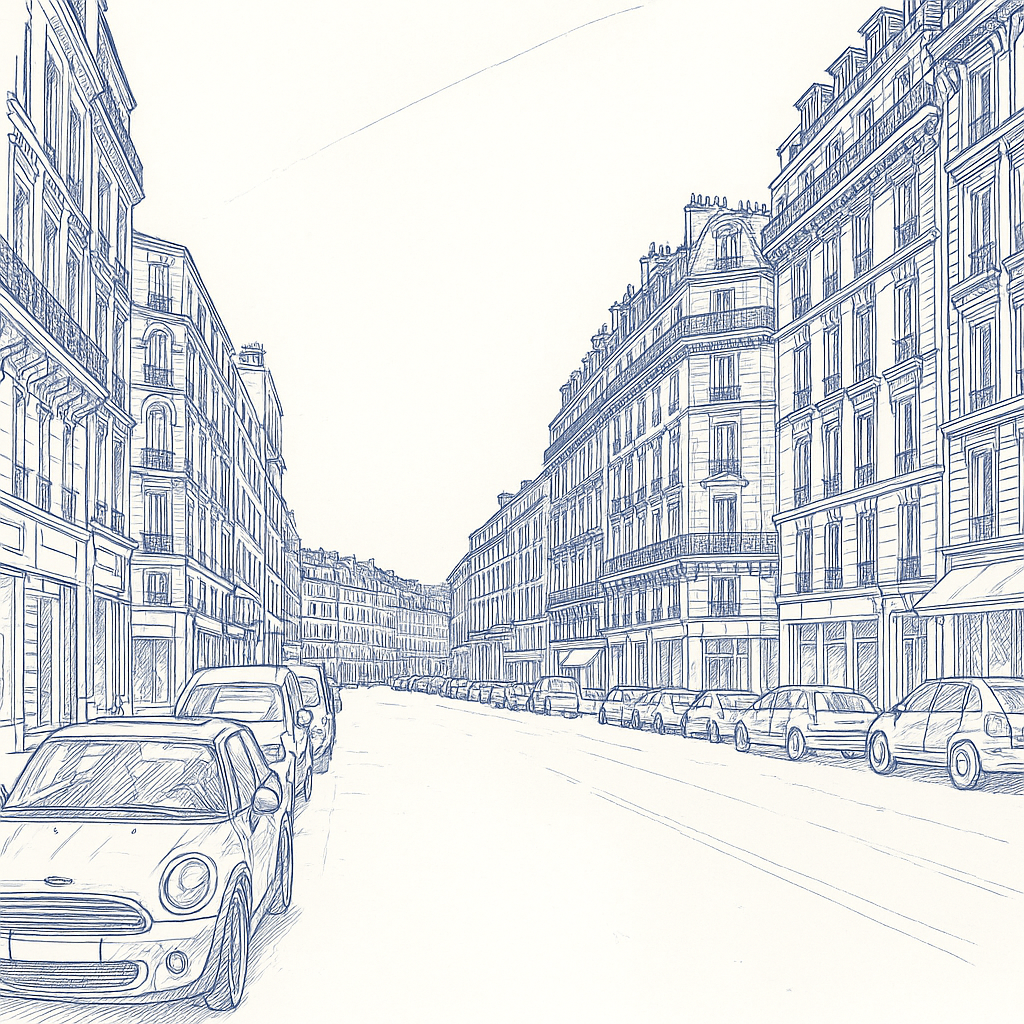
The rue Monge displays typically Haussmannian architecture along most of its length, with stone buildings rising between four and six stories, adorned with continuous balconies on the second and fifth floors, sculpted cornices, and zinc roofs with their characteristic slope. The facades, often carefully restored, testify to rigorous maintenance and a will to preserve heritage. Toward the upper part of the street, near the Contrescarpe, a few older buildings remain, with more modest facades and irregular volumes, recalling the urban fabric predating the great works. The ground floors, largely occupied by shops, feature varied storefronts, some retaining old painted wood elements, others more contemporary. The whole offers a pleasant visual coherence, punctuated by trees planted along the sidewalks that soften the mineral quality of Parisian stone.
Neighborhood life
Life on the rue Monge follows several distinct rhythms. In the morning, residents flock to the Monge market, set up on the eponymous square three times a week, where greengrocers, cheesemongers, and fishmongers offer quality products in a convivial, good-natured atmosphere. During the day, students from nearby institutions animate the cafés and bookshops, while food shops, artisan bakeries, and neighborhood restaurants welcome a loyal clientele. In the evening, terraces fill up and Le Grand Action cinema, an institution of auteur cinema, attracts film lovers from the entire neighborhood. The proximity of the Jardin des Plantes, the Institut du Monde Arabe, and the Arènes de Lutèce offers precious green and cultural breathing spaces. Transport links are excellent, with the Place Monge and Censier-Daubenton metro stations on line 7, as well as numerous bus lines, facilitating travel to the rest of the capital.
Real estate market
The real estate market on the rue Monge attracts a varied clientele: young senior executives, families seeking large family apartments, investors drawn by the proximity of universities and constant student rental demand, as well as foreign buyers charmed by the authenticity of the Latin Quarter. Properties on offer range from studios for rental investment to large family apartments of 100 to 150 square meters, including through-apartments with beautiful Haussmannian volumes and original moldings. Upper floors with unobstructed views over Parisian rooftops or the Jardin des Plantes are particularly sought after. Prices per square meter currently range between 9,800 and 10,800 euros for a standard property requiring renovation, between 11,500 and 12,800 euros for a high-end renovated apartment with quality finishes, and can exceed 14,000 euros, even reaching 15,500 euros, for an exceptional property: a top floor with terrace, a fully restored through-apartment, or a rare private mansion. The average marketing period remains short, between four and eight weeks, reflecting sustained demand and a dynamic market, driven by the scarcity of supply in this sought-after sector of the Latin Quarter.
Conclusion
The rue Monge beautifully embodies this Parisian alchemy between ancient history, intellectual effervescence, and everyday sweetness of life. An address sought after by both families and investors, it appeals to those who wish to live in a lively, cultured, and perfectly connected neighborhood, while benefiting from architectural heritage of great quality. It is a street for those who love Paris in its most authentic dimension, between erudition and popular market life.
Thomas Herremans