
Rue Monsieur-le-Prince
Introduction
Rue Monsieur-le-Prince connects rue de Vaugirard to place de l'Odéon, in the heart of the 6th arrondissement, within that prestigious quadrilateral where university tradition, bourgeois elegance, and cultural effervescence intertwine. A quiet, residential street despite its immediate proximity to the major axes of the Latin Quarter, it stands out for an almost secret atmosphere, sheltered from the tourist bustle animating the nearby boulevard Saint-Michel. Lined with elegant buildings and old facades, it embodies the Paris of scholars and erudites, a cradle of brilliant students and historical figures, while remaining an extremely sought-after residential address for a demanding clientele seeking calm and prestige in the very heart of the Left Bank.
History
Rue Monsieur-le-Prince owes its name to the title held by the Princes of Condé, owners of the land on which it was laid out in the 17th century, "Prince" being then the honorific title attributed to the head of this illustrious family, cousins of the kings of France. The street was cut through as part of the urbanization of the neighborhood surrounding the Palais du Luxembourg, a royal family property, and gradually took on its current appearance in the 18th century. From that era, it attracted a population of students, lawyers, and intellectuals, due to its proximity to the Faculty of Medicine and the School of Law. Among the famous figures who lived or stayed on rue Monsieur-le-Prince are several prominent personalities in French literary and political history, including Auguste Comte, founder of positivism, who lived there and whose apartment has now been transformed into a museum, the Maison d'Auguste Comte, a precious place of memory for lovers of intellectual history. The street also hosted many foreign students who came to study in Paris, particularly South American and Russian students in the 19th century, contributing to its cosmopolitan and intellectual atmosphere. During the French Revolution, the neighborhood experienced intense political agitation, with nearby clubs and cafés serving as places of debate and gathering for revolutionaries. Over the centuries, rue Monsieur-le-Prince has managed to preserve its residential and discreet character, largely escaping the great Haussmannian cuts that transformed other neighborhoods of the capital, which explains the remarkable preservation of its old urban fabric.
Architecture
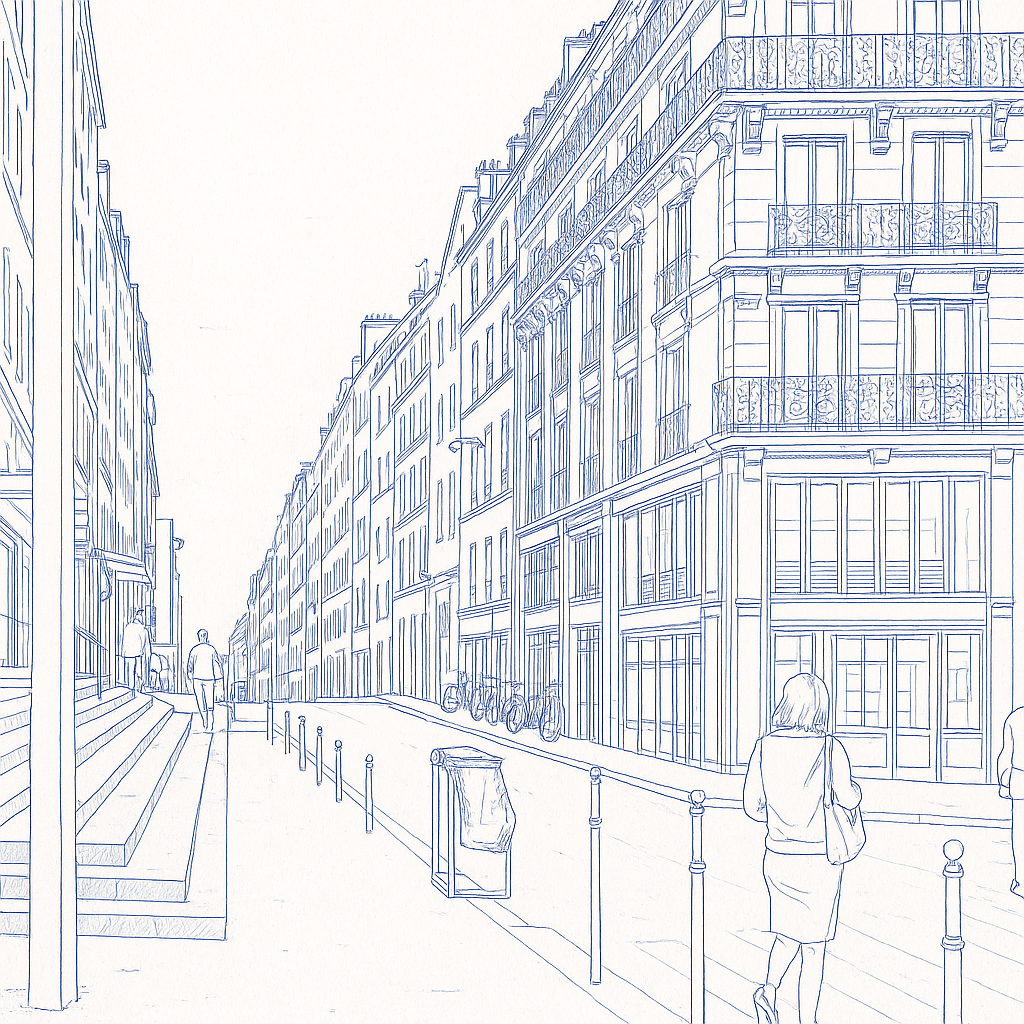
The architecture of rue Monsieur-le-Prince displays great stylistic diversity, mixing 17th and 18th century buildings with sober classical facades, more ornamented 19th-century constructions, and a few discreet Haussmannian additions. The buildings, generally rising between four and six stories, feature stone facades, old carriage doors leading to cobbled interior courtyards, as well as varied decorative elements: mascarons, wrought-iron balconies, and sculpted cornices. This architectural heterogeneity, far from harming the harmony of the street, instead gives it an authentic charm and discreet elegance, characteristic of preserved old Paris.
Neighborhood life
Rue Monsieur-le-Prince enjoys a peaceful but refined neighborhood life. There are several old and specialized bookshops, restaurants renowned for traditional French cuisine, and a few quality food shops. The immediate proximity of the Jardin du Luxembourg offers an exceptional green setting, highly appreciated by residents for strolling and relaxation. The Théâtre de l'Odéon, located a few steps away, as well as the Sorbonne and the School of Medicine, maintain a constant cultural and intellectual atmosphere. Transport links are excellent, with the Odéon and Luxembourg (RER B) metro stations in immediate proximity. The neighborhood's population is mainly composed of professionals in liberal professions, academics, wealthy families, and an international clientele drawn by the prestige of the address.
Real estate market
The real estate market on rue Monsieur-le-Prince appeals to a particularly demanding clientele, composed of wealthy families, liberal professionals, diplomats, and international buyers seeking a prestigious address on the Left Bank. Available properties are mainly high-end family apartments, from 80 to 200 square meters, often featuring beautiful ceiling heights, period moldings, and original marble fireplaces. Apartments overlooking the courtyard generally benefit from absolute calm, while those facing the street enjoy remarkable natural light. Prices per square meter currently stand between 13,500 and 14,800 euros for a standard property, between 15,500 and 17,000 euros for a high-end renovated apartment, and can exceed 19,000 euros, even reaching 21,000 euros, for an exceptional property, particularly an apartment with a view of the Jardin du Luxembourg or a rare private mansion. The market remains extremely tight, with limited supply and generally short marketing periods, between three and seven weeks for the best-located properties, reflecting the lasting prestige of this address in the 6th arrondissement.
Conclusion
Rue Monsieur-le-Prince embodies the discreet elegance and intellectual excellence of the Parisian Left Bank. An address sought by a refined clientele looking for calm, prestige, and proximity to the capital's most beautiful green and cultural spaces, it remains one of the most coveted streets in the Latin Quarter for those wishing to combine history, culture, and exceptional quality of life.
Thomas Herremans