
Rue Mouffetard — Where Roman Legacy Meets Bohemian Soul
Introduction
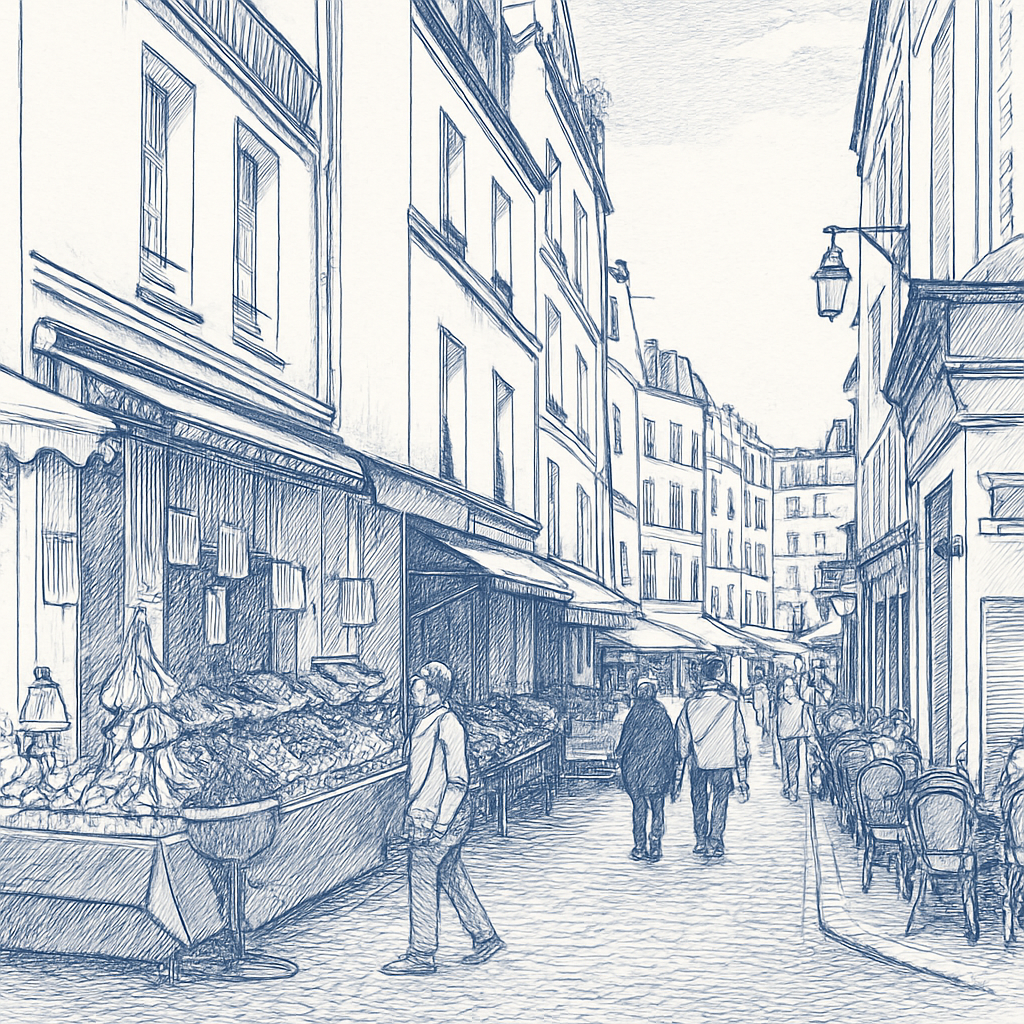
Winding from the Place de la Contrescarpe down to the Rue Censier, the Rue Mouffetard is undoubtedly one of the liveliest and most picturesque streets in Paris's 5th arrondissement. Roughly 650 meters long, narrow and gently curving, it follows the path of an ancient Roman road linking Lutetia to Rome. This antique heritage gives the street a singular, almost timeless soul that visitors feel from their very first steps on its cobblestones. Unlike the wide Haussmannian avenues that structure much of the capital, Mouffetard has preserved a medieval layout, low façades, and a human scale that make it a village within the city. It distinguishes itself from its neighbors - the wider, busier Rue Monge, or the quieter Rue Descartes - through its intense commercial character, its permanent food market, and its Mediterranean atmosphere filled with terraces, the smell of cheese, and lively conversation. It is a street to be explored as much for its shops as for its atmosphere, a place where popular Paris and the intellectual Paris of the Latin Quarter meet with happy results.
History
The origin of the name "Mouffetard" is subject to several hypotheses. The most widespread evokes the Bièvre river, now covered over, which flowed nearby and whose waters, fouled by the activities of local tanners, gave off a foul smell - hence the term "moffette," meaning a foul exhalation. Other linguists see it as a deformation of the name of an ancient hill, "mont Cetardus." Regardless, the street has existed since Gallo-Roman times under the name "Via Mons Cetardus," an axis linking Lutetia to the south of Gaul. In the Middle Ages, it became a bustling suburb outside the walls of Philippe Auguste, populated by artisans, tanners, and small merchants who took advantage of the nearby Bièvre for their trades. The street truly took off commercially in the 17th century, becoming one of the busiest food markets on the Left Bank - a status it has never lost. Old fountains and shop signs still remain today, such as "Le Vieux Chêne" at number 69, one of the oldest taverns in Paris, or the Pot-de-Fer fountain, once fed by the Médicis aqueduct. Rabelais, who lived nearby, already described the bustle of this popular neighborhood. In the 19th century, the street became a haunt for artists and writers drawn by its bohemian, working-class atmosphere; it is said that figures like Hemingway, who lived nearby on Rue du Cardinal Lemoine, came here for daily shopping. The street was also the setting for scenes of Parisian life immortalized by many painters and photographers, including Doisneau, who captured the soul of this popular market in several iconic photographs. After the war, Mouffetard experienced a period of decline before being gradually rediscovered in the 1980s and 1990s by a wealthier population attracted by its village charm, without ever losing its commercial and popular character.
Architecture
The architecture of Rue Mouffetard reflects its centuries-old history. There is a heterogeneous mix of buildings, combining timber-framed houses from the 16th and 17th centuries - rare surviving traces of medieval Paris - with more classical buildings from the 18th and 19th centuries. The façades are generally low, rarely exceeding four or five stories, which enhances the impression of intimacy and village-like character. Many buildings retain original features: exposed beams, half-timbering, narrow carriage doors, winding wooden staircases. The commercial ground floors, often adorned with old painted wooden storefronts, add to the picturesque charm of the street. There are also a few more recent buildings, constructed at the turn of the 20th century in an eclectic style, with wrought ironwork and sculpted cornices. The lower part of the street is pedestrianized, which has preserved its architectural character without the nuisances of car traffic, making it one of the best-preserved streets in old Paris.
Neighborhood Life
From dawn, Rue Mouffetard comes alive to the rhythm of its market: greengrocers, cheesemongers, fishmongers, and bakers set up their colorful stalls, attracting residents and tourists in search of authenticity. During the day, café terraces fill up, the smell of fresh bread mingling with that of aged cheeses and marinated olives. In the evening, the street changes character: numerous restaurants, wine bars, and crêperies attract a student and festive crowd, thanks to the proximity of the Sorbonne and the Panthéon. Notable addresses include the Androuet cheese shop, the historic bakery at number 134 known for its éclairs, and the restaurant "Le Verre à Pied," a neighborhood institution for decades. Public transport is excellent: the Censier-Daubenton metro station (line 7) serves the lower part of the street, while Place Monge (also line 7) and the nearby RER B facilitate travel to the rest of the capital. The Jardin des Plantes and the Arènes de Lutèce, a few minutes' walk away, offer green spaces appreciated by families and strollers. The neighborhood's population is a skillful mix of students, long-established families, and young professionals drawn by the authenticity and vibrancy of the place.
Real Estate Market
The real estate market on Rue Mouffetard attracts a varied clientele: young professionals seeking a first purchase, rental investors drawn by strong student demand, and families wishing to settle in a vibrant, well-connected neighborhood. Available properties are mostly old apartments, often small to medium in size (25 to 70 sqm), located in 18th or 19th century buildings, sometimes with atypical layouts inherited from the old building stock (low ceilings, exposed beams, narrow staircases). Upper floors with unobstructed views over the Parisian rooftops are particularly sought after. Prices per square meter range as follows: for a standard property requiring renovation, expect between €9,500 and €10,800/sqm; for a high-end renovated property, prices climb to between €11,500 and €13,000/sqm; for an exceptional property - a top-floor unit with a terrace, a private mansion, or a duplex with a view of the Panthéon - prices can reach €14,500 to €16,000/sqm. Demand remains strong, driven by the constant appeal of the Latin Quarter, and quality properties that are well located and bright generally sell in under two months. Small units intended for student rental investment also remain highly sought after, offering attractive yields given the proximity of major schools and universities.
Conclusion
Rue Mouffetard beautifully embodies the spirit of old, popular Paris, where history, gastronomy, and neighborhood life combine harmoniously. A sought-after address for those wishing to combine authenticity with centrality, it appeals equally to families and investors, students and heritage lovers alike. Buying a property on Rue Mouffetard means choosing a lively, warm, and timeless Paris.
Thomas Herremans