
Rue Oberkampf — Where Paris Pulses After Dark
Introduction
Rue Oberkampf runs through the 11th arrondissement of Paris for nearly a kilometer, connecting Place de la République to Boulevard de Ménilmontant. An emblematic artery of popular and creative Paris, it has established itself since the 1990s as one of the epicenters of Parisian nightlife and culture. Unlike the more bourgeois streets of the western arrondissements, Oberkampf retains a raw, authentic identity, shaped by decades of artisan industry and later by the effervescence of bars, galleries, and artist workshops that transformed it. It stands clearly apart from its surroundings - the more residential Rue de Ménilmontant, or the quieter Rue Saint-Maur - through its constant energy, its social and generational mix, and its status as a border street between neighborhoods with strong identities: Belleville, Bastille, and the Marais. It is a street that lives intensely at all hours, a vivid embodiment of a Paris in perpetual transformation, where early bohemians, young creatives, long-established families, and night owls in search of atmosphere all mingle.
History
Rue Oberkampf owes its name to Christophe-Philippe Oberkampf, an industrialist of German origin who settled in France in the 18th century, famous for founding the toile de Jouy manufacture in Jouy-en-Josas. Although he did not live directly on this street, it was named in his honor for his pioneering role in the French textile industry, a sector that long marked this eastern Parisian neighborhood. Gradually opened in the 19th century, the street developed alongside the urbanization of the 11th arrondissement, then a haven for workers, furniture craftsmen, and small industries spreading out from the Faubourg Saint-Antoine. Long modest and working-class, Rue Oberkampf has a rich social history: ironworking workshops, print shops, and garment workshops succeeded one another, testifying to the neighborhood's artisan dynamism. It was truly in the 1990s that the street experienced its most spectacular transformation: former industrial premises and abandoned shops were taken over by a generation of young entrepreneurs who opened bars, live music cafés, and alternative venues, making Oberkampf the symbol of eastern Paris's trendy renewal, much as Saint-Germain-des-Prés had represented decades earlier for the Left Bank. Iconic establishments like Café Charbon, opened in 1996 in a former 19th-century theater-café-concert hall, perfectly embody this transformation, preserving the original architecture while breathing new nightlife into the neighborhood. The street then became the setting for intense nightlife, attracting Parisian youth seeking authentic, unformatted venues far from traditional tourist circuits. Even today, the memory of this 1990s-2000s effervescence permeates the street's identity, even though it has since gained in mix and commercial diversity.
Architecture
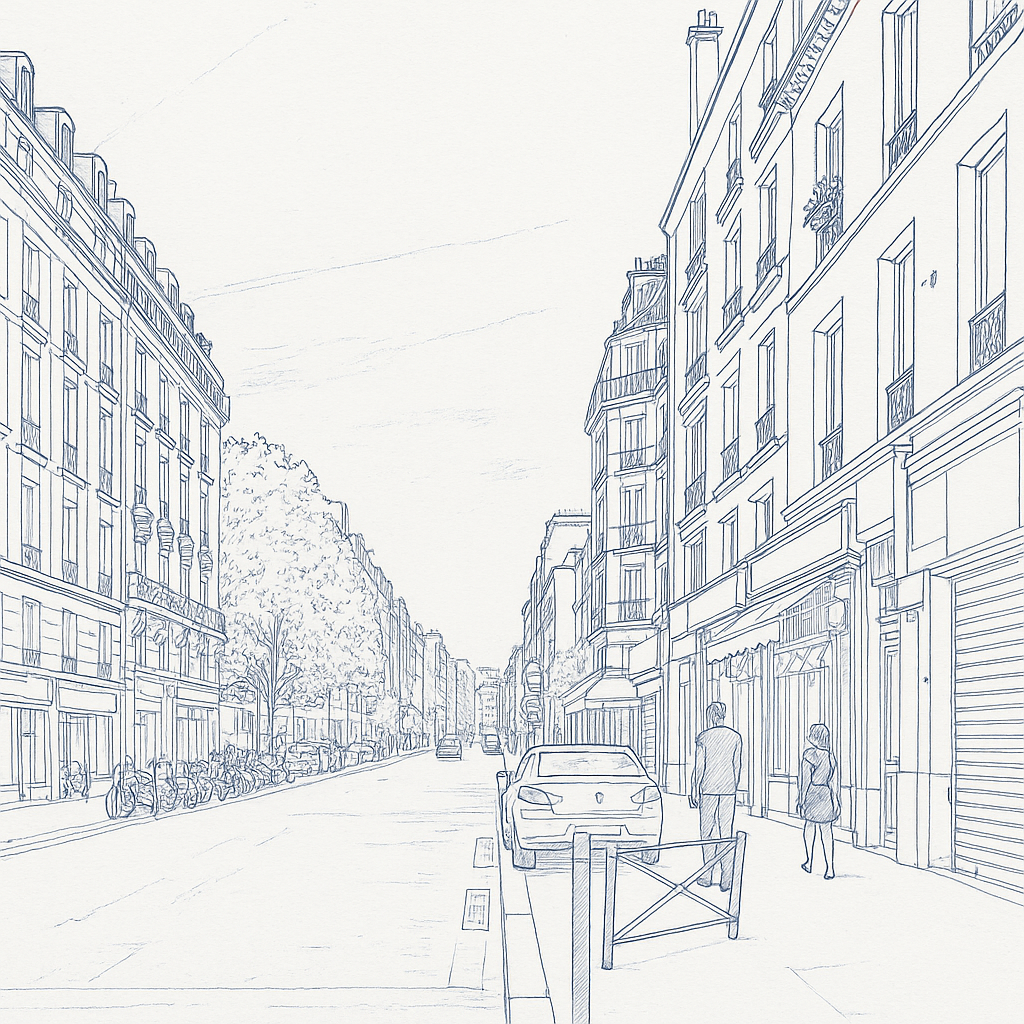
The architecture of Rue Oberkampf reflects its industrial and working-class past. Mostly buildings from the late 19th and early 20th centuries can be found here, built of millstone or cut stone, with sober façades sometimes adorned with continuous wrought-iron balconies. Many former workshops and industrial courtyards remain behind the street façades, today often converted into lofts or coworking spaces, witnesses to the neighborhood's rich artisan past. The buildings are generally uniform in height, between four and six stories, with some more recent buildings constructed during the post-war decades when certain blocks were rehabilitated. The commercial storefronts, often colorful and lit with neon for bars and restaurants, contribute to the street's unique and lively visual identity, blending old heritage with contemporary energy.
Neighborhood Life
Rue Oberkampf truly lives at two different speeds. During the day, the atmosphere is calmer, punctuated by neighborhood shops, bakeries, delicatessens, and small restaurants serving a loyal local clientele. From nightfall, the street transforms into one of the hotspots of Parisian nightlife: cocktail bars, pubs, concert venues like Le Nouveau Casino, and trendy restaurants attract a dense and joyful crowd late into the night, especially on Thursday, Friday, and Saturday evenings. The Parmentier (line 3), Ménilmontant (line 2), and Saint-Maur (line 3) metro stations efficiently serve the street, facilitating access from across the capital. Green spaces are not lacking nearby, with the Square Maurice-Gardette offering a welcome breathing space in the heart of this lively street. The neighborhood's population is young, creative, and cosmopolitan, mixing students, artists, young digital professionals, and long-established families, forming a rare and precious social mix in contemporary Paris.
Real Estate Market
The real estate market on Rue Oberkampf mainly attracts a young clientele: first-time buyers, rental investors drawn by strong demand from students and young professionals, and buyers seeking an urban, trendy lifestyle. The properties on offer are varied, ranging from compact studios to family apartments of 80 to 100 sqm, as well as atypical lofts converted from former workshops. Upper floors with balconies or unobstructed views are particularly sought after, as are dual-aspect properties offering good natural light. Prices per square meter are distributed as follows: for a standard property, expect between €8,800 and €9,800/sqm; for a high-end renovated property, prices range between €10,200 and €11,500/sqm; for an exceptional property - an artist's loft, a duplex with terrace, or a fully renovated old building - prices can reach €12,500 to €14,000/sqm. The market has seen strong growth over the past fifteen years, driven by the neighborhood's progressive gentrification, without yet reaching the price levels of more central arrondissements, making it a still relatively accessible value within inner Paris. Quality properties generally sell within three to six weeks, a particularly fast timeframe reflecting the sector's continued appeal.
Conclusion
Rue Oberkampf embodies a Paris in motion, where popular authenticity and creative effervescence combine happily. A sought-after address for a young, dynamic clientele open to cultural diversity, it represents an attractive investment opportunity in a still-accessible but rapidly appreciating sector. Buying on Rue Oberkampf means betting on a lively, creative Paris resolutely turned toward the future.
Thomas Herremans