
Rue Poissonnière: The Ancient Fish Road Continued, Immigrant Heritage and a Street Between Two Worlds
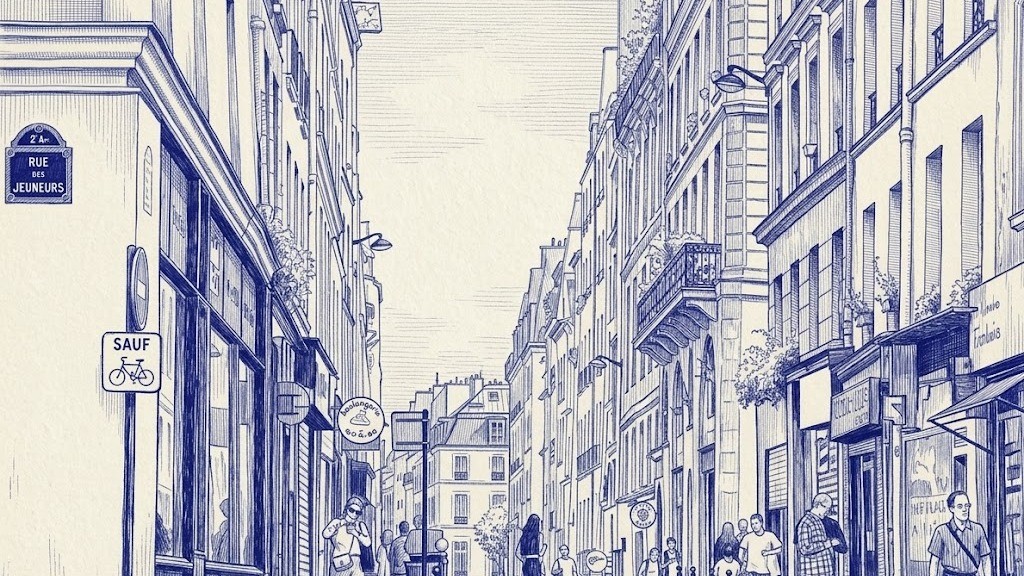
Rue Poissonnière is distinct from the Boulevard Poissonnière that it approaches at its southern end — it is the older, narrower, more intimate artery that preceded the boulevard and from which the latter takes its name. Running north to south through the eastern section of the 2nd arrondissement and crossing into the 9th at the Grands Boulevards, the rue is the original incarnation of the "fish road" — the ancient route along which fresh fish from the Normandy coast was transported to the markets of Paris for centuries before the modern city reshaped it into a boulevard.
This distinction — between the rue and the boulevard that share a name — is characteristic of the way in which Haussmann's urban transformation preserved and renamed existing arteries while creating new, wider ones alongside them. The Rue Poissonnière is in this sense the more ancient and more intimate of the two, carrying the full history of the fish trade within its narrower and more irregular alignment, while the boulevard represents the nineteenth-century ideal of the grand urban axis.
Today, Rue Poissonnière runs through a neighbourhood that has been shaped over two centuries by successive waves of immigration, creating one of the most culturally diverse and historically layered communities in the 2nd arrondissement. The street's character is inseparable from this immigrant heritage, which has given it a social richness and commercial vitality quite unlike the more institutionally dominated streets of the southern arrondissement.
1. The Ancient Route and the Fish Trade
The history of Rue Poissonnière as a transport route predates its formalisation as a street by centuries. The road that connected the fish markets of the Normandy coast to the markets of Paris was one of the most economically vital supply routes into the medieval city, and its importance was such that it was subject to specific royal regulations governing the speed of transport, the hours of passage and the standards of freshness required of the fish being carried.
The poissonnières — the fish sellers, often women — who worked this route became one of the most celebrated social types in Parisian popular culture, appearing in literature, theatre and visual art as emblems of a particular kind of female commercial authority and social independence. Their name, and the name of the road they worked, entered permanently into the toponymy of Paris.
As the city expanded northwards and the Grands Boulevards were laid out in the seventeenth and eighteenth centuries, the old fish road was absorbed into the urban grid, eventually becoming Rue Poissonnière within the city proper, and continuing as the Rue du Faubourg Poissonnière beyond the old city boundary into the growing northern faubourgs.
2. Immigrant Communities and Cultural Diversity
One of the defining characteristics of Rue Poissonnière and its immediate surroundings has been the successive presence of immigrant communities who have made this part of the 2nd and 9th arrondissements their home and commercial base over the past two centuries.
Jewish immigrants from Eastern Europe — Ashkenazi communities from Poland, Russia and the Austro-Hungarian Empire — settled in large numbers in the streets around Rue Poissonnière in the late nineteenth and early twentieth centuries, establishing synagogues, kosher food businesses, workshops and community institutions that gave the neighbourhood a distinctive Eastern European Jewish character.
Later waves of North African immigration brought Sephardic Jewish communities and Muslim communities from Tunisia, Morocco and Algeria, further enriching the cultural and religious life of the neighbourhood. The street and its surroundings today retain traces of all these communities in their synagogues, restaurants, specialist food shops and community organisations.
3. Commercial Character
Rue Poissonnière retains a strongly commercial character at street level, with a dense mix of small businesses, workshops, food retailers and specialist shops that reflects the working-class and immigrant commercial traditions of the neighbourhood. The ground floors of buildings along the street are almost entirely given over to commercial uses, creating an animated and varied retail environment that contrasts with the more uniform commercial character of the principal arteries of the Sentier.
The food offer on and around Rue Poissonnière is particularly notable — a reflection of the diverse culinary traditions of the communities that have called this neighbourhood home. Kosher delicatessens, North African pastry shops, Middle Eastern restaurants and traditional French bistros coexist on the same short stretch of street, creating a gastronomic diversity that is one of the neighbourhood's most distinctive features.
4. Urban Context
Rue Poissonnière runs from the Rue du Faubourg Poissonnière at the northern end of the Grands Boulevards to the interior of the 2nd arrondissement, connecting the border of the 9th arrondissement to the Sentier district. The street is served by the Bonne-Nouvelle and Poissonnière metro stations.
5. Architectural Character
The architecture of Rue Poissonnière reflects the older and more varied building stock of this part of the 2nd arrondissement. Pre-Haussmann buildings of three to five storeys sit alongside later constructions, creating a streetscape of considerable variety and historical texture. The narrower width of the street compared with the boulevard creates a more intimate spatial experience, with the buildings on either side creating a sense of enclosure that is characteristic of the older streets of Paris.
6. The Residential Market
The residential market on Rue Poissonnière reflects the neighbourhood's social diversity and its position between the Sentier district and the Grands Boulevards corridor. The street's authentic commercial character and immigrant heritage have historically made it more accessible than the more institutionally prestigious addresses of the southern 2nd arrondissement, attracting a diverse residential population:
- buyers seeking an authentic and socially diverse central Paris neighbourhood
- investors attracted by the sustained rental demand from the neighbourhood's working population
- creative professionals drawn by the cultural diversity and commercial energy of the street
- buyers interested in a neighbourhood that is undergoing gradual gentrification while retaining its authentic character
7. Property Prices
Property values on Rue Poissonnière reflect the combination of central location, authentic character and relative accessibility:
- €12,000 to €15,000 per m² for unrenovated or standard apartments
- €15,000 to €18,500 per m² for renovated properties with quality finishes
- €18,500 per m² and above for exceptional units in the best buildings
Rue Poissonnière carries one of the most evocative names in the 2nd arrondissement and one of the most layered histories — from the medieval fish road that gave it its identity, through the successive immigrant communities that have shaped its social character, to the contemporary neighbourhood that is gradually evolving while retaining the authentic urban vitality that makes it one of the most genuinely Parisian addresses in the arrondissement.
Thomas Herremans