
Rue Saint-André-des-Arts
Introduction
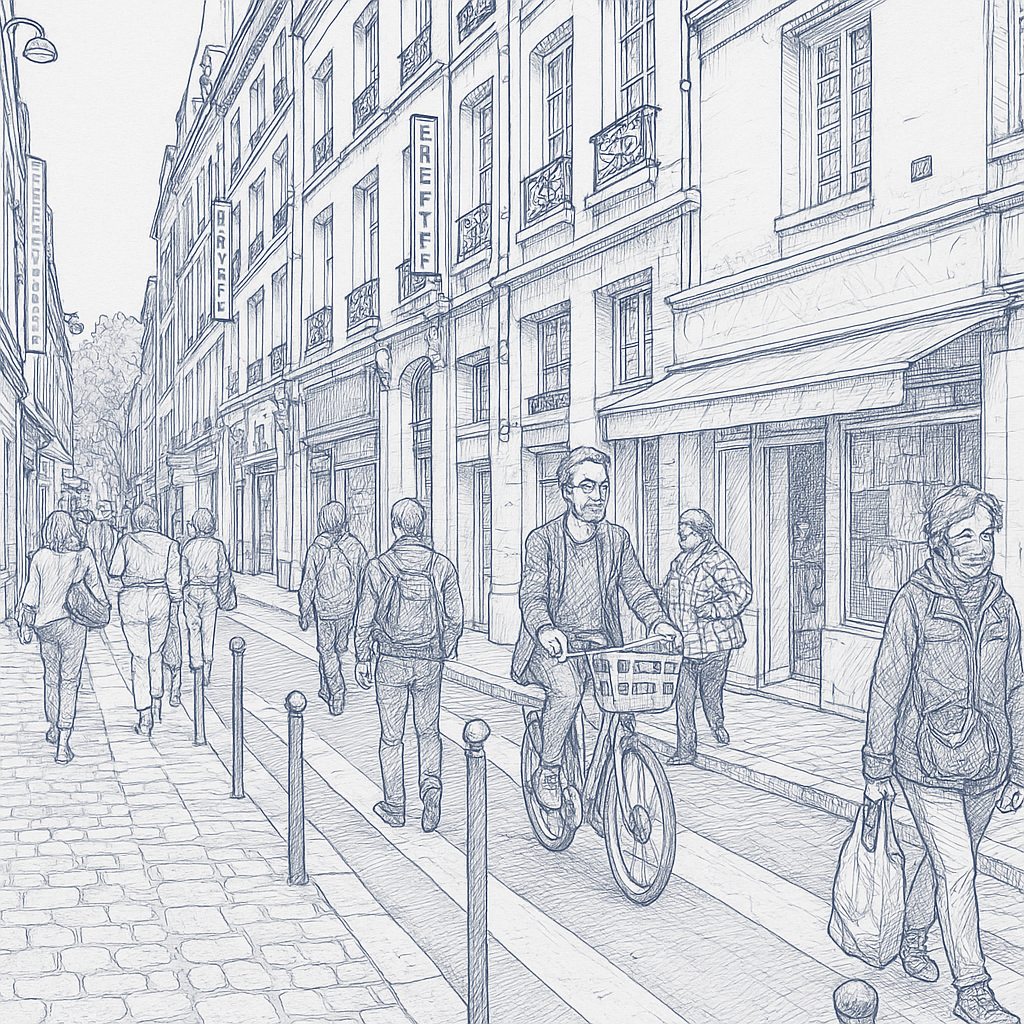
In the 6th arrondissement, Rue Saint-André-des-Arts connects Place Saint-Michel to the Carrefour de Buci, tracing one of the liveliest and most picturesque arteries of the greater Latin Quarter. Lined with varied shops, art-house cinemas, restaurants and bookstores, it forms an essential pedestrian axis between the Seine and Boulevard Saint-Germain. More popular and lively than nearby Rue de Tournon, it offers a more bohemian and cosmopolitan face, frequented by students, tourists and longtime residents alike.
History
Rue Saint-André-des-Arts takes its name from a former church, Saint-André-des-Arcs, destroyed during the French Revolution, whose name is said to derive from a deformation of the term "arcs," referring to the arcades that once bordered the neighboring cemetery. The street has existed since the Middle Ages and ranks among the oldest thoroughfares of the Left Bank, having retained a winding layout characteristic of medieval urbanism, unlike the straight Haussmannian avenues. It once crossed one of the densest and most working-class neighborhoods of Paris, populated by craftsmen, printers and students gravitating around the nearby Sorbonne. In the 17th century, the street had numerous mansions, some of which partially survive. It was also the scene of historic events: during the French Revolution, several revolutionary sections held their assemblies there. In the 19th and 20th centuries, the street became a hub of intellectual and artistic bohemia, with numerous cafés and bookstores frequented by writers and students. The nearby Théâtre de l'Odéon and the Sorbonne reinforced this intellectual vocation. The street also housed several historic cinemas that marked 20th-century Parisian cinephilia, some of which still survive today in renovated form.
Architecture
The architecture of Rue Saint-André-des-Arts is heterogeneous, reflecting successive layers of urbanization from the Middle Ages to the 19th century. There are hidden half-timbered buildings, classical 17th- and 18th-century cut-stone facades, and a few later Haussmannian-style constructions. The street's winding layout, inherited from the medieval plan, creates shifting perspectives and picturesque viewing angles, rare in the rectilinear 19th-century Paris. Several porches and interior courtyards reveal old architectural elements, notably spiral staircases and exposed beams.
Neighborhood life
Rue Saint-André-des-Arts is one of the liveliest arteries of the Latin Quarter, animated from morning to night by a dense crowd of students, tourists and residents. Bookstores, crêperies, restaurants offering world cuisine and typical cafés follow one another along the street. Proximity to Place Saint-Michel, the Pont Neuf and the Carrefour de Buci makes it an essential crossing point, very well served by the Saint-Michel and Odéon metro stations.
Real estate market
The real estate market on Rue Saint-André-des-Arts attracts a varied clientele, from student rental investors to first-time buyers and international purchasers drawn by the neighborhood's buzz. Properties are mainly small and medium sizes, from studios to three-room apartments, in old buildings with preserved charm. Prices range from €11,000 to €12,500/m² for a standard property, €13,500 to €15,000/m² for a high-end renovation, and up to €16,500 to €18,000/m² for an exceptional property with an open view or remarkable architectural character. Sale timelines are short, generally two to three months, driven by constant student and tourist rental demand.
Conclusion
Rue Saint-André-des-Arts embodies the bohemian and lively spirit of the Latin Quarter, a dynamic and accessible address for all those wishing to live at the heart of the Left Bank's intellectual and cultural effervescence.
Thomas Herremans