
Rue Saint-Honoré
Introduction
Rue Saint-Honoré unfurls its elegant ribbon at the heart of the 1st arrondissement, between the Louvre district and the Concorde, running for nearly two kilometers that trace Paris's history from the Middle Ages to today's most cutting-edge fashion. Running parallel to Rue de Rivoli and extended westward by the Faubourg Saint-Honoré, it carves out its own identity: narrower, denser, it retains the character of a historic shopping street where international luxury boutiques rub shoulders with artisan workshops, art galleries and old buildings with sober façades. People come here to window-shop, to have a quiet lunch, or simply to cross a slice of Paris that has seen kings, revolutionaries and fashion designers pass through. Unlike Avenue Montaigne or Place Vendôme, Rue Saint-Honoré retains an almost village-like feel in certain stretches, particularly around Place du Marché Saint-Honoré, while rivaling the chicest avenues as it nears the Palais-Royal.
History
The street's name dates back to the 13th century, honoring Saint Honoré, bishop of Amiens in the 6th century, who was designated patron saint of bakers — a trade heavily represented in this district near the old markets. As early as the Middle Ages, the street connected the Porte Saint-Honoré, one of the gates in Philippe Auguste's city wall, to the heart of the city, quickly becoming a major thoroughfare between the Louvre and the western outskirts.
Under the Ancien Régime, Rue Saint-Honoré filled with private mansions and religious institutions, including the Jacobin convent, which lent its name to the political club that met there during the French Revolution. Maximilien de Robespierre lived on the street at the home of the carpenter Duplay, at what was then number 398 — a house long since demolished, though its memory remains attached to the street: it was from there that he set out on his final journey to the scaffold on 9 Thermidor. The Église Saint-Roch, completed in the 18th century, still bears traces of a tragic episode in French history: the shooting of 13 Vendémiaire 1795, when Bonaparte's troops crushed a royalist uprising on its steps.
During the 19th century, the street gradually transformed into a prestigious shopping thoroughfare, benefiting from its proximity to the Palais-Royal and the aristocratic, then bourgeois, clientele who frequented the neighborhood. The 20th century firmly established its vocation as a temple of elegance: the Colette concept store, opened in 1997 at number 213 and closed in 2017 after twenty years reigning over international fashion and design, remains its most emblematic example, having made this stretch a mandatory stop for trend-seekers from around the world.
Architecture
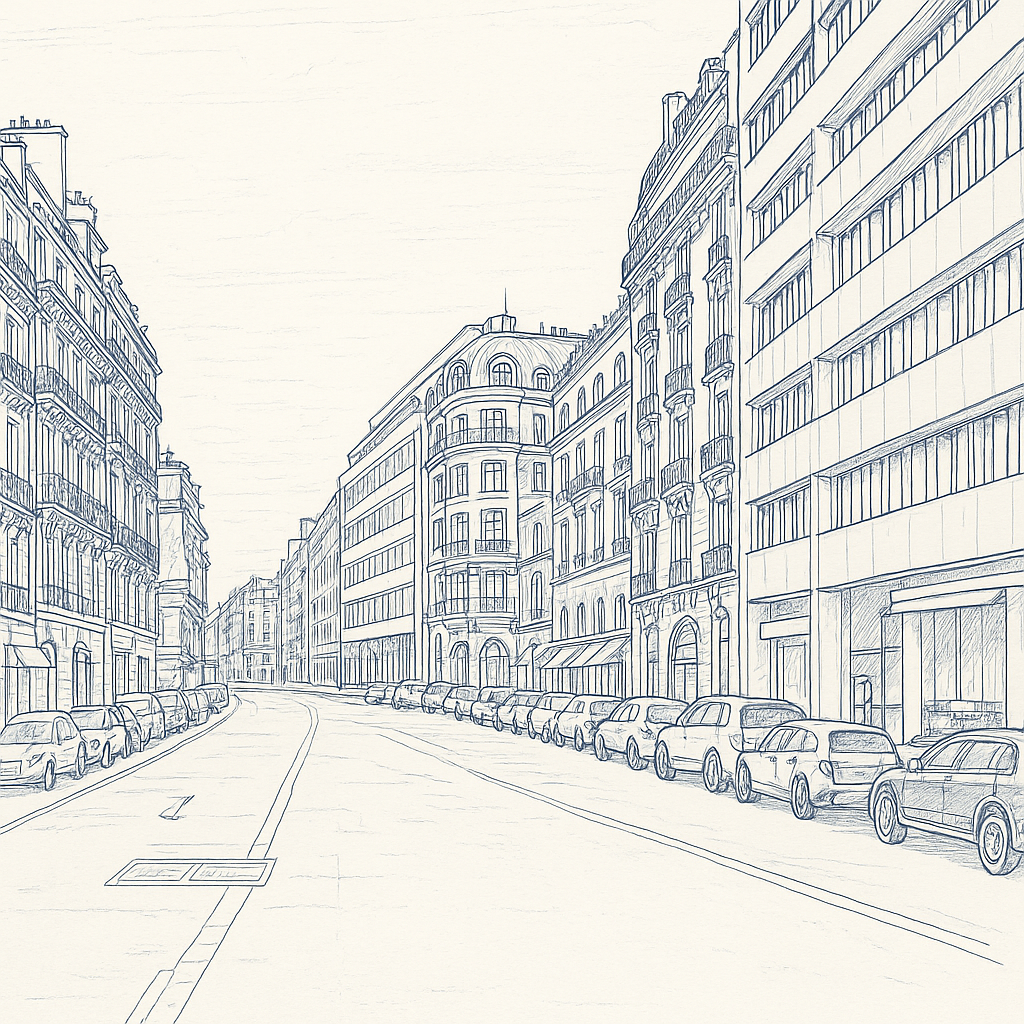
The architecture of Rue Saint-Honoré reflects several centuries of layered construction. A few 17th- and 18th-century private mansions still stand, with classical façades punctuated by tall small-paned windows and carved wooden carriage doors, particularly in its eastern section near the Louvre. Most of the visible buildings today, however, date from the 19th century — Haussmann-era or pre-Haussmann stone buildings with running balconies on the second floor and characteristically pitched zinc roofs. Ground floors have often been extensively transformed to accommodate luxury boutique storefronts, with contemporary glass-and-steel display windows that sometimes contrast sharply with the sobriety of the upper floors. This juxtaposition of architectural layers, between old stone and commercial modernity, gives the street a particularly rich visual texture rarely found elsewhere in the 1st arrondissement.
Neighborhood Life
From dawn, deliveries animate the street before the first customers of the luxury houses arrive, as most open around 10 a.m. Place du Marché Saint-Honoré, rebuilt in the 1990s on the site of a 19th-century covered market, concentrates cafés and restaurants where office workers, tourists and neighborhood residents cross paths. During the day, Rue Saint-Honoré pulses to the rhythm of international shopping, drawing a mix of discerning Parisians, wealthy tourists and fashion professionals. In the evening, terraces fill up, and certain gastronomic addresses tucked between the boutiques attract a more intimate clientele. The neighborhood benefits from exceptional transport links via the Tuileries, Palais Royal-Musée du Louvre and Pyramides metro stations, as well as the immediate proximity of the Tuileries Garden, a green haven just minutes away on foot for residents seeking fresh air and open space.
Real Estate Market
The real estate market on Rue Saint-Honoré caters to a particular, often international, clientele drawn by the district's absolute centrality and commercial prestige. Buyers range from investors seeking to lease retail space to luxury brands, to wealthy individuals looking for a Parisian pied-à-terre, to a rare few families wishing to settle permanently in this lively area. Residential properties, often located on the upper floors of old buildings, are characterized by generous volumes, high ceilings and sometimes period moldings, but frequently require renovation given the age of the building stock. The most sought-after sizes range from small pied-à-terre apartments to large 150-square-meter family homes overlooking either an inner courtyard or the street itself. Prices per square meter break down as follows: for a standard property requiring work, expect between €12,000 and €14,000; for a high-end renovated apartment with refined finishes, the range sits between €16,000 and €19,000; finally, exceptional properties, on a noble floor, with unobstructed views or remarkable architectural character, can reach €20,000 to €25,000 per square meter. Demand remains strong, and well-presented quality properties generally sell within two months.
Conclusion
A legendary address in Parisian shopping for over a century, Rue Saint-Honoré combines a turbulent history, eclectic architecture and international commercial influence. Today it attracts a population of international buyers seeking a prestigious foothold in the heart of Paris, a stone's throw from the Louvre and the Tuileries. Whether one seeks a high-end rental investment, a pied-à-terre for short stays, or a genuine place to live at the beating center of the capital, Rue Saint-Honoré remains a safe bet, buoyed by structural land scarcity and a heritage appeal that time has never diminished.
Thomas Herremans