
Rue Saint-Jacques — Medieval pilgrimage meets Left Bank elegance
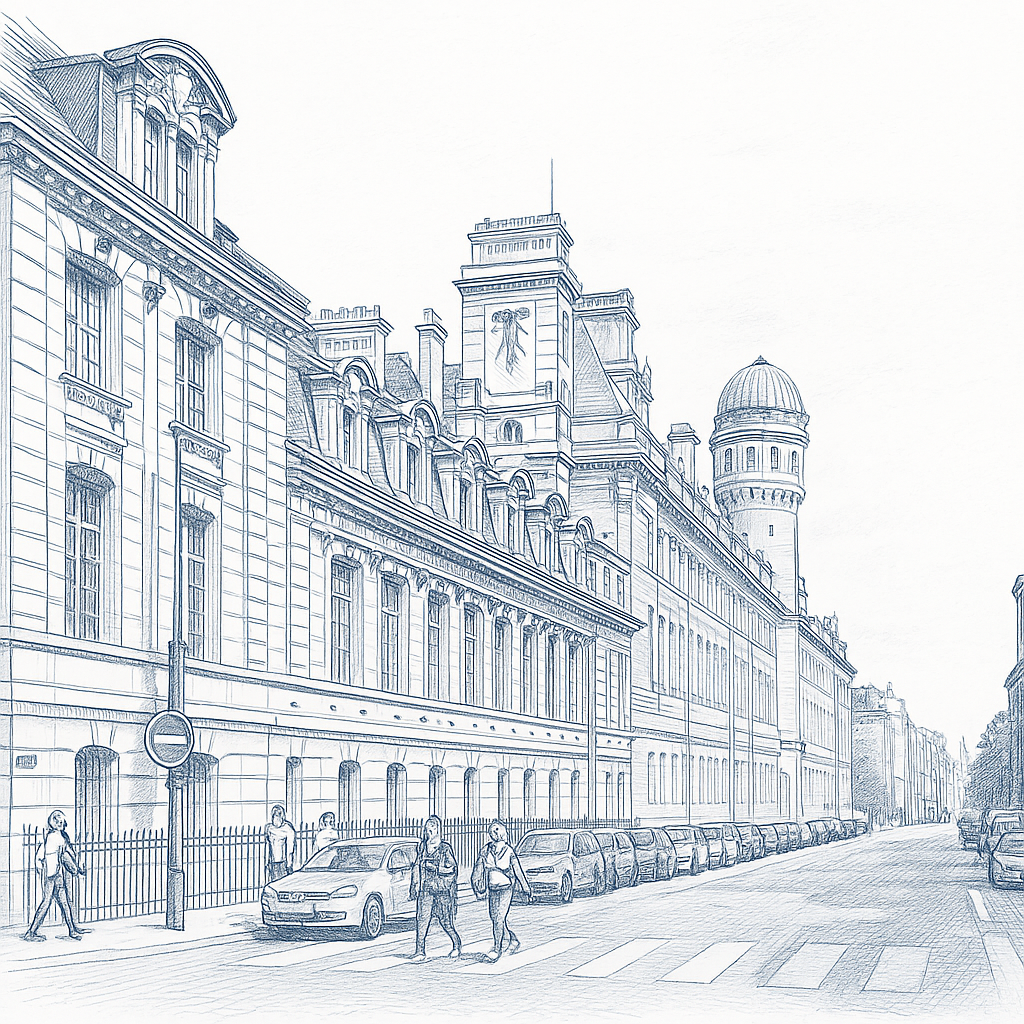
The Rue Saint-Jacques is undoubtedly one of the oldest and most historically charged thoroughfares on the Left Bank of Paris. It crosses the heart of the 5th arrondissement, running from the Petit Pont to the Boulevard de Port-Royal, following a route that dates back to Roman antiquity. As the backbone of the Latin Quarter, it runs alongside the Sorbonne, the Lycée Louis-le-Grand, the Collège de France, and the Val-de-Grâce church, concentrating a rare density of institutions within the capital. Unlike the busier, more touristic streets nearby, Rue Saint-Jacques retains a sober, almost monastic character in places, punctuated by high enclosure walls, discreet carriage doors, and façades that narrate eight centuries of education and spirituality. It embodies a studious Paris, dedicated equally to students, scholars, and families seeking a pied-à-terre steeped in genuine history, far from the touristic artifice of the nearby Boulevard Saint-Michel.
Historically, Rue Saint-Jacques fully deserves its reputation as 'the oldest street in Paris.' It corresponds precisely to the route of the Roman cardo maximus, the north-south axis that structured Lutetia and connected the Île de la Cité to the hills of the Montagne Sainte-Geneviève. Its current name dates from the Middle Ages: it served as the starting point of the pilgrimage route to Santiago de Compostela for generations of pilgrims who set off toward Spain after receiving a blessing at the Saint-Jacques-du-Haut-Pas church, still visible today at number 252. This church, built in the 17th century on the site of a former pilgrims' hospice, remains a precious witness to this vocation. Throughout its history, the street was also the stage for the rise of Parisian printing: from the 15th and 16th centuries, numerous typographic workshops settled here, benefiting from proximity to the Sorbonne and its clientele of students and clerics. Étienne Dolet, humanist and printer, practiced his trade here before being burned at the stake at Place Maubert in 1546, an episode still engraved in the neighborhood's memory. Further south, the monumental Val-de-Grâce complex, commissioned by Anne of Austria in gratitude for the birth of Louis XIV, has raised its Baroque dome since the 17th century, now integrated into a military hospital. The street has also seen generations of students pass through, who, since the founding of the Sorbonne in the 13th century, have shaped the intellectual identity of the Latin Quarter. In the 19th century, the opening of Boulevard Saint-Michel somewhat sidelined Rue Saint-Jacques, paradoxically granting it a tranquility it had not previously known, one that still persists today in its southern section.
Architecturally, Rue Saint-Jacques offers a remarkable palimpsest. One finds remnants of religious and university buildings from the 17th and 18th centuries, with classical cut-stone façades, often hidden behind high walls and sober portals marked with coats of arms. The Lycée Louis-le-Grand, founded by the Jesuits in the 17th century, displays impressive institutional architecture, while the Collège de France, rebuilt in the 19th century in neoclassical style, boasts an elegant colonnade. Further north, toward the Seine, a few 18th-century residential buildings remain with a more modest appearance, featuring small-paned windows and rendered rubble-stone façades. The southern part of the street, partially rebuilt in the 19th century, presents classic Haussmannian buildings in honey-colored cut stone, with continuous balconies on the second and fifth floors, zinc roofs, and mansard dormers. This stylistic diversity, rare along a single axis, gives Rue Saint-Jacques a particular charm, made of ruptures and continuities.
Neighborhood life here is marked by a dense but discreet student population, amid libraries, specialized bookshops, and small cafés frequented by researchers and teachers. In the morning, the street comes alive around the entrances of the Sorbonne and Lycée Louis-le-Grand, with a constant flow of hurried students. During the day, the atmosphere becomes more studious, punctuated by the bells of Val-de-Grâce and the silences of institutional inner courtyards. In the evening, a few university restaurants and traditional bistros, such as those nestled near Place de l'Estrapade, welcome a loyal clientele. Shops here are rare but of quality: antiquarian bookshops, stationers, fine grocers. Transport access is excellent, with the Luxembourg and Port-Royal RER stations, as well as several bus lines. The Luxembourg Gardens, a few minutes' walk away, offer a green space prized by families and students alike for their breaks.
The real estate market on Rue Saint-Jacques attracts a mixed clientele: affluent academics, rental investors targeting the upscale student market, and Parisian families attached to the authenticity of the Latin Quarter. Available properties range from 18 to 25 sqm student studios to large family apartments of 100 to 150 sqm, often located in period buildings with moldings, marble fireplaces, and Hungarian point parquet flooring. Prices per square meter break down as follows: approximately €10,500 to €11,500/sqm for a standard property requiring renovation; €12,500 to €13,800/sqm for a high-end renovated apartment with quality fittings; and up to €15,000 to €16,500/sqm for an exceptional property, a top-floor apartment with a view over Val-de-Grâce or a dual-aspect apartment in a historic building. Demand remains strong, driven by the scarcity of properties and immediate proximity to major academic institutions. Marketing periods are generally short, two to four months for well-presented properties, somewhat longer for atypical surfaces requiring complete renovation.
Ultimately, Rue Saint-Jacques stands as an exceptional address for those seeking the authenticity of intellectual old Paris, far from tourist agitation yet at the beating heart of knowledge. It will particularly appeal to academic families, collectors of Parisian history, and savvy investors attuned to the enduring strength of student and academic demand.
Thomas Herremans