
Rue Saint-Paul — Where Medieval Paris Lives On
Introduction
Nestled in the historic Marais, straddling the Saint-Paul neighborhood of the 4th arrondissement, Rue Saint-Paul unfolds a rare medieval charm, preserved from the great Haussmannian transformations that shaped most of Paris. Connecting Rue Saint-Antoine to Rue Charlemagne, it crosses a maze of narrow lanes and secret courtyards, among which the famous Village Saint-Paul, a haven for antique dealers nestled in the former outbuildings of the Hôtel Saint-Pol. Less frequented than Rue des Rosiers or Rue Saint-Antoine, this street offers a parenthesis of calm at the heart of one of the capital's liveliest neighborhoods.
History
Rue Saint-Paul takes its name from the former Saint-Paul-des-Champs church, now gone, which was destroyed during the French Revolution after having been the parish of numerous noble Marais families for centuries. This church notably housed Rabelais's tomb. But the street's name also and especially evokes the Hôtel Saint-Pol, a vast complex of royal residences built by Charles V in the 14th century to escape the insecurity of the Louvre and the Palais de la Cité after the troubles of the Jacquerie and Étienne Marcel's insurrection. This Hôtel Saint-Pol, which extended over a considerable area between the Seine and today's Rue Saint-Antoine, comprised several residential buildings, gardens, menageries, and aviaries, and served as the main residence of the kings of France until Charles VII. Gradually abandoned in the 15th century in favor of other royal residences, the complex was progressively dismantled and sold off in parcels, giving rise to the network of small streets and courtyards that survives today, including Rue Saint-Paul itself, laid out over part of its former grounds. The neighborhood then underwent progressive urbanization in the 17th and 18th centuries, with the establishment of more modest mansions and artisan workshops. In the 20th century, the area fell into disuse before experiencing a remarkable revival in the 1970s-1980s, with the creation of the Village Saint-Paul, an ensemble of courtyards and alleys rehabilitated to house antique dealers and secondhand merchants, part of the vast movement to preserve the Marais initiated by the Malraux law of 1962.
Architecture
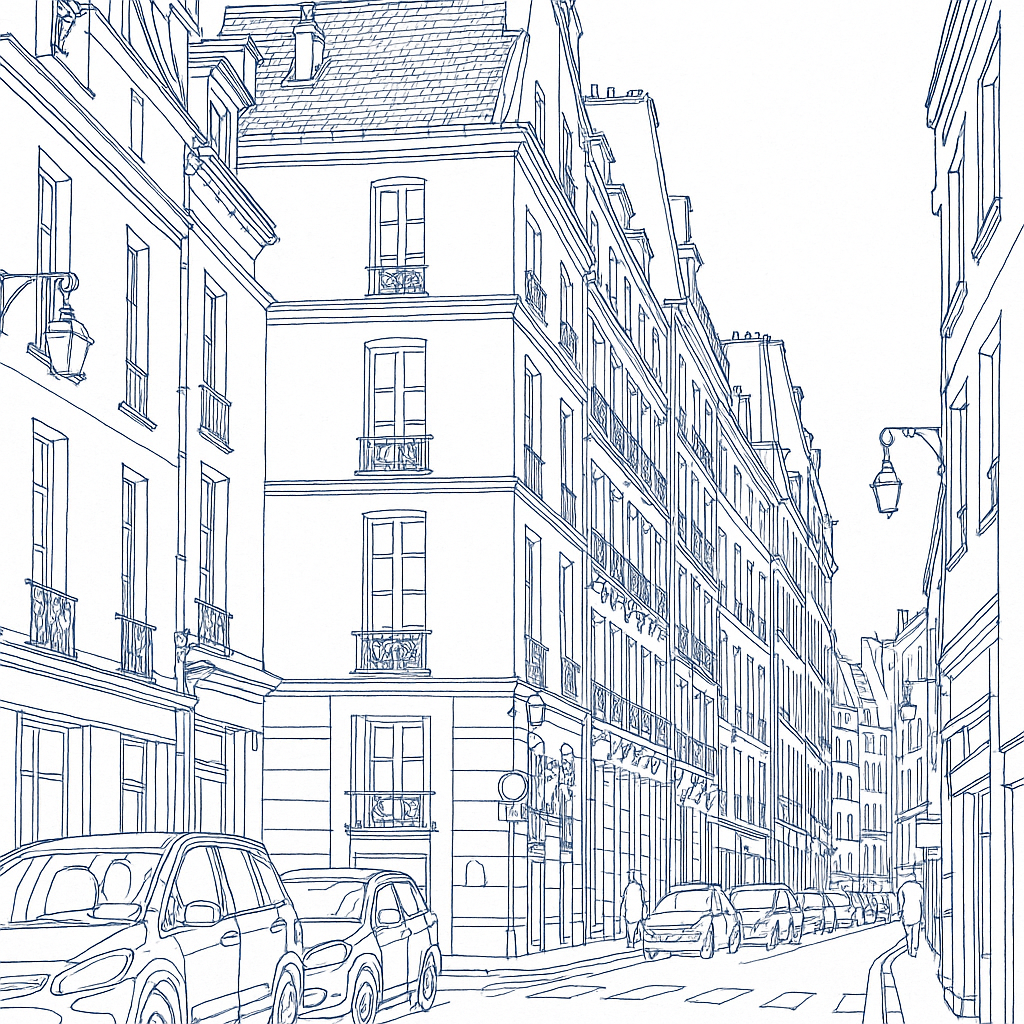
Rue Saint-Paul and its immediate surroundings retain a remarkable medieval urban fabric, with narrow, winding streets, irregular paved courtyards, and buildings with modest but authentic façades, often in limestone with hidden timber framing. The Village Saint-Paul, accessible through several discreet porches from Rue Saint-Paul, Rue Charlemagne, and Rue des Jardins-Saint-Paul, unfolds a set of interconnected inner courtyards lined with former outbuildings transformed into antique shops, offering a village atmosphere unique in Paris. A few remnants of the Philippe Auguste city wall also remain in the immediate vicinity.
Neighborhood life
Rue Saint-Paul and its adjoining village live at the pace of bargain hunters and art lovers, particularly lively on weekends when the antique dealers open their doors in the village's courtyards. On weekdays, the atmosphere is calmer, punctuated by a few neighborhood cafés and traditional food shops. The proximity of the Seine, the Hôtel de Sens garden, and Place des Vosges offers multiple opportunities for strolling. Saint-Paul and Sully-Morland metro stations efficiently serve the area. The population consists of long-established families, artists, and collectors attached to the intimate, preserved atmosphere of this corner of the Marais.
Real estate market
The real estate market on Rue Saint-Paul attracts a clientele seeking rare authenticity, willing to invest in an exceptional historical setting rather than standardized modern amenities. Available properties are often characterized by irregular layouts, exposed beams, stonework, and private courtyards, in old buildings mostly without elevators. Prices range between 11,500 and 13,000 euros per square meter for a standard property needing renovation, between 13,500 and 15,500 euros for a renovated apartment with preserved charm, and up to 17,500 euros per square meter for an exceptional property, particularly apartments overlooking the Village Saint-Paul courtyards or with a private terrace. Demand remains strong and stable, driven by a clientele passionate about history and heritage, with average sale periods of two to three months given the rarity and specificity of these properties.
Conclusion
Rue Saint-Paul embodies a secret and authentic Marais, far from the touristic bustle of neighboring streets. A prime address for lovers of history and heritage, it appeals to a clientele seeking an intimate Paris, steeped in royal and medieval memory, carefully preserved through the centuries.
Thomas Herremans