
Rue Saint-Séverin — Where Medieval Paris Whispers Timeless Elegance
Introduction
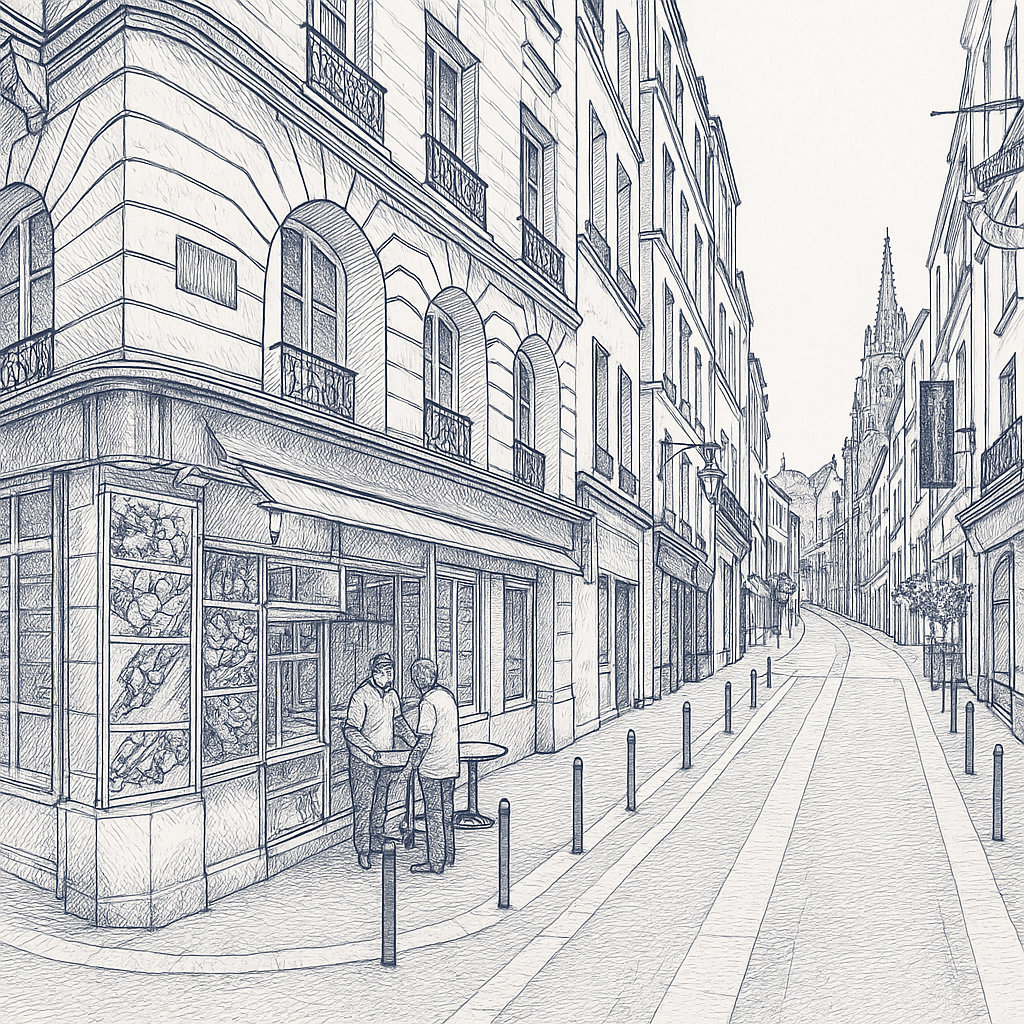
Rue Saint-Séverin winds narrowly between Rue Saint-Jacques and Boulevard Saint-Michel, in the heart of the Latin Quarter, in the 5th arrondissement, just steps from the Seine and Notre-Dame. This medieval street, one of the oldest in Paris, retains a winding layout inherited from the Middle Ages, lined with narrow, tall façades that bear witness to eight centuries of urban history. Eminently touristic and academic in atmosphere at once, Rue Saint-Séverin embodies this picturesque, dense Paris sought by visitors from around the world, while retaining, for those who know how to look beyond the restaurant terraces, a rare heritage authenticity—that of a medieval urban fabric almost intact, squeezed between the eponymous church and the neighbouring lanes of Huchette and de la Harpe.
History
The street takes its name from the Church of Saint-Séverin, one of the oldest parishes on the Left Bank, whose origins date back to the eleventh century, built on the presumed site of the hermitage of a sixth-century hermit saint named Séverin, who is said to have converted and instructed Saint Cloud, grandson of Clovis. The current church, rebuilt several times between the thirteenth and fifteenth centuries in a remarkable flamboyant Gothic style, remains one of the architectural jewels of the Latin Quarter, with its ambulatory featuring twisted columns unique in Paris. The street itself developed as early as the Middle Ages as an access road serving this densely populated parish, at the heart of the nascent University of Paris, which attracted students and masters from all over Europe starting in the twelfth century to study at the nearby Sorbonne. The neighbourhood, then known as the « quartier des écoles » (school district), teemed with colleges, taverns and the stalls of booksellers and scribes, as still evidenced today by the tight layout of the surrounding lanes. Rue Saint-Séverin retained a working-class and artisanal character until the nineteenth century, largely escaping the great Haussmannian breakthroughs that nevertheless transformed the nearby Boulevard Saint-Michel, opened in 1855. This relative preservation explains the exceptional nature of its medieval fabric and its land division, which has remained almost intact since the Middle Ages—an extremely rare fact within the walls of Paris. In the twentieth century, the street became a hub of student and artistic bohemia, then a major tourist centre from the 1960s-1970s onward, with the proliferation of Greek, Middle Eastern and Mediterranean restaurants that still characterise its commercial identity today.
Architecture
The architecture of Rue Saint-Séverin stands out for the survival of medieval and early modern buildings, an extremely rare thing in present-day Paris. Some timber-framed houses, although extensively reworked over the centuries, hint at structures dating back to the fifteenth and sixteenth centuries, while the majority of current façades date from the seventeenth and eighteenth centuries, with their tall small-paned windows and low studded wooden doors. The Church of Saint-Séverin itself constitutes a masterpiece of flamboyant Gothic architecture, with its western façade adorned with a thirteenth-century portal relocated from the demolished Church of Saint-Pierre-aux-Bœufs, and its famous twisted pillar at the centre of the ambulatory, a true technical feat of the late fifteenth century. The street, extremely narrow in places, retains a dense medieval land division, with narrow but tall party-wall buildings.
Neighbourhood life
Rue Saint-Séverin lives at the intense pace of international tourism, with its Greek, Lebanese and Mediterranean restaurant terraces animating the street from morning to evening, particularly in the evening when multilingual touts invite passers-by to come taste moussaka or kebabs. Students from the Sorbonne and neighbouring faculties also frequent the street for its affordable prices and convivial atmosphere. The immediate proximity of the Shakespeare and Company bookshop, Place Saint-Michel and the Seine riverbanks makes it an obligatory passage point for anyone discovering the Latin Quarter. Transport links are excellent, with the Saint-Michel station (line 4, RER B and C) just a few metres away.
Real estate market
The real estate market on Rue Saint-Séverin is characterised by a limited supply, mainly composed of small and medium-sized units in old buildings with atypical volumes, inherited from medieval architecture and the seventeenth century. Available properties are often studios or two-room apartments, prized by rental investors targeting a student or tourist clientele through furnished rentals, as well as by an international clientele seeking a pied-à-terre steeped in history. Prices per square metre are established as follows: for a standard property requiring work, expect between €9,500 and €10,800 per square metre; for a renovated apartment with fine finishes, prices range between €11,200 and €12,800 per square metre; for exceptional properties, particularly apartments with exposed beams or views of the Church of Saint-Séverin, transactions can reach €13,500 to €15,000 per square metre. Marketing periods are generally fast, between one and two months.
Conclusion
Rue Saint-Séverin remains one of the most singular addresses on the Left Bank, a living testament to a medieval Paris miraculously preserved at the heart of the Latin Quarter. Its cosmopolitan atmosphere, exceptional architectural heritage and privileged location make it a sought-after address for international investors and lovers of Parisian history.
Thomas Herremans