
Rue Saint-Sulpice — Where Left Bank Elegance Meets Timeless Grandeur
Introduction
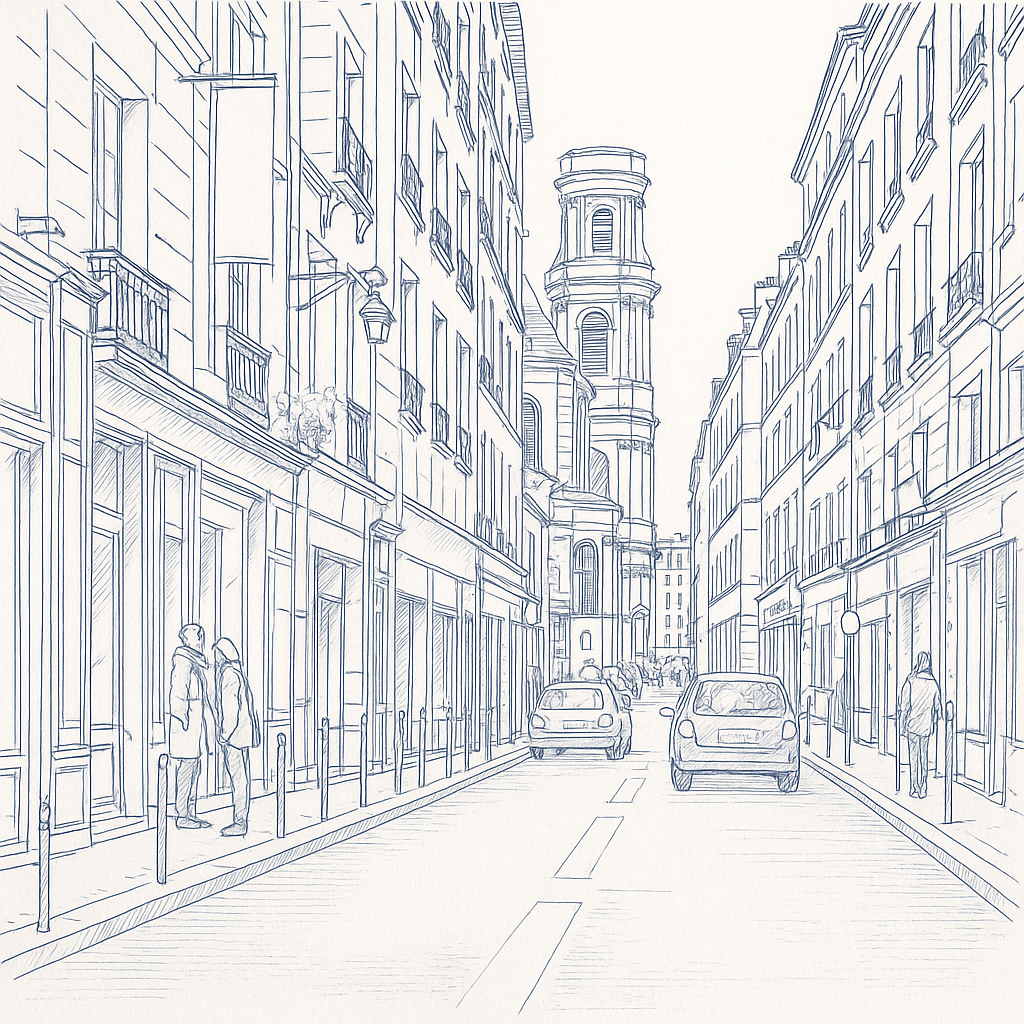
Located in the 6th arrondissement, between the Odéon crossroads and Place Saint-Sulpice, Rue Saint-Sulpice unfolds its distinctive atmosphere, a blend of Left Bank elegance and intellectual effervescence. Dominated by the massive silhouette of the Church of Saint-Sulpice from which it takes its name, this relatively short but institution-dense street lined with refined shops is one of the most sought-after axes of the Saint-Germain-des-Prés neighborhood. Unlike the nearby Rue de Rennes, more commercial and busy, Rue Saint-Sulpice cultivates a tasteful discretion, punctuated by antiquarian bookshops, prestigious publishing houses, and discreet fashion boutiques. It is a street for enlightened strollers, publishers, and academics, where one encounters both tourists admiring the Fountain of the Four Cardinal Points and regulars of the Café de la Mairie, an unmissable neighborhood institution. Its blend of monumental and intimate character makes it a sought-after address of literary, bourgeois Paris.
History
Rue Saint-Sulpice takes its name from the eponymous church, itself dedicated to Saint Sulpice the Pious, bishop of Bourges in the seventh century. The current layout of the street gradually formed from the seventeenth century onward, directly linked to the construction of the Church of Saint-Sulpice, begun in 1646 to plans by architect Christophe Gamard and continued by several successive architects until its late completion in the eighteenth century under the direction of Jean-Baptiste Servandoni, whose name was given to an adjacent street. This church, the second largest in Paris after Notre-Dame, long structured neighborhood life, attracting religious object merchants, artisans, and clergy. In the nineteenth century, the street became a hub of Parisian publishing: numerous publishing houses and printers settled there, benefiting from the proximity of the Sorbonne and the Latin Quarter. Place Saint-Sulpice, adorned since 1844 with the Fountain of the Four Bishops (also known as the Fountain of the Four Cardinal Points) by Louis Visconti, became an emblematic meeting place. Rue Saint-Sulpice also gained international notoriety thanks to Dan Brown's novel The Da Vinci Code, which sets a key scene in the church, prompting an influx of curious visitors in the early 2000s. Literary and artistic figures long frequented this area, between Delacroix's nearby studio on Place de Furstemberg and the cafés frequented by Left Bank intellectuals. The street has also retained several eighteenth-century mansions testifying to its status as an upscale neighborhood since the Ancien Régime.
Architecture
The architecture of Rue Saint-Sulpice shows remarkable classical continuity. The buildings, built mostly between the seventeenth and nineteenth centuries, feature sober and elegant cut-stone façades, with wrought-iron running balconies and zinc roofs with the mansard style characteristic of Parisian architecture. The Church of Saint-Sulpice itself, with its façade of two unequal towers designed by Servandoni and later modified by Chalgrin, dominates the entire area and imposes a monumental scale on the street. The surrounding buildings, often five to six stories high, frequently feature paved inner courtyards and sculpted entrance porches, remnants of mansions converted into condominiums. The street furniture, carefully preserved by the City of Paris given the area's protected status, contributes to the visual harmony of the street, between old streetlamps and carefully restored cobblestones.
Neighborhood life
Rue Saint-Sulpice lives to the rhythm of literary seasons and the bourgeois habits of the 6th arrondissement. In the morning, booksellers open their storefronts laden with antique books and first editions, while employees of the surrounding publishing houses settle at the terraces of the Café de la Mairie for a quick coffee. In the afternoon, Place Saint-Sulpice comes alive around its fountain, between students revising, tourists photographing the church, and residents walking their children. In the evening, a few discreet restaurants and wine bars welcome a clientele of regulars, far from the tourist bustle of nearby Saint-Germain-des-Prés. The street enjoys privileged access to transport, with the Saint-Sulpice metro station a few meters away and Mabillon or Odéon in immediate proximity. The Luxembourg Gardens, a few minutes' walk away, offer valuable green space for neighborhood families. The population, mainly composed of professionals, academics, and affluent families, gives the street a hushed and polished atmosphere.
Real estate market
The real estate market on Rue Saint-Sulpice caters to a demanding clientele, often composed of senior executives, professionals, and international buyers drawn by the prestige of the address and the immediate proximity of the Luxembourg Gardens and Saint-Germain-des-Prés. Properties available are mostly family apartments of three to five rooms, located in Haussmannian or older buildings, with herringbone parquet, moldings, and period fireplaces. Upper floors with views of the towers of Saint-Sulpice church are particularly sought after and command premium prices. Prices per square meter are as follows: between 13,000 and 14,500 euros for a standard property needing refreshing, between 15,500 and 17,500 euros for a high-end renovated apartment with refined finishes, and above 19,000 euros, reaching up to 22,000 euros, for an exceptional property such as a top floor with terrace or a former mansion. Demand remains very strong, driven by the scarcity of available properties in this protected sector, with marketing times generally under six weeks for quality properties correctly priced.
Conclusion
Rue Saint-Sulpice embodies the discreet, literary elegance of the 6th arrondissement, between monumental religious heritage and refined intellectual life. Sought after by an affluent clientele in search of calm and prestige, it remains one of the most emblematic streets of the Parisian Left Bank, perfect for those seeking a living environment both historic and vibrant.
Thomas Herremans