
🌄 The Most Beautiful Streets in Paris’s 18th Arrondissement: A 2 000-Word Climb Through Art, Altitude, and Authenticity
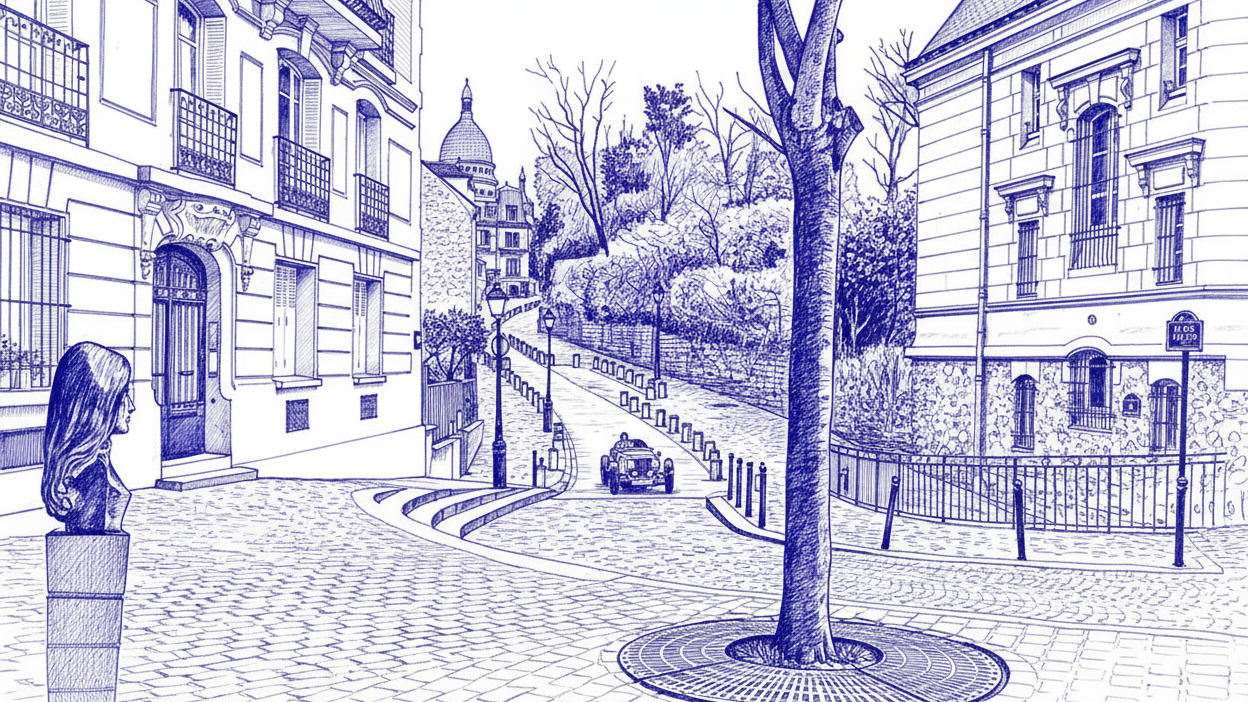
The 18th arrondissement of Paris is a world in itself. From the quiet gardens below the Butte Montmartre to the golden dome of the Sacré-Cœur, it holds within its hills the full emotional range of the city — sacred and profane, touristy and local, refined and raw.
This is the Paris of painters and pilgrims, dreamers and shopkeepers, where beauty refuses to stay still. It hides behind vines, dances through staircases, and whispers in courtyards that have outlived revolutions.
To wander the 18th is not to move through streets, but through stories — and every street tells one differently.
Let’s begin a long, 2 000-word walk through the most beautiful streets of Paris’s 18th arrondissement: from the cobbled slopes of Montmartre to the quiet grids of Jules Joffrin and La Chapelle, where the true spirit of Paris continues to breathe.
🎨 1️⃣ Rue de l’Abreuvoir — The Picture Everyone Falls in Love With
If Montmartre had to be captured in a single image, it would be rue de l’Abreuvoir. Its gentle curve, the pink façades of La Maison Rose, and the distant silhouette of the Sacré-Cœur form one of the most iconic views in all of Paris.
The street’s name (“watering place”) recalls a time when donkeys climbed here carrying milk and vegetables from the plain below. Today, ivy replaces livestock, but the pastoral calm endures.
Most of the houses date from the 19th century, modest yet romantic, with green shutters and wisteria climbing the walls. In spring, the scent of lilacs mixes with the hum of artists sketching at the corners.
📸 Insider moment: Arrive at sunrise — before the cafés open, when the cobblestones are still damp and the only sound is birdsong over the basilica.
🕊️ 2️⃣ Rue des Saules — Between Vineyard and Legend
A few meters away, rue des Saules offers another vision of Montmartre: rustic, secretive, and alive with history. It borders the Clos Montmartre, the city’s last active vineyard, planted in 1933 to preserve Montmartre’s agricultural memory.
Halfway up stands the Lapin Agile, the legendary cabaret where Picasso, Modigliani, and Apollinaire once traded jokes and sketches for wine.
Architecturally, the street alternates between plastered cottages and taller 19th-century façades with tile roofs — a gentle blend of countryside and city. Every bend feels cinematic; every step, a return to the era when Montmartre was still a village of windmills and poets.
🍇 Once a year, in October, the Fête des Vendanges turns the street into a celebration of wine, music, and community — a reminder that Montmartre’s soul still belongs to its people.
🏡 3️⃣ Rue Lamarck — The Balcony of Paris
Few Parisian streets command such views as rue Lamarck. It zigzags up the Butte from boulevard Barbès to the steps of the Sacré-Cœur, offering glimpses of rooftops, church domes, and the distant La Défense skyline.
Its upper portion, flanked by staircases and cafés, epitomizes the Montmartre postcard: iron balconies draped with flowers, façades glowing gold in afternoon light.
At the lower end, the tone shifts — wider sidewalks, Belle-Époque apartment buildings, and a sense of daily life beyond tourism. Here, Montmartre becomes part of the city again, not just its myth.
☕ Stop at Lamarck-Caulaincourt metro, one of the prettiest in Paris: green Art Nouveau railings, a staircase curling into the street, and the skyline unfolding behind you.
🌸 4️⃣ Rue Cortot — The Street of Painters
Nestled behind the Place du Tertre, rue Cortot hides one of Montmartre’s finest small museums: the Musée de Montmartre, housed in a 17th-century building where Renoir once painted.
The street’s charm lies in its proportions: narrow, sloping, cobblestoned, framed by façades softened by age. Here you feel the weight of art history in the air — every shutter and doorway has seen generations of painters searching for light.
🎨 Did you know? Suzanne Valadon, the painter and mother of Maurice Utrillo, lived at No. 12 bis — the same courtyard where Renoir painted The Swing in 1876.
Rue Cortot is not grand; it’s intimate. That intimacy is what makes it timeless.
🪴 5️⃣ Rue Lepic — The Hill’s Artery
Running diagonally across Montmartre, rue Lepic connects the busy Place Blanche to the quiet heights near the Moulin de la Galette. It’s both commercial and residential — a real, working street that never lost its local rhythm.
The lower part buzzes with cafés and bakeries; the upper part, with its leafy courtyards and the famous windmill, feels like a village lane.
🍷 At No. 54 stands Café des Deux Moulins, made famous by the film Amélie. But step beyond the film set: further uphill, 19th-century houses with brick details and tiny balconies still whisper the district’s original melody.
At sunset, the slope glows pink — and you suddenly understand why Van Gogh lived nearby, painting the same light.
🕯️ 6️⃣ Rue Ravignan — The Quiet Bohemia
Parallel to rue Lepic, rue Ravignan descends toward Place Emile-Goudeau, where the famous Bateau-Lavoir once stood — the birthplace of modern art.
Between 1904 and 1914, Picasso, Braque, and Modigliani lived and worked here, inventing Cubism in tiny, freezing studios. Today, the rebuilt structure still houses artists’ workshops, its façade marked by modest dignity.
The street itself feels contemplative — narrow, shaded, paved with stone. Balconies overflow with plants, and the echo of footsteps reminds you that creative solitude is still possible, even in Paris.
🎭 For a true sense of history, visit late in the day when the tourists have gone; the silence here hums with ghosts who changed the art world.
🌿 7️⃣ Rue Caulaincourt — The Grace of Curves
Winding gently around the northern slope of the Butte, rue Caulaincourt is the 18th’s grand boulevard of serenity. Built in 1868, it was one of the first modern streets carved into the hill, connecting Place Clichy to Porte de Clignancourt.
The architecture is classic 1900s elegance: pale stone façades, ornate balconies, carved pediments. Its graceful curve follows the topography, revealing hidden perspectives of the Sacré-Cœur above and the city below.
The street passes over the Cimetière de Montmartre, crossing it on an arched iron bridge — a uniquely Parisian sight where beauty and melancholy intertwine.
🌇 At the corner of rue Joseph de Maistre, pause for a coffee at Le Café Lamarck: here, the hill seems to pause too.
🏛️ 8️⃣ Avenue Junot — Discreet Elegance Above the City
Tucked behind rue Lepic, avenue Junot is Montmartre’s best-kept secret. Designed in 1910 as a luxurious residential enclave, it features wide cobbled lanes, art-deco mansions, and gardens hidden behind high walls.
Among its famous residents were the poet Tristan Tzara and the singer Dalida, whose bronze statue stands nearby on Place Dalida.
This is Montmartre’s quiet face: manicured, cultivated, filled with architectural surprises — a world apart from the crowds below.
🪶 Architectural gem: the Cubist-inspired Maison Tristan Tzara (No. 15), designed in 1926 by Adolf Loos — one of the pioneers of modern architecture.
At sunset, the avenue glows like gold leaf, and the rooftops below shimmer in layers of light.
🌸 9️⃣ Rue Norvins — The Beating Heart of Old Montmartre
Though it winds through one of the busiest parts of the Butte, rue Norvins still retains its 18th-century irregularity and charm. It curves around the Place du Tertre, where painters set up their easels as they have for over a century.
Despite the crowds, the street’s cobblestones and irregular façades tell of an older rhythm — when Montmartre was an artists’ commune rather than a postcard.
🎨 For authenticity: explore early in the morning or late at night, when café chairs are stacked and the lamps cast amber reflections on the stones.
Even in silence, rue Norvins hums with memory — of laughter, absinthe, and sketches that changed the city’s identity.
🧺 🔟 Rue Ramey — Between Montmartre and the World Below
Descending the Butte toward boulevard Barbès, rue Ramey bridges two Parises: the hill’s serenity and the multicultural bustle below. It’s less known to tourists, yet one of the most authentic streets of the 18th.
Boutiques and bakeries mix with Moroccan cafés and Senegalese restaurants. The façades, a blend of late-19th-century stone and early-20th-century brick, reflect the district’s layered history.
🌍 Local note: The lower part near rue Custine has become a creative hub — vintage stores, design ateliers, and bakeries that draw both locals and expats seeking a different kind of Montmartre, one that still feels alive.
🏡 1️⃣1️⃣ Rue Custine — Everyday Paris with a View
Running east-west just below the Sacré-Cœur, rue Custine offers perhaps the best “local’s perspective” of the 18th. It’s lined with neighborhood shops, artisan bakers, and wine bars, yet every now and then, between rooftops, the white dome of the basilica peeks through.
Its geometry — straight yet ascending — frames Paris in a series of cinematic perspectives. You can sense the everyday rhythm here: parents walking children to school, the smell of espresso, the hum of scooters.
☀️ Best moment: early evening, when sunlight slides along the façades, and you catch the faint toll of the Sacré-Cœur bells above.
🪞 1️⃣2️⃣ Rue Damrémont — From Village to City
Extending north from Montmartre toward the outer boulevards, rue Damrémont reveals the arrondissement’s dual nature — part urban artery, part village main street.
At its southern end, Belle-Époque buildings flank small squares and cafés. Further north, the rhythm opens up — 1930s buildings with geometric balconies, parks, and a sense of open sky rare in central Paris.
It’s not postcard-pretty; it’s lived-in beauty — the kind that makes the 18th one of the most beloved districts for young families and creatives.
🌳 At No. 100, the small Square Léon Serpollet honors the pioneer of the steam-powered automobile — a nod to the district’s long history of invention and reinvention.
🧱 1️⃣3️⃣ Rue Muller — The Stairway Street
Connecting boulevard de Rochechouart to the foot of the Sacré-Cœur, rue Muller is a vertical poem in stone. Its narrow slope is punctuated by staircases that climb toward rue de Clignancourt, with breathtaking views at every landing.
Small ateliers, mosaic signs, and pastel shutters evoke the old Montmartre of artisans. In the morning, light pours down like liquid silver; at night, the lamps create a chiaroscuro worthy of a film noir.
🎥 Cinematic note: Rue Muller appears in several French films precisely for its theatrical composition — Paris distilled into incline, light, and memory.
🌇 1️⃣4️⃣ Rue du Mont-Cenis — The Backbone of the Hill
No street captures Montmartre’s topography like rue du Mont-Cenis. It rises from Clignancourt to the Sacré-Cœur plateau, cutting straight through the hill’s heart.
Along its length, you’ll find cafés where Edith Piaf once sang, artists’ studios, and elegant turn-of-the-century houses. The slope opens suddenly to reveal sweeping views of Paris — the kind of vistas that made the Butte irresistible to painters and poets.
🕊️ At No. 83, Dalida lived until her death in 1987. A bronze bust now honors her nearby, surrounded by flowers left daily by admirers.
🌿 1️⃣5️⃣ Rue de Clignancourt — The Lower Gateway
At the base of the Butte, rue de Clignancourt forms a bridge between historic Montmartre and the more cosmopolitan neighborhoods of Barbès and La Goutte d’Or.
Its architecture mixes grand Haussmannian façades with art-nouveau shopfronts and early-20th-century arcades. It’s a street of constant movement — but look closely, and beauty reveals itself in details: carved keystones, stained-glass windows, and old signage from another century.
🎭 Urban note: The street’s southern end near boulevard Rochechouart was once the border of the “Zone,” a belt of workshops and theatres that gave Montmartre its free-spirited edge.
🧭 Conclusion — The Soul of the 18th: A City on a Hill
The 18th arrondissement is not a museum; it’s a mirror. Every street reflects a different facet of Paris — sacred and secular, old and new, quiet and chaotic.
Its beauty isn’t curated; it’s lived and layered. From the vine-covered cottages of rue des Saules to the modern rhythm of rue Ramey, the arrondissement continues to reinvent itself without losing its light.
The 18th teaches a timeless lesson: that Paris’s grandeur doesn’t only rise in domes and boulevards — it also blooms in cobblestones, balconies, and the everyday poetry of people who call these streets home.
Walk slowly, breathe deeply, and listen. You’ll hear what the painters once heard — the heartbeat of a city that never stops creating itself.
Thomas Herremans